

There is no single price for seeing a psychiatrist in Texas. The first evaluation usually costs more than any visit after it, and cash prices for an evaluation in the Dallas area run from about $150 to a little over $800, depending on where you go. What you pay out of pocket depends on that setting, whether your plan covers the visit, and what you need from the appointment.
We see this question come up before almost every first call. People are not shopping for the cheapest option so much as trying to avoid a surprise bill. So this guide gives you the numbers we can stand behind, explains why they spread so widely, and tells you what to ask before you book.
TL;DR
- In the Dallas-Fort Worth area, hospital cash prices for a psychiatric diagnostic evaluation range from $152.10 to $840.17, with a median of $328.28.
- The first evaluation is the largest single charge. Follow-up medication visits are shorter and usually cost less.
- With insurance, your deductible, copay and network status matter more than the sticker price. Federal parity rules say mental health benefits can’t be harder to use than medical ones.
- Telehealth is a legitimate option for evaluations and medication management, and it can save time even when the fee is similar.
- If cost is the barrier, sliding-scale and public clinics exist. Call us or ask any practice for a written estimate before the visit.
Table of Contents
- What the numbers look like in Texas
- Why the same visit can cost $150 or $800
- What an initial evaluation includes, and why it costs more
- Follow-up visits: where most of the cost lives over time
- How insurance changes what you pay
- Telehealth: does it cost less?
- When the treatment is more than medication
- Our perspective, from the exam room
- If you can’t afford a psychiatrist right now
- Booking with us
- FAQ
- Sources
What the numbers look like in Texas
Public price data for psychiatry is patchy, so it helps to look at more than one source and be honest about what each one covers.
The most useful local figure comes from hospital price transparency data. As of October 2026, 32 hospitals in the Dallas-Fort Worth-Arlington area report self-pay prices for psychiatric diagnostic evaluations (CPT 90792) ranging from $152.10 to $840.17, with a median of $328.28. In McKinney, Baylor Scott & White Medical Center and The Heart Hospital both list an outpatient cash price of $328.28 for that same code, according to the same data.
For a general statewide picture, one cost estimator puts the average cash price of a psychiatrist visit in Texas at $83 to $116, with the caveat that actual costs may be higher or lower. That estimate is based on older data, and in our experience a private-practice psychiatrist’s visit, particularly a first one, often lands above it. Treat it as a floor for a brief follow-up, not a quote.
| Type of visit | What it usually covers | Typical price signal |
|---|---|---|
| Initial diagnostic evaluation | Full history, mental-status exam, diagnosis, treatment plan | Dallas-area hospital cash prices: $152.10 to $840.17, median $328.28 |
| Follow-up medication visit | Check response, side effects, dose changes | Statewide average cash estimate: $83 to $116 |
| Telehealth visit | Same clinical content, by video | Often similar to in-person; you save travel and time |
| Interventional treatment (TMS, Spravato, ketamine, SGB) | Repeated sessions, monitoring | Priced per course or per session; ask for a written estimate |
We don’t publish fixed prices for our interventional services online, because the right plan differs from person to person, and we would rather give you an accurate estimate after we know what you need.
Why the same visit can cost $150 or $800
It surprises people that two offices a few miles apart can charge so differently. It surprised us too, early on.
A 2026 study in JAMA Network Open looked at 94,228 commercial negotiated rates from 1,398 hospitals and found a median between-hospital price ratio of 4.16 for psychiatric services. Put plainly, the typical gap between a higher-priced and a lower-priced hospital for the same service was more than fourfold, and prices also varied by insurer and site of care.
Several things drive that spread in everyday practice:
- Site of care. A hospital outpatient department often bills differently from an independent office.
- Who sees you. A psychiatrist (a physician) is priced differently from a nurse practitioner or a therapist. A therapist visit and a psychiatric visit are not interchangeable, and you may need both.
- Length and complexity. A 15-minute check-in and a 60-minute diagnostic interview are different services.
- Insurance contracts. The rate your plan negotiated may be far from the cash price.
- What gets bundled. Some practices fold rating scales, records review or paperwork into the fee. Others bill them separately.
So a low number isn’t automatically a good deal, and a high one isn’t automatically padding. What you want is to know what is in it.
What an initial evaluation includes, and why it costs more
The first visit is where the real work of diagnosis happens. Federal contractor guidance describes an initial psychiatric diagnostic evaluation as ordinarily including a complete medical, psychiatric, family and social history, a mental-status examination, an initial diagnosis, an assessment of your ability to respond to treatment, and an initial treatment plan.
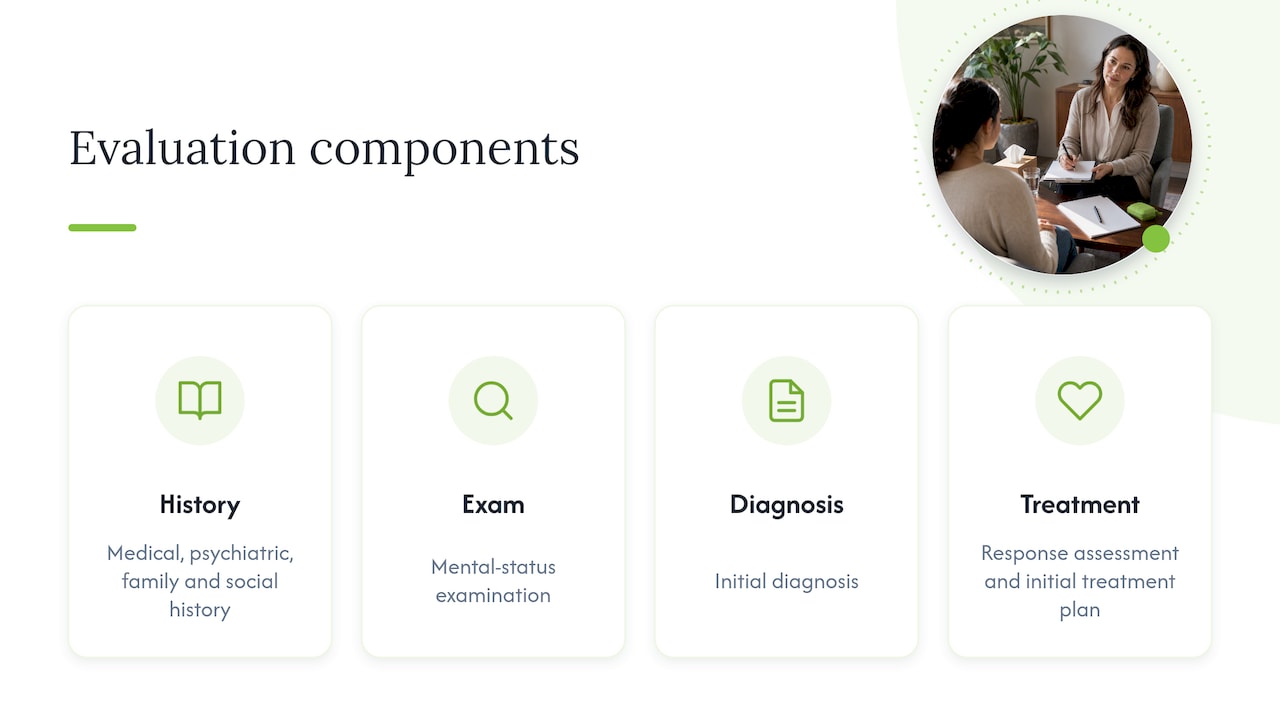
That matches what we do. We ask about sleep, past medications, family history, substance use, medical conditions, and what a bad week actually looks like for you. Often we need more than one conversation to get it right. If you want a plainer walkthrough of the visit itself, we wrote about what to expect from a psychiatric evaluation.
Billing-wise, the evaluation often goes under CPT code 90791 or 90792, and when a medical assessment is part of it, a physician may use 90792 or an evaluation-and-management code. Knowing the code helps when you call your insurer, because you can ask exactly what your plan pays for that code.
One more detail that surprises people: Medicare guidance says the diagnostic evaluation is generally covered once at the onset of an illness, with repeats allowed in specific situations such as a long break in treatment, a psychiatric admission, a significant change in mental status, or a need for diagnostic clarification. Commercial plans have their own rules, but the logic is similar. A new evaluation is a bigger event than a return visit.
Follow-up visits: where most of the cost lives over time
After the evaluation, most medication-focused care becomes a rhythm of shorter visits. The American Psychiatric Association describes follow-up as the time to assess whether the medicine is working, discuss side effects, and adjust the dose when needed, and notes that regular visits help maintain benefit and prevent relapse.
In the first months we usually see people more often, every few weeks, while we find a dose that works. Later, visits space out, and for some people they happen every three months or so. We can’t promise a number for you. It depends on the medication, how you respond, and how stable things are. What we can say is that the total cost of a year of care is mostly follow-ups, so the per-visit rate and your copay matter more than the evaluation fee alone.
For reference, the standard established-patient visit codes are described by the AMA as 99212 (typically 10 minutes), 99213 (typically 15 minutes) and 99214 (a more detailed visit, typically 25 minutes face to face). If your statement shows one of these, that is why one follow-up costs more than another.
How insurance changes what you pay
The price on a hospital list is a cash price. If you have insurance, what you actually pay is shaped by three things: your deductible, your copay or coinsurance, and whether the psychiatrist is in your network.
A few points we find ourselves repeating:
- Parity. Marketplace plans must follow parity protections, so financial requirements for mental health benefits are generally no more restrictive than those for medical and surgical benefits. The same guidance says this extends to limits like prior authorization and visit caps.
- Essential benefit. All Marketplace plans cover mental health and substance use disorder services as essential health benefits. Coverage exists, but your deductible may still mean you pay most of the first visits yourself.
- Network status. Out-of-network care costs more. A Health Affairs analysis found patients used out-of-network mental health providers more often than comparison providers, which raised average cost-sharing.
If you are on Medicare, evaluation and follow-up visits fall under the Physician Fee Schedule, and the rules around mental health counseling and billing codes are laid out in this overview of Medicare coverage for mental health services.
Questions to ask your insurer before the first visit
- Is this psychiatrist in network for my specific plan, not just the insurance company?
- What is my remaining deductible, and does it apply to office visits?
- What is my copay or coinsurance for a psychiatric evaluation (90791 or 90792) and for a follow-up?
- Does the plan cover telehealth psychiatry at the same rate?
- Do any of the treatments I may need require prior authorization?
Write down the name of the person you talk to and the date. It sounds fussy, and it has saved patients real money.
Telehealth: does it cost less?
Sometimes, and not always in the way people expect. Telehealth psychiatry can provide evaluations and medication management through live video or audio, and Medicare permits real-time audio-video telecommunications for psychiatric diagnostic evaluations as of 2026.
The fee itself is often the same as in person. Where you save is everything around it: the drive on 75 or the Dallas North Tollway, the time off work, the childcare. Some plans do price telehealth lower. For instance, one Texas state-plan briefing described a telehealth mental health benefit at $185 for an initial psychiatrist visit and $95 for later sessions before the deductible, dropping to $19 per session after it was met. That is a specific plan from 2022, not a market rate, but it shows how much the benefit design can matter.
For many of our patients in Allen, Plano, Frisco and McKinney, a mix works best: an in-person first visit, then video follow-ups. We explain why busy adults like that in our post on telepsychiatry for North Dallas professionals. If ADHD is your reason for calling, what you can and can’t do remotely in Texas is worth reading first, and our guide to ADHD testing costs in North Dallas covers the separate price of formal testing.
When the treatment is more than medication
Some people come to us after several medications have not been enough. Interventional options exist for them, and they are priced differently from an office visit because they involve repeated sessions, equipment and monitoring.
At Nortex Psychiatry we offer Transcranial Magnetic Stimulation (TMS), Spravato (esketamine), ketamine therapy and stellate ganglion block. Whether insurance helps depends on your diagnosis, your treatment history and your plan. TMS involves a daily-session schedule, and if you are weighing the time commitment, this explanation of TMS session length and scheduling gives a sense of what a course looks like. For Spravato specifically, we put together a step-by-step approach to insurance coverage.
We do not list prices for these on our site, so we will give you a written estimate after your evaluation, and we check benefits with you before you start.
Our perspective, from the exam room
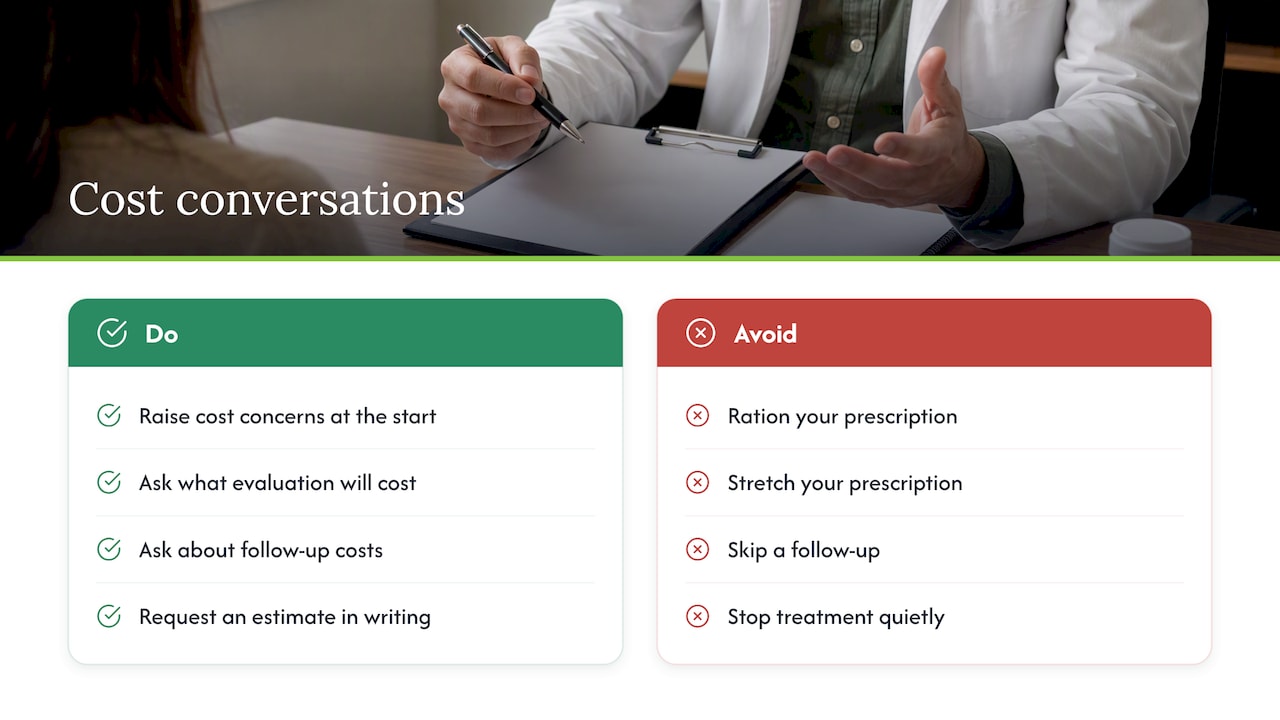
We have learned that cost conversations go better early. When a patient waits until the second or third visit to say they are worried about the bill, they have often already started rationing, stretching a prescription, skipping a follow-up, or quietly stopping. That is worse for their health and, in the end, worse for their wallet.
So we say it out loud at the start. What will this evaluation likely cost you? What will follow-ups look like? Is there a cheaper path that is still safe? Sometimes there is. Sometimes a primary care doctor can reasonably manage a stable, straightforward prescription and you see us for the evaluation and a periodic check. Sometimes the less expensive-looking option is a false economy, because a rushed visit misses the diagnosis and you spend months on the wrong medication.
We often notice that people overestimate what the first appointment will cost and underestimate what a year of poorly matched treatment costs. We don’t say that to sell anything. It is just what we see.
We also don’t think price should decide everything. A psychiatrist you trust and can reach, who listens and adjusts without hurry, is worth a lot. Ask questions. Ask for an estimate in writing. If we are not the right fit for your budget, we will say so and try to point you somewhere that is.
— Felix
If you can’t afford a psychiatrist right now
There are real options, and you should not wait in silence while you look for them.
- Community mental health centers. Each Texas county is served by a local mental health authority. In Collin County, LifePath Systems offers services on a sliding scale based on income, and accepts Medicaid, Medicare and Children’s Health Insurance. Many of its services may be free for people earning under 150% of the federal poverty level.
- State clinics. Texas Health and Human Services runs outpatient clinics at some state facilities. For example, the Rio Grande State Center in Harlingen offers low-to-no-cost provider visits, pharmacy, lab and counseling, with registration required. It is far from North Dallas, but it shows that the public system exists, and your local authority can tell you what is near you.
- Self-pay discussions. Many private practices will talk about a self-pay rate or a payment plan. Ask directly.
- Primary care. For common conditions such as mild to moderate depression or anxiety, a primary care physician can start treatment and refer you if it is not enough.
If you are in crisis or thinking about hurting yourself, do not wait for an appointment. Call or text 988, or go to the nearest emergency room.
Booking with us
We are based in Allen and see adults and families from Plano, Frisco, McKinney and the surrounding North Dallas area, in person and by telehealth. If you are not sure where to start, our short piece on why seek psychiatry in Texas covers the basics, and you can reach our practice here to ask about an evaluation, insurance and what your visit would likely cost. We would rather you ask the money question first than the last.
FAQ
How much does a psychiatrist visit cost per session in Texas?
It depends on whether it is a first evaluation or a follow-up. A statewide cash estimate for a visit is $83 to $116, though actual prices can be higher or lower. Initial evaluations cost more, with Dallas-area hospital cash prices ranging from $152.10 to $840.17. Ask any practice for its exact self-pay rate in writing.
How much does a psychiatric evaluation cost in McKinney or Allen?
Two McKinney hospitals, Baylor Scott & White Medical Center and The Heart Hospital, list an outpatient cash price of $328.28 for CPT 90792. Private practices set their own fees, and they can be lower or higher. Call and ask what is included in the evaluation fee.
Does insurance cover psychiatric visits in Texas?
Usually yes. Marketplace plans must cover mental health services, and parity rules keep cost-sharing for them in line with medical care. What you pay still depends on your deductible, copay and whether the psychiatrist is in network.
What can I do if I can’t afford a psychiatrist?
Start with your local mental health authority, which in Collin County means a sliding-scale program based on income. You can also ask private practices about self-pay rates or payment plans, and talk to your primary care doctor about starting treatment for common conditions. If you are in crisis, call or text 988.
Sources
- Psychiatric evaluation cost in Dallas, TX (CPT 90792 self-pay prices)
- Cost of psychiatrist visit by state
- Commercial Price Variation for 11 Outpatient-Based Psychiatric Services, JAMA Network Open
- Outpatient Psychiatry and Psychology Services Fact Sheet, CMS
- Billing and Coding Guidelines, Psychiatry and Psychology Services, CMS
- Psychiatric Medications: An Overview, American Psychiatric Association
- Telehealth services covered by Medicare, AMA
- Mental health and substance abuse coverage, HealthCare.gov
- Tips about the Health Insurance Marketplace, HealthCare.gov
- Medicare Advantage and Commercial Prices for Mental Health, Health Affairs
- What is Telepsychiatry?, American Psychiatric Association
- Medicare and Mental Health Coverage (MLN1986542), CMS
- TRS-Care Standard info session transcript
- Crisis Services, LifePath Systems, Allen TX
- Rio Grande State Center, Texas Health and Human Services
- Does Medicare cover mental health counseling
- TMS session length and scheduling