


Benzodiazepines can cause dependence and serious harm, including overdose when combined with opioids or alcohol, even when taken exactly as prescribed. Dependence can start within days to weeks, so you should never stop these medications abruptly. If you notice trouble breathing, extreme drowsiness, or seizures, treat it as an emergency and seek care immediately, and talk to your prescriber about a supervised taper rather than quitting cold turkey.
TL;DR:
- Benzodiazepines were involved in about one-third of prescription opioid overdose deaths, highlighting the high overdose risk when combined with opioids.
- Short-acting benzodiazepines like alprazam and triazolam can cause withdrawal symptoms that are more intense and require careful, gradual tapering.
- Long-term use increases risks of cognitive impairment, falls, and fractures, especially in older adults, and often involves dose creep and reliance beyond initial indications.
- Combining benzodiazepines with alcohol or other sedatives significantly worsens respiratory depression risk, with naloxone being ineffective against benzodiazepine overdose alone.
- Patients with a history of substance use disorder, older adults, pregnant women, or those with untreated sleep apnea should avoid or scrutinize benzodiazepine use due to elevated safety concerns.
Table of Contents
- Benzodiazepines Risks at a Glance: Fast Facts You Should Know
- What Are Benzodiazepines and How Do They Work?
- When Are Benzodiazepines Actually Appropriate?
- What Are the Short-Term Side Effects of Benzodiazepines?
- What Are the Long-Term Risks of Benzodiazepine Use?
- How Do Benzodiazepines Increase Overdose Risk With Other Drugs?
- How Does Benzodiazepine Dependence and Withdrawal Work?
- Who Faces Higher Risk From Benzodiazepines?
- What Practical Steps Reduce Benzodiazepine Risk Right Now?
- How Nortex Psychiatry Approaches Benzodiazepine Risk
- Our Take on Benzodiazepine Risk
- Sources
- FAQ
Benzodiazepines Risks at a Glance: Fast Facts You Should Know
In our work, we find patients are often surprised by how much regulatory attention this drug class has received. The FDA has required a boxed warning on every benzodiazepine, its strongest safety label, covering abuse, addiction, physical dependence, and withdrawal reactions that can occur even at recommended doses. That is not boilerplate language. It reflects real postmarketing data the agency reviewed before deciding the entire drug class needed a shared warning.
Here are the medications most commonly involved:
- Alprazolam (Xanax)
- Lorazepam (Ativan)
- Diazepam (Valium)
- Clonazepam (Klonopin)
- Temazepam (Restoril)
- Chlordiazepoxide (Librium)
- Oxazepam (Serax)
- Triazolam (Halcion)
The number that should give you pause: benzodiazepines were involved in roughly 1 in 3 prescription opioid overdose deaths in data the FDA reviewed. That single statistic is why we ask about every medication and every drink when we prescribe.
What Are Benzodiazepines and How Do They Work?
Benzodiazepines work by enhancing the effect of GABA, the brain’s main inhibitory neurotransmitter. Think of GABA as your brain’s built in brake pedal. Benzodiazepines do not press that pedal themselves. They make the pedal more responsive, so the braking signal your brain is already sending gets amplified. That is why these drugs calm anxiety, relax muscles, stop seizures, and induce sleep, often within minutes of taking a dose.
The mechanism is elegant, but it is also blunt. GABA receptors sit throughout the central nervous system, not just in the areas tied to anxiety. Amplify inhibitory signaling broadly enough and you also slow reaction time, impair memory formation, and, at high doses or in combination with other depressants, suppress the drive to breathe. This is not a design flaw. It is simply what a CNS depressant does when you increase the dose or stack it with something else that depresses the same system.
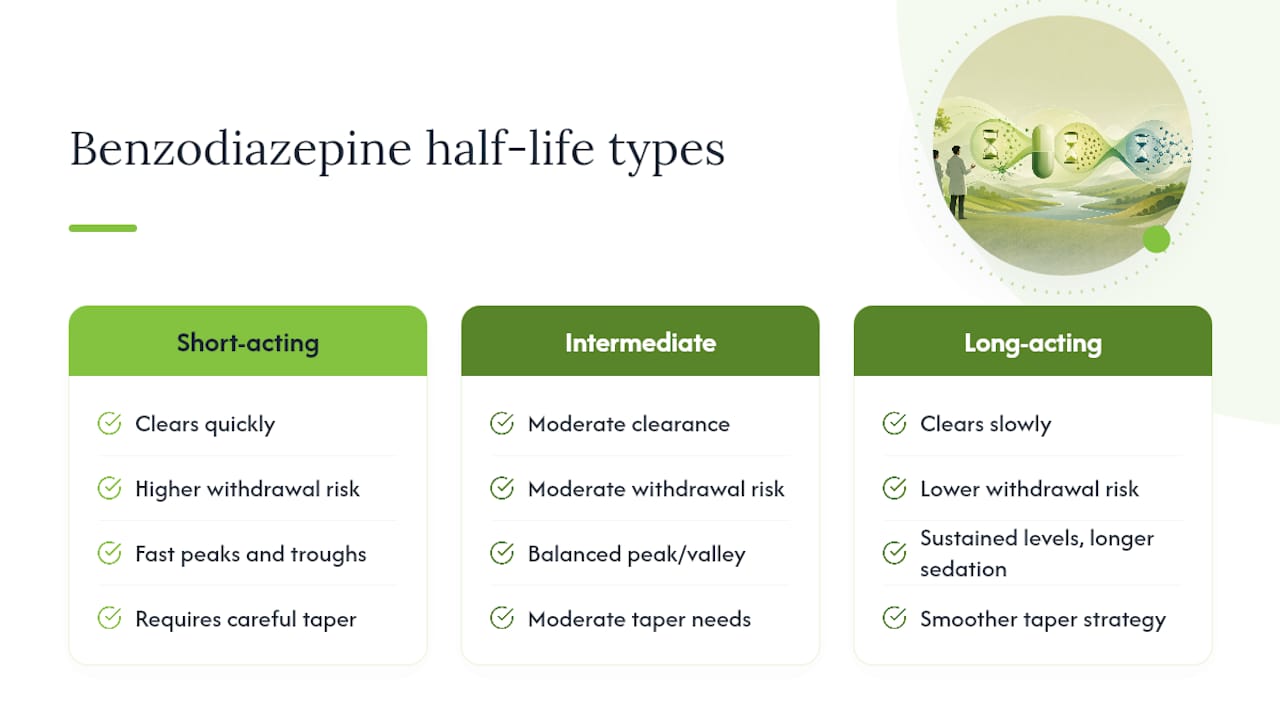
Half-life matters more than most patients realize. Short-acting agents like alprazolam and triazolam clear the body quickly, which means blood levels rise and fall fast. That rapid clearance is part of why alprazolam in particular has a reputation for a rougher withdrawal experience and more pronounced between-dose rebound anxiety. Intermediate-acting drugs like lorazepam and temazepam sit in the middle. Long-acting agents like diazepam and clonazepam stay in the system for days, which smooths out the peaks and valleys but also means the drug (and any sedation) lingers longer than patients expect.
We bring this up early because half-life is not a pharmacology footnote. It directly shapes how a taper gets built later. A drug that leaves the body quickly demands a more careful, more gradual withdrawal plan than one that tapers itself off slowly by nature. We often switch patients from a short-acting benzodiazepine to a longer-acting equivalent like diazepam specifically to make the taper smoother, a strategy grounded in clinical tapering literature.
When Are Benzodiazepines Actually Appropriate?
Benzodiazepines have real, legitimate uses. The issue has never been that the drug class is inherently bad. The issue is duration and dose creeping past what the evidence supports.
Approved and typical clinical uses include:
- Short-term treatment of generalized anxiety disorder, usually as a bridge while an antidepressant takes effect
- Acute panic attacks and panic disorder
- Short-term insomnia, generally measured in days to a few weeks, not months
- Seizure disorders and status epilepticus
- Alcohol withdrawal management, where benzodiazepines remain a first-line, medically necessary treatment
- Pre-procedure sedation and certain muscle spasm conditions
Good prescribing practice follows a few consistent principles: the lowest effective dose, the shortest duration that accomplishes the clinical goal, and a scheduled review rather than an open-ended refill. We rarely start a benzodiazepine without already discussing an exit plan. That conversation happens on day one, not six months in when a taper suddenly feels urgent.
For anxiety and insomnia specifically, nonpharmacologic alternatives often work as well or better over time. Cognitive behavioral therapy for anxiety, and its insomnia-specific cousin CBT-I, both have strong evidence bases and carry none of the dependence risk. When medication support is still needed, we sometimes turn to options like mirtazapine for sleep, buspirone for anxiety, or an SSRI or SNRI as the primary long-term anxiety treatment, with a benzodiazepine used only as a short bridge, if at all.
What Are the Short-Term Side Effects of Benzodiazepines?
Even a single appropriately dosed pill produces measurable effects on the body, and patients often underestimate how much.
Common short-term side effects include:
- Drowsiness and sedation, sometimes lasting well into the next day
- Slowed reaction time and impaired coordination
- Dizziness and lightheadedness, especially on standing
- Short-term memory problems, including gaps for events that happened while the drug was active
- Slurred speech and muscle weakness at higher doses
- Paradoxical agitation or disinhibition in a minority of patients, particularly older adults and children
The statistic that matters here: benzodiazepines are consistently linked to increased fall and motor vehicle accident risk, a concern significant enough that the National Institute on Aging flags them specifically among CNS-active drugs that raise fall risk in older patients. This is not a theoretical concern. It is why we tell every patient starting a benzodiazepine to avoid driving or operating machinery until they know exactly how the medication affects them, and to be cautious again after any dose increase.
Certain symptoms cross the line from expected side effect into emergency. Seek urgent care immediately if you or someone you are with experiences trouble breathing, cannot be woken up, has blue-tinged lips or fingertips, or has a seizure. These signs suggest an overdose or a dangerous interaction, and they do not wait for a callback from the prescriber’s office.
What Are the Long-Term Risks of Benzodiazepine Use?
The risks of benzodiazepine use change character the longer the medication continues. Short-term use mostly produces reversible sedation and impairment. Extended use raises harder questions about cognitive health, physical safety, and how many other medications are stacking on top of it.
Research reviewed in a peer-reviewed benzodiazepine safety analysis connects long-term use to measurable cognitive effects, including problems with attention and memory that persist beyond the dosing window. Whether these changes fully reverse after stopping the medication is still debated, and that uncertainty alone is a reason to keep long-term use as narrow as possible.
Older adults carry a disproportionate share of this risk. Falls and fractures rise notably with benzodiazepine use in this population, and the National Institute on Aging specifically names benzodiazepines among the CNS-active medications it prioritizes for deprescribing review. Add a second CNS-active drug (an opioid, a sleep aid, certain antihistamines) and the risk compounds rather than simply adding.
Pro Tip: Bring every bottle, not just a list, to your next medication review. Patients routinely forget an over-the-counter sleep aid or an old prescription refill they still take “as needed,” and those are exactly the drugs that turn a manageable benzodiazepine dose into a dangerous combination.
A few patterns we watch for in long-term patients:
- Gradual dose creep, where tolerance quietly pushes the effective dose higher over months
- Reliance on the medication for sleep long after the original anxiety or insomnia trigger has resolved
- Overlapping prescriptions from more than one provider without either one seeing the full picture
- New cognitive complaints from family members before the patient notices anything themselves
None of this means every long-term patient needs to stop immediately. It does mean long-term use deserves a scheduled, honest reassessment rather than an automatic refill.
How Do Benzodiazepines Increase Overdose Risk With Other Drugs?
This is the section we spend the most time on in clinic, because the interaction risk is where benzodiazepines shift from “sedating” to “lethal.”
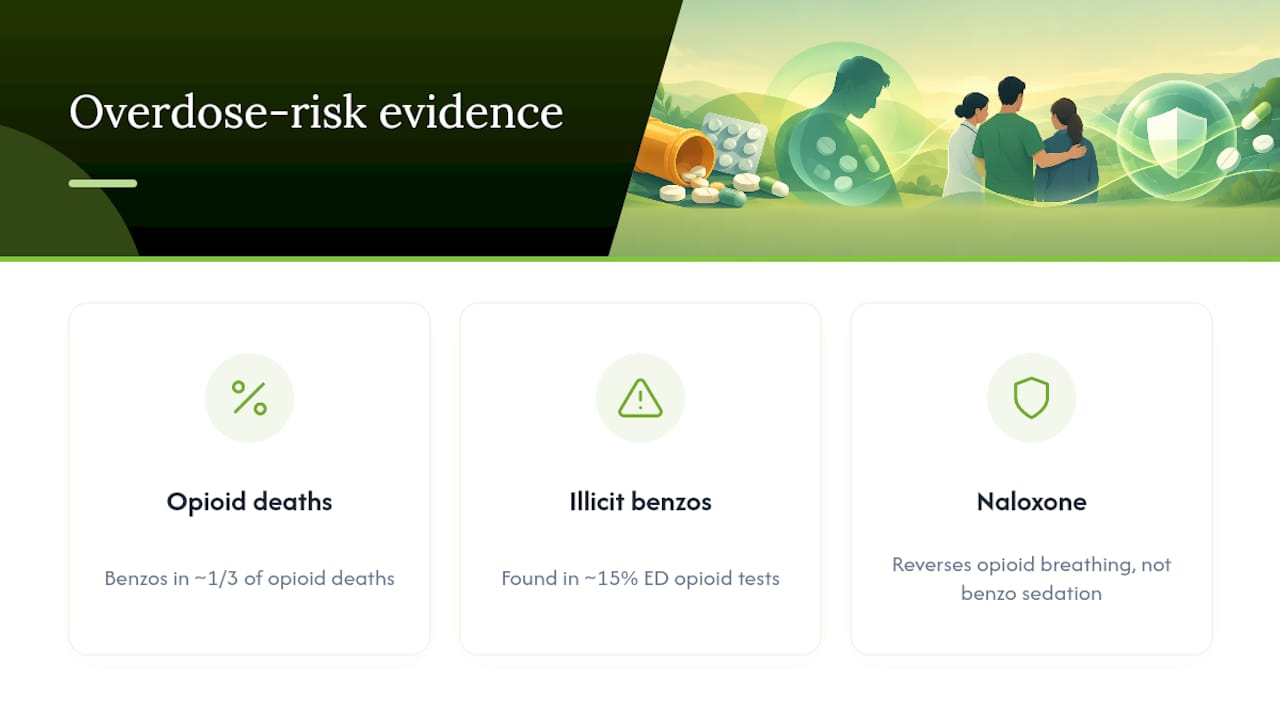
Benzodiazepines and opioids both suppress the brainstem’s drive to breathe, through different receptor systems that happen to converge on the same outcome. Combine them and the respiratory depression is not simply additive, it is synergistic, meaning the combined effect is worse than you would predict from either drug alone. The FDA’s own safety analysis found benzodiazepines involved in roughly a third of prescription opioid overdose deaths, a figure that pushed the agency to require boxed warnings on both drug classes about co-prescribing.
Alcohol behaves the same way. It is a CNS depressant, and mixing it with a benzodiazepine produces the same dangerous stacking effect as an opioid combination, sometimes with less warning because alcohol feels familiar and patients underestimate it.
A detail that surprises most patients: naloxone, the medication that reverses opioid overdose, does nothing for benzodiazepine intoxication. The CDC is explicit about this limitation. If someone has taken both an opioid and a benzodiazepine, naloxone may restore breathing driven by the opioid component but leave the person still dangerously sedated from the benzodiazepine.
This limitation has become more urgent with the rise of illicit benzodiazepines showing up in the drug supply. A CDC MMWR report found illicit benzodiazepines in nearly 15% of emergency department patients tested for suspected opioid overdose, often alongside opioids the patient did not necessarily know were combined with anything else. These illicit formulations are unpredictable in both potency and composition, which makes overdose harder to anticipate and, per the same report, harder to reverse with naloxone alone.
The safest rule we give patients: never combine a benzodiazepine with alcohol, opioids, or another sedating medication without your prescriber explicitly signing off, and if you or someone near you shows signs of overdose after any combination, call 911 immediately rather than waiting to see if naloxone works.
How Does Benzodiazepine Dependence and Withdrawal Work?
Dependence is not the same thing as addiction, though the two get confused constantly. Dependence means your body has adapted to the drug’s presence and reacts when it is removed. It can happen to a patient taking the medication exactly as prescribed, with no misuse involved at all. Addiction adds compulsive use despite harm. Both matter clinically, but dependence is the one that catches patients off guard, because it can start within days to a few weeks of regular use, according to the peer-reviewed clinical review on benzodiazepine risks.
Withdrawal symptoms range from uncomfortable to life-threatening. On the milder end: rebound anxiety, irritability, tremor, insomnia, muscle tension, and sweating. On the severe end: seizures, hallucinations, and a withdrawal delirium that carries real mortality risk if unmanaged. This severity spectrum is exactly why abrupt discontinuation, especially after weeks or months of regular use, is never the right approach.
A general, evidence-informed taper framework looks like this:
- Establish a baseline. Your prescriber calculates your total daily dose and, if you are on a short-acting agent like alprazolam, may convert you to a longer-acting equivalent such as diazepam for a steadier taper.
- Reduce gradually. A commonly used pace is a 5 to 10 percent reduction in total dose every two to four weeks, though the right pace is always individualized rather than fixed.
- Reassess at each step. Symptoms are tracked before deciding whether to continue at the current pace, slow down, or briefly hold steady.
- Slow the taper near the end. The last portion of the dose is often the hardest to remove, and many protocols intentionally slow down as the total dose gets small.
- Add psychosocial support. CBT for anxiety or CBT-I for insomnia alongside the taper measurably improves the odds of completing it, based on tapering outcome research.
Individualization matters more than the framework itself. Patients on high doses for years may need a taper that stretches many months, sometimes longer, with planned pauses whenever withdrawal symptoms intensify. A clinical commentary on tapering strategy notes that a flat 5 to 10 percent cut can be genuinely destabilizing for long-term, high-dose patients, which is exactly why switching to a longer-acting agent first often makes the whole process more predictable.
Pro Tip: If a taper step causes withdrawal symptoms that do not settle within a few days, do not push forward on schedule. Tell your prescriber and expect the pace to slow down, sometimes considerably. A taper that takes longer than planned is a sign the plan is working correctly, not a sign of failure.
Red flags that require urgent, same-day attention include any seizure, hallucinations, confusion, or a withdrawal delirium presentation. These need emergency evaluation, not a scheduled follow-up appointment. Patients with a history of high-dose or long-duration use, a prior difficult taper, or a co-occurring substance use disorder often benefit from involving an addiction medicine specialist alongside their psychiatric prescriber, since that combination of expertise handles the more complex tapers with better outcomes.
Who Faces Higher Risk From Benzodiazepines?
Risk is not evenly distributed across every patient who takes these medications. A few groups deserve specific mention.
Pregnancy and breastfeeding. Benzodiazepine use during pregnancy has been associated with risks to the developing fetus and, when used near delivery, with neonatal sedation and withdrawal symptoms in the newborn. If you are pregnant, planning a pregnancy, or breastfeeding and currently taking a benzodiazepine, this is a conversation to have with both your psychiatric prescriber and your obstetric provider before making any changes, since stopping abruptly carries its own risks and continuing without a plan carries others.
Older adults. This population appears repeatedly throughout the research on benzodiazepine harm, and for good reason. The National Institute on Aging identifies benzodiazepines as a priority target for deprescribing given the compounded risk of falls, fractures, and cognitive impairment when combined with the other medications older patients commonly take. Patients with dementia face an even sharper risk profile, since benzodiazepines can worsen confusion and increase fall risk in a population already vulnerable to both.
People with a substance use disorder. A history of alcohol or opioid use disorder changes the risk calculus substantially. It does not automatically rule out benzodiazepine use, particularly for legitimate alcohol withdrawal management, but it does mean tighter monitoring, shorter prescribing intervals, and closer coordination between psychiatric and addiction care.
A short list of who should raise the conversation with their prescriber before starting or continuing a benzodiazepine:
- Anyone pregnant, trying to conceive, or breastfeeding
- Adults over 65, especially those on multiple other medications
- Anyone with a personal or family history of substance use disorder
- Patients with a diagnosed sleep apnea or significant respiratory condition
- Anyone already taking an opioid, sleep medication, or other sedating drug
What Practical Steps Reduce Benzodiazepine Risk Right Now?
Most of what reduces harm here is not complicated. It is consistent, unglamorous habit.
Start with a full medication check. List every prescription, over-the-counter product, and supplement you take, and share it with whoever prescribes your benzodiazepine, not just your primary care provider. Our guide on medication management for chronic conditions walks through how to build that list and keep it current.
A short checklist worth keeping on your refrigerator or phone:
- Never combine a benzodiazepine with alcohol
- Confirm with your prescriber before adding any new sedating medication, including over-the-counter sleep aids
- Store benzodiazepines securely, especially in homes with teenagers or curious young children
- Avoid driving or operating machinery until you know exactly how a new dose affects you, a caution that applies the same way after other sedating treatments
- Keep a simple symptom diary if you are preparing for a taper, noting dose, timing, and any withdrawal symptoms
If you are getting ready to taper, a symptom diary and a support plan matter as much as the dosing schedule itself. Log your doses daily, note sleep quality and anxiety levels, and identify one person, a partner, friend, or family member, who knows the taper is happening and can check in during harder weeks.
Pro Tip: If you or someone you are with has taken a benzodiazepine together with an opioid and shows signs of overdose, call 911 immediately. Naloxone can help with the opioid component but will not reverse benzodiazepine sedation, so do not wait to see if it works before getting emergency help.
How Nortex Psychiatry Approaches Benzodiazepine Risk
In our work, benzodiazepine management starts long before a prescription pad comes out. We screen for personal and family history of substance use disorder as part of the initial evaluation, not as an afterthought, because that history shapes whether a benzodiazepine is appropriate at all and how closely it needs to be monitored if it is.
When a benzodiazodiazepine is already part of a patient’s regimen and it is time to reduce or stop, we build a taper around the individual, not a fixed protocol. That means:
- Assessing taper readiness, including current dose, duration of use, and any prior withdrawal experience
- Pairing the taper with therapy referrals, particularly CBT for anxiety or CBT-I for insomnia, since medication tapers succeed more often with psychosocial support alongside them
- Using telehealth follow-up for frequent check-ins during the taper, so dose adjustments do not require an in-person visit every time
- Considering nonpharmacologic and interventional alternatives for patients whose underlying anxiety or depression needs a different long-term approach, including options like Transcranial Magnetic Stimulation for treatment-resistant depression or Spravato therapy when standard antidepressants have not worked
For patients whose history includes a substance use disorder, or whose prior taper attempts did not go well, we coordinate directly with addiction specialty care rather than trying to manage every complexity solo. Complex cases deserve that extra layer of expertise, and we would rather bring in the right specialist early than watch a taper stall.
If you are currently taking a benzodiazepine and have questions about your dose, your risk, or whether it is time to start planning a taper, Nortex Psychiatry offers both in-person and telehealth evaluations across North Dallas, including Allen, Frisco, McKinney, and Plano. That conversation is worth having before a crisis forces it.
Our Take on Benzodiazepine Risk
The conventional advice on this topic tends to stop at “these drugs are risky, be careful.” That is true but not especially useful. What the evidence actually supports is narrower and more actionable: the risk is concentrated in three specific places, duration of use, what else the patient is taking, and how a discontinuation gets handled.
Where we think the standard messaging falls short is the emphasis on avoiding benzodiazepines altogether rather than managing them well. For alcohol withdrawal, for a genuine short-term panic crisis, these drugs remain appropriate and, frankly, hard to replace. The failure mode we see most often is not the initial prescription. It is the absence of a plan for what happens at week eight, month six, year two.
If you take one thing from this guide, prioritize the exit plan before you need it. Ask your prescriber on day one how long this medication is meant to last and what the taper will look like when it is time. That single question prevents more harm than almost any other intervention we know of.
— Felix
This article is general information, not a substitute for advice from a qualified doctor. Consult a qualified healthcare professional about your own circumstances before acting on anything here.
Sources
The clinical claims in this guide draw from a small set of primary sources worth knowing about directly:
- FDA: FDA requiring boxed warning, updated to improve safe use of benzodiazepine drug class
- Benzodiazepines: Uses, Dangers, and Clinical Considerations (PMC review)
- The dangers of polypharmacy and the case for deprescribing in older adults | National Institute on Aging
FAQ
Which Organ Does Xanax Affect Most?
The liver processes alprazolam and most other benzodiazepines, so significant liver impairment can slow clearance and raise blood levels unexpectedly. The brain and respiratory system bear the brunt of the drug’s actual effects, particularly when combined with opioids or alcohol, which is where the most serious harms occur.
Is It Safe to Take Benzodiazepines Every Day?
Daily use carries meaningfully higher risk than short-term or as-needed use, since dependence can develop within days to weeks of regular dosing. Long-term daily use is sometimes clinically appropriate for specific conditions like certain seizure disorders, but it requires ongoing monitoring and periodic reassessment with a prescriber rather than an indefinite, unreviewed refill.
What Is the Most Serious Side Effect of Benzodiazepines?
Respiratory depression, particularly when a benzodiazepine is combined with an opioid or alcohol, is the most serious and potentially fatal adverse effect. This combination was involved in roughly 1 in 3 prescription opioid overdose deaths in FDA-reviewed data, which is why co-prescribing now carries a boxed warning.
Who Should Avoid Taking Benzodiazepines?
People with a history of substance use disorder, older adults on multiple CNS-active medications, and anyone with significant untreated sleep apnea face elevated risk and need extra caution before starting one. Pregnant or breastfeeding patients should also discuss risks and alternatives carefully with both their psychiatric and obstetric providers before starting or continuing use.