
In the Dallas-Fort Worth area, a single IV ketamine infusion usually costs between $425 and $675, and most North Dallas clinics land between $450 and $600, according to a 2025 review of DFW clinic pricing. A standard starting series of six sessions generally runs $2,550 to $3,600 in total. Insurance almost never covers it. That is the short answer, and the rest of this page is about what sits behind those numbers, so you can plan without surprises.
We are a psychiatric practice in Allen, and people ask us about cost in the first five minutes of nearly every ketamine conversation. It is a fair question. Treatment-resistant depression is exhausting enough without a billing shock on top of it.
TL;DR
- IV ketamine in the DFW area typically costs $425 to $675 per session, and a six-session induction series runs roughly $2,550 to $3,600 (DFW pricing review).
- Intravenous ketamine is used off-label for depression, so it is mostly self-pay. Spravato (esketamine) is FDA-approved and is usually covered with prior authorization.
- Plan for maintenance. After the first series, boosters every 4 to 8 weeks are common and rarely covered.
- The cheapest session is not automatically the best value. Supervision, monitoring and follow-up care are part of what you are paying for.
- We do not publish a ketamine price on our site, so call us for a current quote before you decide anything.
Table of Contents
- What a ketamine infusion costs in North Dallas
- Why the price is higher than you’d expect for a cheap drug
- Why insurance usually does not pay for IV ketamine
- Ketamine infusion versus Spravato: the cost picture
- The total cost over a year, not one session
- Is the cheapest option the best value?
- Our perspective: what we tell patients about cost
- Safety comes before price
- Where our care fits
- How to prepare before you ask for a quote
- FAQ
- Sources
What a ketamine infusion costs in North Dallas
The figures that matter for a reader in Allen, Frisco, McKinney or Plano are local ones. National pricing pages quote anything from $400 to $1,000 per session, depending on the city and the clinic, and that spread is too wide to budget around. The DFW range is tighter.
| What you are paying for | Typical DFW range |
|---|---|
| One IV infusion | $425 to $675 |
| Most North Dallas, Plano and Frisco clinics | $450 to $600 per session |
| Six-session induction series | $2,550 to $3,600 total |
| Maintenance (booster) infusions | Usually priced per session, needed every 4 to 8 weeks |
These numbers come from a Dallas clinic directory’s market analysis, not from our fee schedule. Treat them as the market’s shape, not as a quote from us. Individual clinics add or bundle things differently: some include the first evaluation in the first infusion price, some charge it separately, and some sell prepaid packages at a discount.
When we talk with patients, we usually ask them to hold the question loosely. A price per session means little until you know how many sessions, how often, and what else is included.
Why the price is higher than you’d expect for a cheap drug
Ketamine itself is an old, inexpensive medication. Patients are often surprised that the bill is still several hundred dollars. The reason is time and attention, not the vial.
A session involves roughly 90 to 120 minutes of professional monitoring so that blood pressure, heart rate, oxygen levels and your mental state can be watched while the drug works. The clinical literature on rising ketamine demand points to this oversight, including watching for dissociation and respiratory effects, as a main driver of the cost of an infusion. You are paying for a clinician’s time, a prepared room, equipment and a safe recovery period.
The protocol with the most evidence is 0.5 mg/kg given intravenously over 40 minutes, as a review of the US ketamine landscape describes. The infusion is short. The monitoring before and after is what fills the visit. If you want the clinical detail, we wrote up our outpatient ketamine infusion protocol.
Why insurance usually does not pay for IV ketamine
This is the part that frustrates people most, so we try to be plain about it.
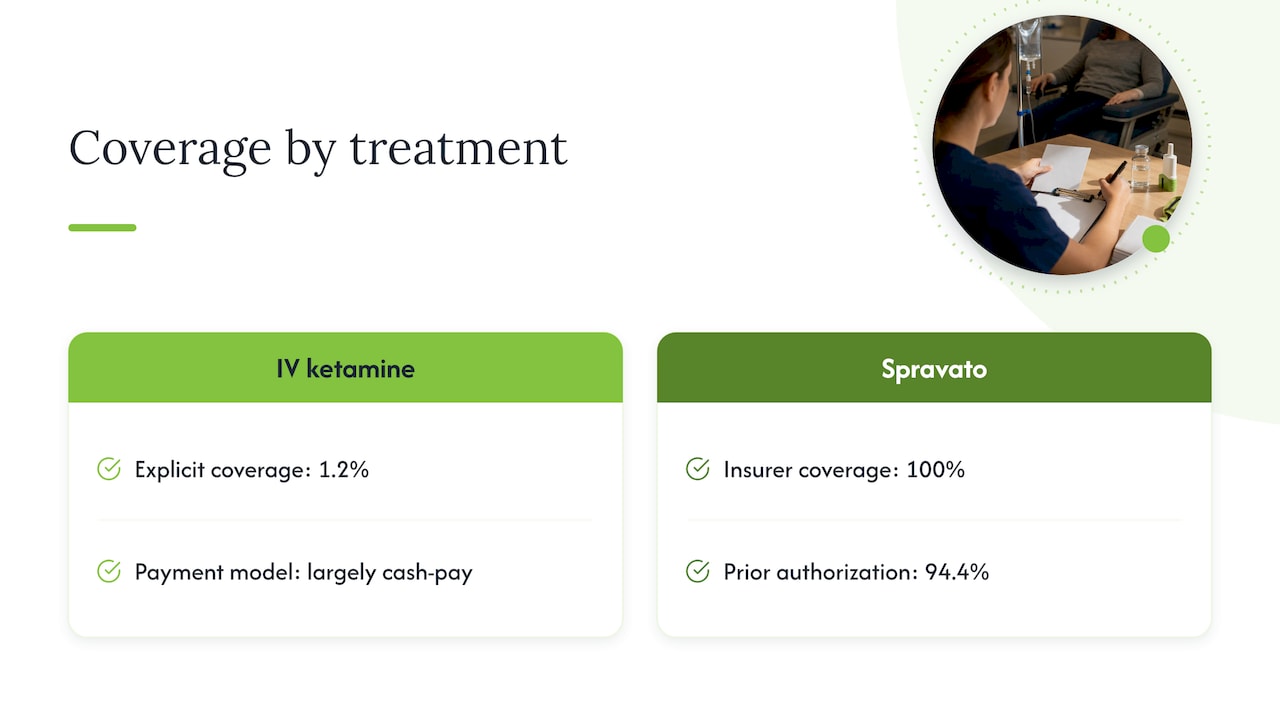
IV ketamine is prescribed off-label for depression. The FDA has not approved it for that use, and insurers follow that line. An August 2025 analysis of 18 major commercial insurers found explicit coverage for IV ketamine at just 1.2 percent of insurers, which is one insurer. Intramuscular and oral ketamine had none. Most policies simply say nothing, and silence in practice means a denial.
Spravato is different. Every insurer in that same analysis covered it, and 94.4 percent required prior authorization. Psychiatric researchers describe this gap as a direct result of regulatory status: an FDA-approved drug gets considered for coverage, while off-label IV ketamine stays largely a cash-pay model.
A practical consequence: do not assume a clinic that says “we accept insurance” is billing your plan for the infusion. Ask which part of the visit is billed. Sometimes it is only the consultation.
A note on superbills
Some patients ask whether they can submit receipts to their insurer for reimbursement. It is worth asking your plan, and an HSA or FSA may be usable for medical expenses, but confirm with your plan administrator before you count on it. We cannot promise reimbursement, and we would rather you hear that from us now than discover it later.
Ketamine infusion versus Spravato: the cost picture
If your goal is treatment-resistant depression and money is the deciding factor, Spravato deserves a serious look. It is esketamine, a nasal spray given in a certified office with observation afterward. Because it carries an FDA approval for treatment-resistant depression, prior authorization is a realistic path to coverage. Your out-of-pocket cost then depends on your plan’s copay or coinsurance structure, not on a clinic’s cash price.
The two are not interchangeable, and cost should not be the only thing steering the choice. Different delivery routes act differently in the body, and some people respond to one and not the other. Our pages on the difference between ketamine and esketamine and the different methods of ketamine delivery lay this out. For a step-by-step on the paperwork side, see how to navigate insurance coverage for Spravato.
Medicare also has a published billing article on esketamine. It notes that administration beyond the FDA label schedule, such as more than eight administrations in the first month, may be subject to medical review. If you are on Medicare, ask your clinic how they handle that.
The total cost over a year, not one session
A single price hides the shape of treatment. Here is how we suggest you think about it.
- Evaluation. A psychiatric assessment comes first. It confirms that ketamine is appropriate and rules out things that make it unsafe.
- Induction series. Often six infusions over a few weeks. Using the DFW range, that is about $2,550 to $3,600.
- Maintenance. Many patients who respond need booster infusions, commonly every 4 to 8 weeks. These are rarely covered by insurance, so they become a recurring self-pay line.
- Supporting care. Therapy, medication review and follow-up visits. Clinicians who write about this stress that the best outcomes often come from an integrated approach, with infusions paired with therapy or ongoing psychiatric monitoring. That belongs in your budget too.
A rough worked example, using the DFW figures only as an illustration: if you completed an induction series at the middle of the range and then needed a booster every six weeks, you would be paying for the series up front and then roughly eight or nine boosters across the following year. The arithmetic gets large quickly, which is exactly why we want you to see it before starting, not after.
A scoping review of ketamine use found that financial barriers were a notable obstacle because of limited insurance coverage. You are not being unreasonable if cost worries you. It is a known problem for patients and for the people treating them.
Is the cheapest option the best value?
Not always. We see patients comparing three or four clinics on a spreadsheet, and the lowest number wins by default. We understand that. But experts caution against focusing only on the lowest per-session price. The clinical environment, the level of medical supervision during the session, and support after the infusion are what make treatment safe and useful.
When you compare clinics, ask these questions:
- Who is in the room during the infusion, and what are their credentials?
- Is a psychiatrist involved in your evaluation and follow-up, or only in the paperwork?
- What does the quoted price include: evaluation, monitoring, recovery time, follow-up?
- What happens if you have a difficult session or a mood dip afterward? Who do you call?
- How are maintenance infusions priced, and how is the decision to continue made?
- Is there an option to step to another treatment if ketamine does not help?
In our experience, a clinic that answers these without hesitation is usually one worth trusting. A clinic that only wants to talk about packages is a different signal.
Our perspective: what we tell patients about cost
We do not publish a ketamine price on our site, and we would rather not quote a figure in an article that may be out of date next quarter. Pricing depends on your evaluation and the plan we build together, so the honest route is a conversation.
What we have learned over time is that cost conversations go better when they happen early. Patients who wait until after the evaluation to ask about money sometimes feel cornered, and a person with severe depression should not be cornered. So we raise it ourselves.
We also try not to lead with ketamine. For some people, a medication adjustment, TMS or Spravato is a better first step, and it may be covered. TMS in particular is a non-drug option with a different cost and coverage profile, and we explain it on our TMS therapy page. If ketamine is the right fit, we will say so, and we will walk through the whole year of cost, not only the first month.
And we would say this plainly: if the cost would cause you real financial strain, tell us. It is a clinical fact, because treatment you cannot sustain is not a good plan. Recovery is a journey, not a straight line, and the plan should be one you can actually keep up with.
— Felix
Safety comes before price
Ketamine is not right for everyone. Uncontrolled high blood pressure, a history of psychosis, certain substance use problems and some heart conditions can all change the answer, and that is something a psychiatrist needs to assess in person. If you are thinking about stopping or changing current medication to start ketamine, talk to your prescriber first. Do not change doses on your own.
If you are in crisis or thinking about harming yourself, do not wait for a consultation. Call or text 988, the Suicide and Crisis Lifeline, or go to the nearest emergency room.
Where our care fits
Our practice in Allen serves patients across North Dallas, including Frisco, McKinney and Plano. We offer ketamine therapy, Spravato, TMS and stellate ganglion block, along with medication management and psychiatric evaluation. That range matters for cost: if one option is not covered or not suitable, we have others to discuss with you.
If you want to compare ketamine against other paths first, our article on whether ketamine therapy is worth the investment goes deeper, and the research on ketamine for treatment-resistant depression is summarized here. To get a current quote and find out which option fits you, contact our team through the Nortex Psychiatry site and we will go over pricing before you commit to anything.
How to prepare before you ask for a quote
A few things make the first cost conversation more useful:
- Write down what you have already tried: medications, doses, how long, and what happened.
- Check whether your plan covers psychiatric visits and whether it has a separate mental health benefit.
- Find out your deductible and whether you have an HSA or FSA.
- Decide how long a commitment you can realistically sustain, including boosters.
- Bring questions about alternatives, including Spravato and TMS.
This takes ten minutes and tends to save a lot of back and forth later.
FAQ
How much does one ketamine infusion cost in Texas?
In the Dallas-Fort Worth area, one IV session typically runs $425 to $675, with most North Dallas clinics between $450 and $600, per a 2025 DFW market review. Prices vary with what is included, such as evaluation and monitoring time. Ask any clinic for an itemized quote.
Does insurance cover ketamine infusions?
Rarely. In an analysis of 18 major commercial insurers, only one explicitly covered IV ketamine. Spravato, by contrast, was covered by all of them, usually with prior authorization. Check your own plan, since policies differ.
How many infusions will I need?
Many programs start with six sessions, then move to boosters every 4 to 8 weeks if you respond. Your psychiatrist decides the pace based on your symptoms and how you tolerate treatment. Not everyone needs ongoing boosters.
Why do ketamine infusions cost so much if the drug is cheap?
The expense is mostly clinical time. A session includes roughly 90 to 120 minutes of professional monitoring for safety, along with staff, space and equipment.
Is Spravato a cheaper alternative?
It can be, for people with insurance, because it is FDA-approved for treatment-resistant depression and generally covered after prior authorization. Your cost then depends on your copay or coinsurance. It is a different treatment, so the choice should rest on clinical fit as well as price.
Sources
- Dallas, TX ketamine clinics and pricing
- Coverage Policies for Ketamine-Based Depression Therapies among Major U.S. Commercial Insurers (SSRN, August 2025)
- The Rapidly Shifting Ketamine Landscape in the US (PMC)
- Increased Demand for Ketamine Infusions and Associated Complexities (PMC)
- Mapping the Use of Ketamine in Treatment-Resistant Depression and Other Psychiatric Disorders (PMC)
- Billing and Coding: Esketamine (A59249), CMS