

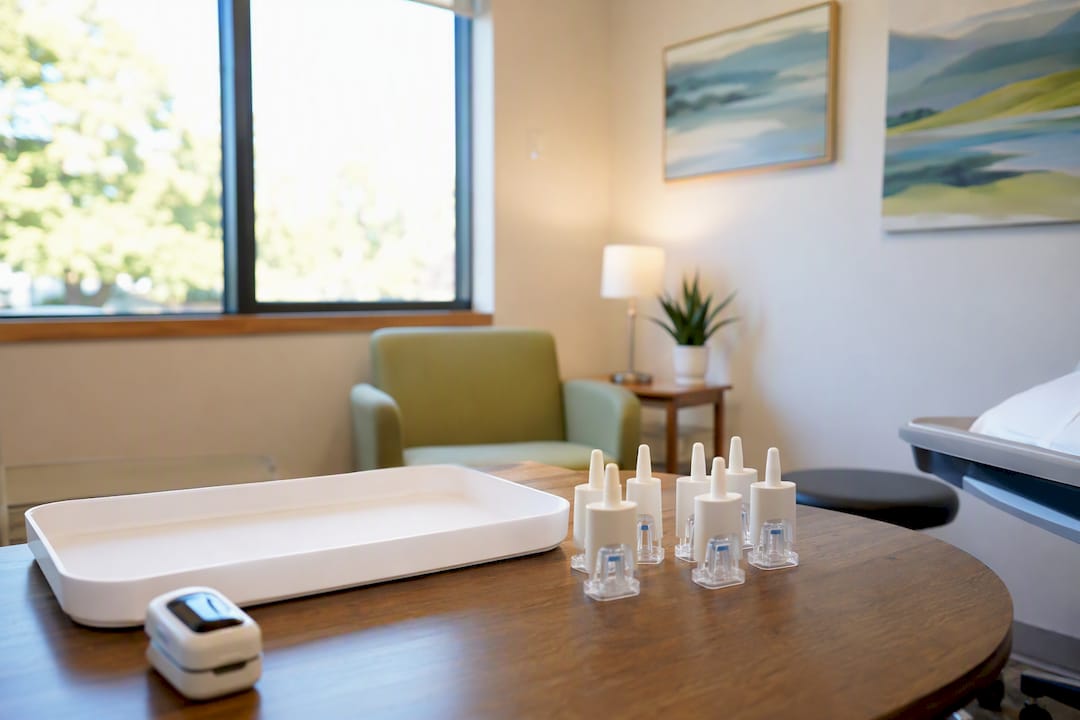
For adults with treatment-resistant depression, esketamine (Spravato) is given intranasally under direct supervision. Induction runs twice weekly for several weeks, then dosing tapers to a maintenance schedule tailored to how you respond. Every session requires at least two hours of monitoring in a REMS-certified setting.
We know that sentence packs a lot in, so let’s break down what it actually means for you or someone you care about.
- Induction (weeks 1 to 4): 56 mg or 84 mg, twice weekly
- Early maintenance: typically once weekly dosing after induction
- Later maintenance: dosing individualized to weekly or every other week
- Device math: each device delivers a set dose; use multiple devices as directed to reach the prescribed dose
- Between devices: a rest period is recommended to allow absorption
Quick fact: the FDA’s clinical pharmacology review describes esketamine’s peak plasma concentration occurring within a typical window after dosing, which is exactly why the spacing and monitoring windows are built the way they are. Nothing about this schedule is arbitrary.
Key Takeaways
Esketamine dosing follows a structured but individualized path: twice weekly induction, tapering maintenance frequency, and mandatory two-hour monitoring in a REMS-certified setting every single session.
| Point | Details |
|---|---|
| Induction dose and frequency | 56 mg or 84 mg twice weekly for the first four weeks, per manufacturer guidance. |
| Device math | Each device delivers 28 mg; use 2 for 56 mg or 3 for 84 mg, with a 5-minute rest between. |
| Blood pressure timing | Pressure commonly peaks around 40 minutes post-dose, so checks are timed around that window. |
| Dose adjustments | Changes happen in 28 mg increments based on tolerability, most often stepping 84 mg down to 56 mg. |
| Where to start | Nortex Psychiatry provides REMS-certified, supervised Spravato treatment with individualized dosing plans. |
Table of Contents
- Esketamine Dosing Schedule: Week by Week
- How a Spravato Session Actually Works
- REMS Rules, Blood Pressure Checks, and Who Should Wait
- Adjusting the Dose: Tolerability, Age, and Missed Sessions
- Before and After Your Session: A Practical Checklist
- What We’ve Learned Treating Patients Through This Protocol
- The Part of Esketamine Dosing Nobody Explains Well
- Get Supervised Spravato Treatment That’s Built Around Your Response
- Sources
- FAQ
Esketamine Dosing Schedule: Week by Week
Patients ask us the same question in almost every intake appointment: “How long am I doing this twice a week?” The honest answer is that the twice-weekly phase is temporary, and it’s designed that way on purpose.
Weeks 1 through 4: Induction
During induction, you receive either 56 mg or 84 mg twice per week, according to the manufacturer’s dosing guidance. In practice, most clinics schedule these sessions on set days, commonly Monday and Thursday, so there’s always a gap of two to four days between doses. That spacing isn’t random. It gives your body time to process the medication and gives your care team a chance to catch tolerability issues before the next dose.
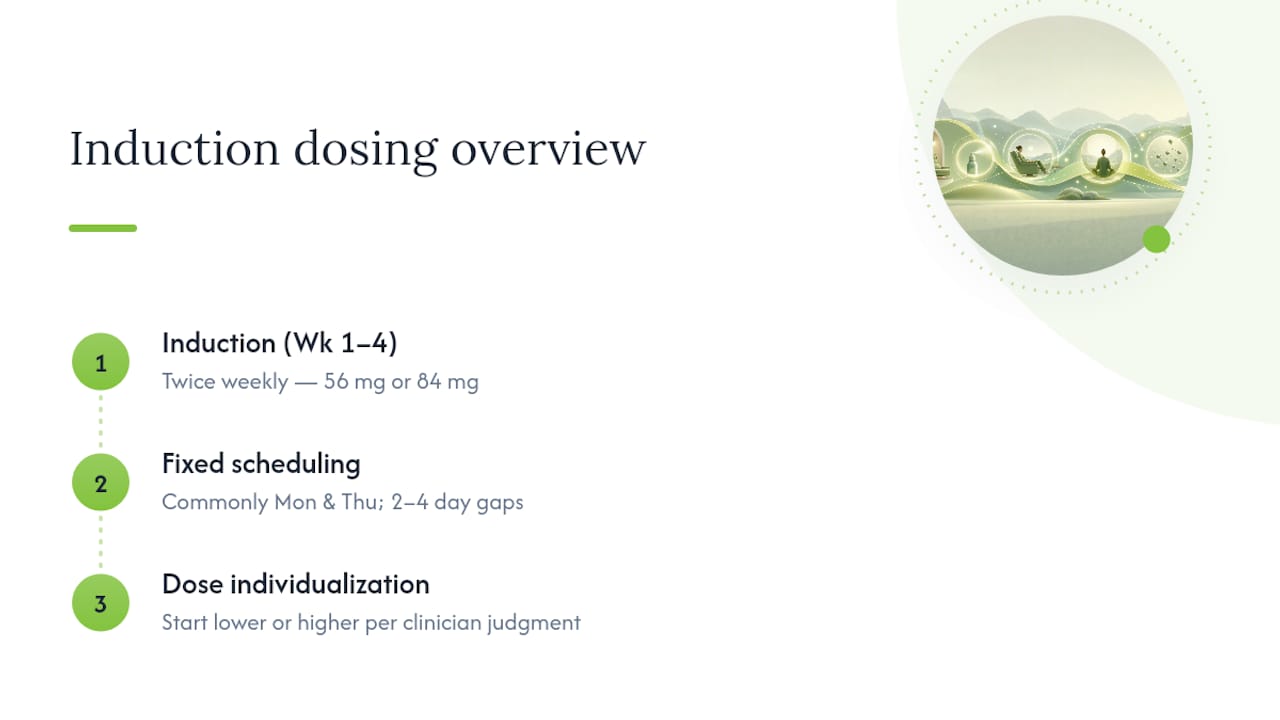
Patients may start at a lower dose and increase if needed, or start at a higher dose depending on clinical judgment and individual factors. This is one of the areas where we lean on clinical judgment rather than a rigid formula. Esketamine dosage guidelines give a range, not a single number, because depression itself doesn’t present the same way twice.
Weeks 5 through 8: The Shift to Weekly Dosing
After induction, patients typically move to less frequent, often once weekly, sessions. This is where the treatment schedule starts to feel less demanding, and where a lot of patients report the biggest sense of relief, both from the depression symptoms and from the logistics of coming in twice a week.
Week 9 and Beyond: Individualized Maintenance
Thereafter, dosing frequency is individualized, often weekly or every other week, depending on response. The clinical trial evidence supporting these frequency choices comes largely from the SUSTAIN and ASPIRE study programs, which tracked how patients held onto their response as sessions spaced out. We aim for the lowest effective frequency, meaning the least frequent dosing schedule that still keeps your symptoms in check. That’s not a cost-cutting measure. It’s the clinical goal.
The Separate Protocol: MDD With Acute Suicidal Ideation
There’s a distinct esketamine dosing schedule for adults with major depressive disorder who are experiencing acute suicidal ideation or behavior. In that scenario, the recommended dose is 84 mg twice weekly for four weeks, always alongside an oral antidepressant. If tolerability becomes a problem, clinicians can reduce this to 56 mg twice weekly, per the same manufacturer dosing protocol. This regimen exists because the evidence supporting rapid symptom reduction in this population is strongest at the higher, more intensive dose. If you’re weighing whether ketamine-based treatment could help during a suicidal crisis, we’ve written more on how ketamine therapy addresses suicidal ideation and how it fits alongside standard care.
Across both regimens, clinical evaluation happens at two key checkpoints:
- End of induction (week 4): your prescriber assesses whether the current dose and frequency are working
- Every four weeks after that: ongoing reassessment to confirm the maintenance schedule still fits
How a Spravato Session Actually Works
Walking into your first session without knowing what to expect adds unnecessary stress to an already vulnerable moment. Here’s what the device and the process actually look like.
Each single-use nasal spray device delivers 28 mg of esketamine across two sprays, one in each nostril, according to the Dailymed product label. To reach a 56 mg dose, you use two devices. For 84 mg, three devices. One detail patients often miss: the device should never be primed before use. Priming wastes medication and throws off the dose you’re supposed to receive.

Between each device, a brief rest period is recommended to allow absorption before the next spray, supporting predictable absorption and safety monitoring.
A typical session sequence looks like this:
- Baseline vital signs, especially blood pressure, are checked before dosing
- You self-administer the nasal spray under direct staff supervision (nobody else administers it for you)
- Staff observe you through the absorption window and watch for acute effects
- Vitals are rechecked at intervals, with particular attention around the 40-minute mark
Dissociation (a sense of feeling detached from yourself or your surroundings) and sedation are the two most common effects patients notice within the first 40 minutes. Both are expected, both are temporary, and both are exactly why you’re not left alone during this window. Staff are trained to reassure you, adjust the room environment, and step in if effects are more intense than anticipated.
Pro Tip: Tell your care team in advance if you’ve had a strong dissociative reaction before. We can adjust the room, lighting, or even offer a weighted blanket. Small comfort measures make a bigger difference than most patients expect.
If you’re deciding between infusion-based ketamine and the nasal spray form, the delivery method changes more than just how the medication is given. Our comparison of ketamine infusions versus nasal spray walks through those practical differences in more depth.
REMS Rules, Blood Pressure Checks, and Who Should Wait
Esketamine’s safety framework isn’t optional paperwork. It’s baked into how the medication is legally allowed to reach you.
Spravato is only available through the SPRAVATO REMS program, which requires certified healthcare settings, enrolled patients, and mandatory reporting of serious adverse events. You cannot take this medication home. Every dose happens on-site, under supervision, in a facility that has met these certification requirements.
The number that surprises most patients: blood pressure increases after dosing commonly peak around 40 minutes post-administration and can last approximately four hours, per manufacturer dosing data. That’s why clinicians don’t just check vitals once and call it done. We check at baseline, again around the 40-minute mark when pressure is most likely to be elevated, and continue monitoring until values trend back down.
Observation lasts at least several hours after each session, with discharge determined by clinical assessment rather than a strict timing rule. Your care team confirms sedation has resolved, dissociation has cleared, and vitals look stable before you leave.
Some patients need extra caution or a delayed start altogether:
- Uncontrolled hypertension or unstable cardiovascular disease
- Conditions involving increased intracranial pressure
- Aneurysmal vascular disease or a history of intracerebral hemorrhage
If you’re also managing another condition that requires careful monitoring before starting a new treatment, this contraindications assessment framework offers a useful model for how clinicians weigh treatment suitability against risk factors, even outside the esketamine context specifically.
Adjusting the Dose: Tolerability, Age, and Missed Sessions
Optimal esketamine dose isn’t a fixed target. It’s a moving conversation between you and your prescriber, especially in the first few weeks.
If 84 mg proves hard to tolerate, clinicians can step down to 56 mg. Dose changes generally happen in 28 mg increments, up or down, rather than large jumps. This gradual approach limits how much any single change disrupts your response.
For patients 65 and older, esketamine dosing recommendations call for added caution. Dose adjustments still happen in 28 mg steps, and it’s worth being direct here: efficacy in this age group isn’t as well established as it is in younger adults, so response gets watched more closely.
Missed sessions come up more than you’d think, whether from illness, travel, or scheduling conflicts.
- If no clinical worsening has occurred, most patients simply resume the existing schedule
- If depression symptoms have worsened, your prescriber may adjust the resumption plan, sometimes stepping back toward a more frequent schedule temporarily
The guiding principle behind every adjustment is the same: find the lowest dose and least frequent schedule that keeps you well. Nothing here is about minimizing medication for its own sake. It’s about not asking you to do more than you need.
Before and After Your Session: A Practical Checklist
Good esketamine administration outcomes depend as much on preparation as on the dose itself.
- Avoid food for at least two hours before your appointment, and skip liquids in the 30 minutes prior. This meaningfully reduces nausea risk.
- Arrange a ride home in advance. You cannot drive yourself, and this isn’t a suggestion.
- Bring photo ID and a current medication list to every session.
- Plan to skip driving or operating machinery until the next day, after a full night’s rest.
Pro Tip: Pack a light snack for after your observation window ends. Many patients feel foggy or fatigued once they’re cleared to leave, and having something ready at home (or in the car, for your driver) makes the transition smoother.
Nausea, mild dissociation, and post-session tiredness are common enough that we consider them part of the routine, not a red flag. Most patients find that lying quietly during observation, rather than checking their phone or trying to power through work emails, shortens how rough the come-down feels.
What We’ve Learned Treating Patients Through This Protocol
In our work with patients starting Spravato, the biggest misconception we run into isn’t about the dose itself. It’s the assumption that twice weekly dosing is permanent. It isn’t, and knowing that upfront changes how people mentally prepare for the first month.
We’ve also learned to treat the 40-minute blood pressure check as a genuine inflection point in the appointment, not a formality. Staffing that window properly, so someone is paying attention right when pressure is most likely to climb, matters more than most protocols give it credit for.
Patients do better when they know what to expect before they walk in: the dissociation will pass, the blood pressure check around 40 minutes is normal, and the schedule gets lighter after week four. Uncertainty is often harder on people than the medication itself.
Counseling priorities on our end are simple. We talk through what dissociation feels like before it happens, we help patients plan their day around the appointment (nothing scheduled right after), and we make sure everyone knows exactly when to call us between sessions rather than waiting for the next visit.
The Part of Esketamine Dosing Nobody Explains Well
Most articles on this topic treat the dosing table as the whole story. It isn’t. The schedule is the easy part, printed right on the label. What’s harder, and what conventional advice tends to skip, is the judgment call around frequency tapering after week eight.
We think too many patients (and honestly, some clinicians) treat “individualized” as a vague afterthought rather than the actual clinical decision it is. The label gives you a range: weekly or every other week. Nobody hands you a formula for which one is right for you at week nine. That call comes from watching how you respond, not from a chart.
If we had to name the single most overlooked piece of esketamine safety and efficacy, it’s the 40-minute blood pressure window. Patients fixate on dissociation because it’s the effect they feel. Blood pressure changes are quieter, and that’s exactly why they deserve more attention than they usually get.
Our advice: prioritize finding a provider who treats dose tapering as an ongoing conversation, not a one-time decision made in week one.
— Felix
Get Supervised Spravato Treatment That’s Built Around Your Response
Reading about induction schedules and blood pressure windows is one thing. Sitting across from a psychiatrist who adjusts your plan based on how you’re actually doing is another. Nortexpsychiatry runs REMS-certified Spravato sessions where dosing frequency isn’t locked to a generic timeline. It shifts as your response and tolerability shift, starting from week one. For adults in North Dallas weighing whether esketamine fits their treatment-resistant depression, that means fewer surprises, closer monitoring around the moments that matter most (like that 40-minute BP check), and a provider who explains every adjustment before making it. If you’re ready to find out whether Spravato is the right next step, start with a psychiatric evaluation to talk through your history and treatment options.
This article is general information, not a substitute for advice from a qualified doctor. Consult a qualified healthcare professional about your own circumstances before acting on anything here.
Sources
FAQ
Is 84 mg of Spravato a lot?
It’s the highest approved dose, but it’s not unusual. It’s the standard induction dose for adults with MDD and acute suicidal ideation, and many treatment-resistant depression patients reach it during induction based on tolerability.
How is esketamine dosed?
Esketamine is dosed intranasally, twice weekly during a four-week induction phase at 56 mg or 84 mg, then shifted to weekly or every-other-week maintenance sessions individualized to your response.
What is the recommended dosing schedule for Spravato?
Weeks 1 through 4 use twice weekly dosing, weeks 5 through 8 typically move to once weekly, and week 9 onward is individualized to weekly or every-other-week sessions based on how well symptoms are controlled.
How many esketamine treatments do you need?
There’s no fixed number. Most patients complete at least the four-week induction phase (eight sessions), then continue on a tapering maintenance schedule for as long as it keeps symptoms in remission.