


ADHD testing costs anywhere from about $150 for a brief online screening to more than $5,000 for a comprehensive neuropsychological battery. The gap comes down to scope: a quick diagnostic conversation costs far less than multi-hour testing with a written report. Insurance can close some of that gap, but coverage depends heavily on documentation and the exact codes your provider bills.
TL;DR:
- Brief online screeners cost under $1,000 and usually involve a single session with a symptom checklist, but may lack detailed documentation for accommodations.
- Formal testing for documentation typically ranges from $1,000 to several thousand dollars, depending on scope, with comprehensive batteries being the most expensive.
- Diagnosis by psychiatrists tends to focus on medication management and is less testing-intensive, while psychologists or neuropsychologists provide detailed evaluation reports for accommodations.
- Insurance coverage varies based on the type of evaluation and provider, with basic interviews covered more reliably than extensive neuropsychological batteries.
- Lower-cost alternatives like training clinics, community centers, and telehealth options can provide evaluations for those with financial barriers, often on sliding scales.
Table of Contents
- How Much Is ADHD Testing? Cost by Evaluation Type
- Who Can Diagnose ADHD, and Does Credential Affect Price?
- Does Insurance Cover ADHD Testing?
- What Exactly Am I Paying For?
- Choosing the Right Level of Testing for Your Situation
- Affordable ADHD Testing: Where to Look When Cost Is the Barrier
- How Nortex Psychiatry Scopes and Prices ADHD Evaluations
- The Real Trade-off Between Cheap and Thorough
- Getting an ADHD Evaluation Through Nortex Psychiatry
- Sources
- FAQ
How Much Is ADHD Testing? Cost by Evaluation Type
We get asked this constantly, and the honest answer is: it depends on what you’re actually buying. ADHD evaluation pricing splits into four rough tiers, and each one produces a different kind of document.
Online screeners and brief telehealth diagnostic visits run in a lower cost range, typically under $1,000. These typically involve a single session, a symptom checklist, and a short conversation with a provider. They’re fast and often enough to start a conversation about medication, but they rarely produce documentation detailed enough for school or workplace accommodations.
Basic clinical diagnostic evaluations generally cost a few hundred to around a thousand dollars. This tier usually includes a clinical interview, standardized rating scales (often from more than one informant), and a brief written summary. The CDC’s diagnostic guidance describes this exact process: history taking, multi-informant rating scales, and confirmation that symptoms show up across more than one setting, whether that’s home, work, or school.
Standard psychological testing usually costs from about one thousand to a couple thousand dollars and includes direct cognitive and attention testing on top of the interview, producing a more substantive report.
Comprehensive neuropsychological batteries typically cost several thousand dollars or more. These involve several hours of direct testing, detailed scoring, and a report thorough enough to support formal accommodation requests at a university or workplace. Aggregated cost data from clinician resources puts the full range for ADHD evaluations at roughly $150 to $5,000+, which matches what we see across practices.
| Testing tier | Typical cost | What you get |
|---|---|---|
| Online screener / brief telehealth visit | $150–$1,000 | Single session, symptom checklist, short consult |
| Basic clinical diagnostic evaluation | $300–$1,000 | Interview, rating scales, brief written summary |
| Standard psychological testing | $1,000 to a couple thousand dollars | Cognitive/attention testing plus fuller report |
| Comprehensive neuropsychological battery | several thousand dollars or more | Multi-hour testing, detailed report for accommodations |
Who Can Diagnose ADHD, and Does Credential Affect Price?
Yes, and it’s one of the biggest cost variables we see. The provider’s training shapes both what’s included and what you’ll pay.
- Psychiatrists (MD/DO) focus on diagnosis in the context of medication management. Their evaluations tend to be interview-based and consult-style, with a higher per-visit fee but less standalone testing.
- Clinical psychologists and neuropsychologists (PhD/PsyD) are the specialists for formal testing. If you need a defensible report for accommodations, this is usually where the cost climbs, because you’re paying for testing hours plus scoring and report writing.
- Primary care providers, nurse practitioners, and physician assistants offer the most accessible and typically lowest-cost route, but they often lack the time or tools for in-depth testing, so their evaluations may be thinner on documentation.
If your goal is simply to start treatment, a psychiatric evaluation is often enough. If you need documentation for a school, employer, or licensing board, a psychologist’s testing battery is usually the better investment. We cover this distinction in more detail in our guide to what a psychiatric assessment actually involves.
Does Insurance Cover ADHD Testing?
Sometimes, and the details matter more than most people expect. Coverage depends on medical necessity, whether your provider is in-network, and whether prior authorization was obtained before testing began. Basic diagnostic interviews tend to be covered more reliably than comprehensive neuropsychological testing, which insurers often scrutinize more closely.
A few practical steps help you estimate your real out-of-pocket cost before you commit to an evaluation:
- Ask your insurer about specific CPT codes your provider plans to bill, commonly 90791 (psychiatric diagnostic evaluation), 96127 (brief emotional/behavioral assessment), and 96136/96137 (psychological test administration and scoring). Coverage can differ code by code.
- Check your deductible and coinsurance before scheduling, since a plan that “covers” testing may still leave you paying the first several hundred dollars.
- Request a Good Faith Estimate if you’re uninsured or paying out of pocket. Federal rules require providers to give you a written estimate of expected charges for scheduled services.
- Ask for a superbill if your provider is out-of-network. You may be able to submit it for partial reimbursement.
Pro Tip: Keep an itemized receipt after your evaluation. ADHD testing generally qualifies as a qualified medical expense for HSA/FSA funds, and having the paperwork ready makes reimbursement much faster.
What Exactly Am I Paying For?
The bill for ADHD testing isn’t just the time in the room with you. A large share of the cost is scoring and report writing that happens after your appointment ends.
- Direct testing hours are the visible part, but scoring standardized instruments and writing the report often take as long or longer than the testing itself.
- Standardized instruments like the WAIS (for cognitive functioning), Conners Rating Scales, and continuous performance tests are common building blocks, chosen because they’ve held up to scrutiny in practice.
- Extra deliverables raise the price: a multi-page report, a formal accommodation letter, or a school consultation call all add time your provider has to bill for.
- Geography and overhead matter too. A practice in a high-rent metro area will typically charge more than a rural clinic offering the same service.
Not every add-on is worth paying for. A systematic evidence review found limited support for EEG or neuroimaging as diagnostic tools for ADHD, while standardized rating inventories performed comparably or better. If a clinic quotes you extra for brain scans as part of a diagnostic package, that’s a fair question to ask about.
Choosing the Right Level of Testing for Your Situation
Matching the evaluation to your actual goal saves money and time. Someone who just wants to explore medication options doesn’t need the same evaluation as someone applying for testing accommodations on the LSAT.
- Identify your end goal first. Starting treatment usually calls for a basic diagnostic evaluation. Formal accommodations, whether academic or workplace, usually require a full testing battery with documented cognitive scores.
- Watch for red flags that justify deeper testing. An inconsistent symptom history, coexisting learning difficulties, or a high IQ that may be masking attention problems are all reasons to go beyond a screener.
- Ask three questions before you book: What instruments will be used? How long is the written report? Is the provider’s documentation accepted by the school, employer, or agency you’re dealing with?
Co-occurring anxiety or mood symptoms can also widen the scope of testing needed, which we walk through in our piece on anxiety and ADHD together.
Affordable ADHD Testing: Where to Look When Cost Is the Barrier
Full neuropsychological batteries aren’t within reach for everyone, and that’s a real constraint we take seriously.
- University training clinics often offer supervised evaluations, typically in the $300 to $800 range, performed by graduate students under licensed supervision.
- Community mental health centers frequently use sliding-scale fees based on income. The SAMHSA mental health services locator is the fastest way to find one near you.
- Telehealth providers work well for straightforward presentations without complicating factors. Our guide to ADHD telehealth in Texas covers what you can and can’t accomplish remotely.
- HSA/FSA funds, payment plans, and superbills can all reduce the actual cash you spend, even when the sticker price looks high.
How Nortex Psychiatry Scopes and Prices ADHD Evaluations
We start every evaluation the same way: figure out what you actually need before quoting a price. A patient who just wants to explore whether medication might help doesn’t need the same evaluation as a college student who needs documentation for extended test time.
- We begin with a clinical interview and standardized rating scales, consistent with the diagnostic process the AAP’s clinical guideline outlines for pediatric ADHD, and adapted for adult patients.
- If the picture is straightforward, that initial evaluation is often sufficient to begin treatment.
- If your goals require more, we’re upfront about what a fuller battery would add, and why.
- Documentation for schools or employers is written to match the standard those institutions expect, with realistic turnaround times discussed at the outset, not after the invoice arrives.
Pro Tip: Ask any provider, including us, how much of the fee covers direct testing time versus report writing. It’s a fair question, and a clinic that can’t answer it clearly is worth a second look.
The Real Trade-off Between Cheap and Thorough
We’ve watched patients choose the cheapest evaluation available, only to need a second, more expensive one later because the first didn’t answer the right questions. That’s not always a mistake. For a straightforward case, a basic evaluation is genuinely enough.
But when the history is complicated, when anxiety or a learning difference is tangled up with the attention symptoms, spending more upfront on a fuller battery usually costs less than paying twice. Our practical advice: match the evaluation to the decision you’re actually trying to make, not to the lowest number on a price list.
— Felix
Getting an ADHD Evaluation Through Nortex Psychiatry
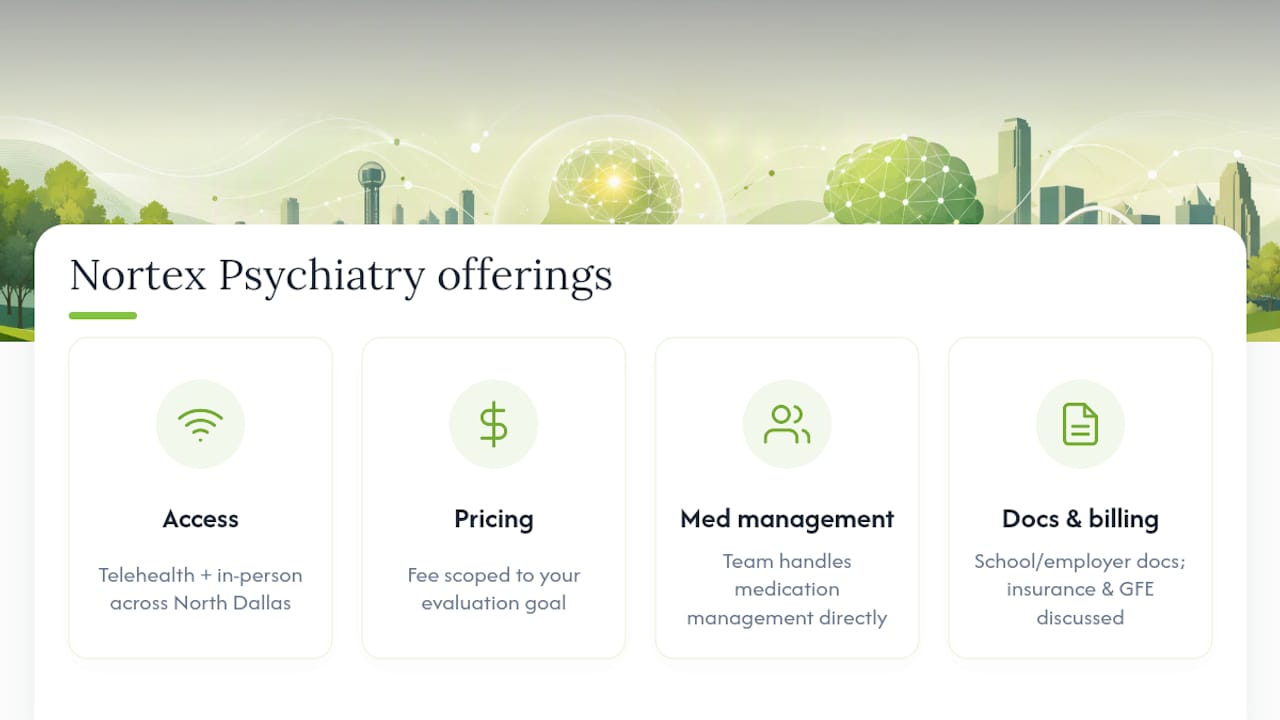
If you’re weighing a screener against a full battery, Nortex Psychiatry gives you a clearer starting point than guessing at price ranges online. We offer both telehealth and in-person psychiatric evaluations across North Dallas, including Allen, Frisco, McKinney, and Plano, and we scope every evaluation to your actual goal before quoting a fee, so you’re not paying for testing hours you don’t need. Our team handles medication management directly if that’s your next step, and we prepare documentation formatted for schools and employers when accommodations are the goal. Billing is discussed upfront, including what your insurance is likely to cover and what a Good Faith Estimate would look like if you’re paying out of pocket. To see what a full evaluation includes and how scheduling works, visit our page on psychiatric evaluations and book a time that fits your schedule.
Sources
For readers who want to dig into the clinical evidence directly, the AHRQ systematic review covers diagnostic accuracy research, the CDC’s diagnosis page explains the standard clinical process, and the SAMHSA locator helps you find lower-cost clinics. For insurance-specific questions, Unparalleled Global Benefits offers useful context on mental health coverage nuances.
This article is general information, not a substitute for advice from a qualified doctor. Consult a qualified healthcare professional about your own circumstances before acting on anything here.
- Comparative effectiveness review on ADHD diagnosis and treatment (AHRQ)
- CDC: ADHD diagnosis
- SAMHSA mental health services locator
- PMC article summarizing ADHD diagnostic and treatment evidence and context
FAQ
Is ADHD testing covered by insurance?
Partially, in most cases. Basic diagnostic interviews are covered more reliably than comprehensive neuropsychological testing, and coverage depends on medical necessity, network status, and prior authorization.
What are the top three signs of ADHD?
Persistent inattention, impulsivity, and hyperactivity or restlessness that shows up across more than one setting are the core signs clinicians look for, per the CDC’s diagnostic framework.
Is it worth getting tested for ADHD?
If symptoms are affecting your work, relationships, or school performance, testing is usually worth it, since an accurate diagnosis opens the door to targeted treatment rather than guesswork.
What are the 12 symptoms of ADHD in adults?
Definitions vary by source, but adult ADHD symptom checklists commonly include difficulty focusing, disorganization, forgetfulness, restlessness, impulsivity, poor time management, and trouble completing tasks, among others assessed through structured rating scales during evaluation.
How much does a basic ADHD evaluation cost compared to a full battery?
A basic clinical diagnostic evaluation generally costs a few hundred to around a thousand dollars, while a comprehensive neuropsychological battery typically entails several thousand dollars, depending on provider credential and report complexity.