


If you have ADHD and anxiety, you are in large company. A 2025 review estimates that anxiety disorders affect 25 to 50 percent of people with ADHD, and many adults spend years treating one while the other quietly keeps the symptoms going. The practical answer is to have both looked at in the same evaluation, then treat them in an order that makes sense for you. That is the work we do with adults across Allen, Frisco, McKinney and Plano, in person or by telehealth.
TL;DR
- ADHD and anxiety overlap in restlessness, poor concentration and trouble sleeping, so they are easy to mistake for each other, and easy to miss when they occur together.
- A useful clue: concentration problems that show up even when you are calm point toward ADHD. Problems that show up mainly when you are worried point toward anxiety.
- Treatment usually starts with whichever condition is causing the most impairment, and changes are often made one at a time so side effects are easy to read.
- Stimulants are first-line for adult ADHD, and non-stimulant options exist for people with significant anxiety. Therapy adds to either.
- A careful evaluation takes more than one short conversation. Bring a spouse, partner or family member’s view if you can.
Table of Contents
- Why ADHD and anxiety show up together
- What the two look like side by side
- How an evaluation sorts it out
- What gets treated first
- Medication when both conditions are present
- Therapy and daily habits
- Our perspective
- Getting evaluated in North Dallas
- FAQ
- Sources
Why ADHD and anxiety show up together
The numbers vary by study. One epidemiological survey found that about 47 percent of adults with ADHD had an anxiety disorder in the previous 12 months, so this is not just a feature of people who seek treatment. The 2025 review also notes that adults with both usually have more severe symptoms and an earlier age of onset.
Why the link? Part of it is likely biological. Part of it is lived experience, and this is the part we hear about most. Dr. Susanna Mierau describes in a 2024 peer-reviewed article on adult ADHD diagnosis how people with ADHD can take two paths. Some stay carefree and become anxious only when the consequences of impulsive choices catch up with them. Others learn to anticipate consequences and develop specific or generalized worry. If you have spent decades missing deadlines, losing keys, or forgetting what someone told you, bracing for the next mistake is a reasonable thing for a mind to do.
That anxiety is real, and it deserves its own attention. But it can also hide the ADHD underneath it.
What the two look like side by side
According to the ADDA’s comparison of ADHD and anxiety in adults, the conditions share trouble concentrating, restlessness, trouble relaxing, and sleep problems. Each also has symptoms of its own.
| ADHD | Anxiety | |
|---|---|---|
| Shared | Trouble concentrating, restlessness, sleep problems | Trouble concentrating, restlessness, sleep problems |
| Attention | Short attention span, forgetfulness | Focus slips mainly in worrisome situations |
| Behavior | Fidgeting, interrupting, trouble waiting a turn | Constant nervousness and tension |
| Body | Often none beyond restlessness | Rapid breathing or heartbeat, sweating, trembling |
| Thinking | Trouble prioritizing, organizing and planning | Trouble controlling worry, a sense of doom |
A person with both may feel anxious about many things at once and also lose the thread in the middle of a calm afternoon. That combination is common, and it is the one that tends to get the wrong label.
The question we ask first
Does your attention drift when nothing is bothering you? The same peer-reviewed article on adult ADHD diagnosis makes the point that people with ADHD get distracted even during leisure and often do not notice their mind wandered. People whose focus is hijacked by anxiety usually describe the opposite: they are painfully aware of what they are worrying about, and often feel guilty about it.
Neither description is a diagnosis. But when you listen for it, it clears up a lot.
ADHD can also look different depending on the person. If your main struggle is a foggy, quiet kind of inattention rather than hyperactivity, our page on inattentive ADHD in adults walks through how that presents. For a broader look at how ADHD travels with other conditions and affects daily functioning, this overview of ADHD and co-occurring conditions is a reasonable place to read further.
How an evaluation sorts it out
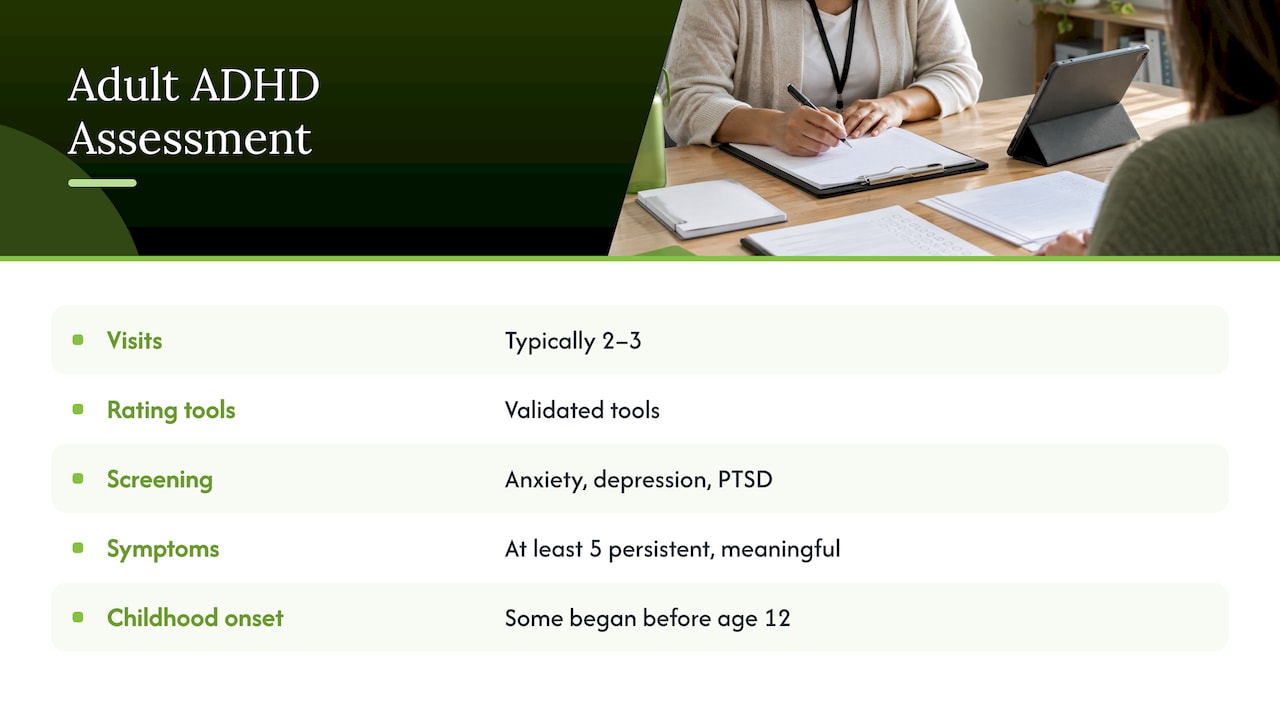
ADHD cannot be diagnosed from a quick chat. The Oregon Health Authority’s guidance for clinicians describes a comprehensive adult assessment as typically taking two to three visits. It uses validated rating tools, screens for anxiety, depression and PTSD, and may include reports from people who know you. A diagnosis requires at least five clinically meaningful, persistent symptoms, some starting before age 12, with impairment in at least two settings such as work and home.
Two parts of that matter to you as a patient.
Childhood history. Anxiety can start at any age. ADHD, by definition, has roots in childhood. Old report cards, comments from teachers, or a parent’s memory can be more helpful than you expect.
Another person’s view. The same guidance notes that a report from a spouse, partner or family member raises diagnostic accuracy when it matches your account and the screening tools. It is not about doubting you. We rarely see ourselves clearly in the places where we struggle most.
The American Family Physician review adds that other mental health conditions have to be part of the differential diagnosis because of the substantial overlap with anxiety, mood, impulse control and substance use disorders. In plain terms: the evaluation is meant to rule things in and out, not just to confirm what you walked in expecting.
If you want to prepare, our guide on what to bring to an anxiety versus ADHD evaluation lists the items that help most, and our page on adult ADHD diagnosis in North Dallas explains what to expect from the process.
What gets treated first
People often assume ADHD and anxiety must be treated together on day one. Sometimes that is right. Often it is not.
The 2025 review recommends prioritizing the most severe, functionally impairing and unstable condition, then addressing the others after stabilization. If ADHD is the main source of impairment, a long-acting stimulant may be the starting point. If both contribute about equally, treating them at once can be considered, but starting one thing at a time is advised so that a side effect or a non-response can be traced to its cause.
In practice, that means a slower start than some people want. We understand the impatience. When you have been struggling for years, waiting a few weeks to see how one change lands feels hard. It usually saves time later, because you are not guessing which pill did what.
Medication when both conditions are present
Stimulants
Amphetamine and methylphenidate are first-line medications for adult ADHD, with the strongest evidence rating, and they work better for many people alongside psychotherapy. A common worry is that a stimulant will make anxiety worse. The honest answer is that it can in some people, and the review acknowledges that anxiety is a possible adverse effect of methylphenidate and amphetamine-derived drugs. It also describes a 10-year study in which stimulant-treated patients had a lower incidence of secondary anxiety or depression than untreated peers, and a growing body of work suggesting that ADHD medication can ease co-occurring anxiety, because the chaos that fed it gets quieter.
Both things can be true. That is why dose, timing and a follow-up plan matter more than the drug name.
Non-stimulant options
For adults with anxiety or depression who cannot take stimulants, the American Family Physician review lists atomoxetine, viloxazine, and bupropion (not FDA-approved for ADHD). The 2025 review adds that atomoxetine has shown benefit for both ADHD and comorbid anxiety or depression.
Adding an antidepressant
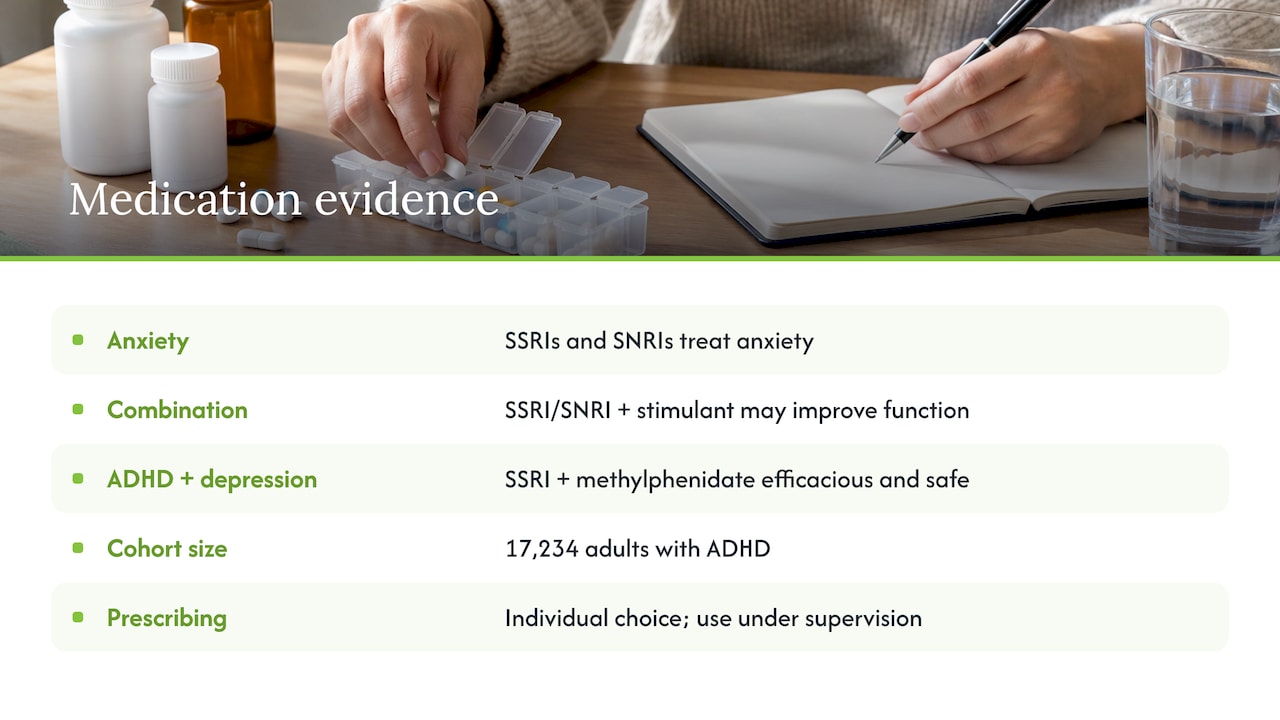
SSRIs and SNRIs treat anxiety. The review describes research suggesting that combining an SSRI or SNRI with a stimulant may improve functional outcomes in people with ADHD and comorbid depression and anxiety. It also cites a cohort of 17,234 adults with ADHD in which concurrent SSRIs and methylphenidate were found efficacious and safe for ADHD with comorbid depression. The same review found that fluvoxamine, fluoxetine and bupropion did not significantly reduce anxiety compared with placebo in people with ADHD, which is one reason the choice should be individual rather than automatic.
So, is it safe to take anxiety medication and ADHD medication together? Often yes, under supervision. Your prescriber needs your full medication list, including supplements, and should know about your heart health, sleep and caffeine use. Never combine or stop prescriptions on your own.
What responsible stimulant prescribing involves
Stimulants are controlled substances. The American Family Physician review notes that physicians should consider controlled substance agreements and prescription drug monitoring programs to watch for misuse or diversion. If you are asked to sign an agreement or come in on a regular schedule, that is a standard part of safe prescribing, not a comment on you.
For a wider view of the options, see our guide to ADHD treatment options for adults and our comparison of medication versus therapy for ADHD.
Therapy and daily habits
The American Family Physician review rates cognitive behavioral therapy, mindfulness, dialectical behavior therapy and hypnotherapy as nonpharmacologic options with good supporting evidence. For someone with both conditions, CBT is useful in two ways. It builds planning and organizing skills for ADHD, and it works on the worry loops that drive anxiety.
A few habits tend to help while treatment finds its footing:
- Write down the one or two tasks that matter today, rather than a long list that triggers dread.
- Use external reminders for things you forget, so that memory lapses stop feeding self-criticism.
- Keep a steady sleep schedule. Poor sleep worsens both conditions.
- Notice what time of day anxiety peaks, and whether it tracks your medication or your caffeine.
Our article on anxiety and ADHD management steps goes into this in more detail. If you are weighing the two routes, how to choose between therapy and medication may help.
If you also have low mood, the overlap with depression is worth a look: ADHD and depression covers how that combination is treated.
Our perspective
We have learned that the hardest part for most adults is not the treatment. It is the years of being told, or telling themselves, that they are lazy, scattered or just nervous people.
When someone comes to us with both ADHD and anxiety, we try not to rush toward a label. We listen for the pattern: when attention slips, what happens in the body, what was true in childhood. Then we decide together what needs help first. Sometimes that is the ADHD. Sometimes the anxiety is loud enough that it has to settle before anything else can be read clearly.
We favor starting with one change at a time and checking in, because it makes the next decision easier. Recovery is a journey, not a straight line, and a dose adjustment or a change of medication is part of the process, not a failure of it.
Our practice offers medication management and psychiatric evaluation, with in-person visits in Allen and telehealth options, so care can fit around a work schedule. A discreet, judgment-free place to sort this out is what we want to provide.
Felix
Getting evaluated in North Dallas
If you recognize yourself here, the next step is a psychiatric evaluation that looks at attention and anxiety together. Nortex Psychiatry in Allen, Texas, serves adults and families in Frisco, McKinney, Plano and nearby areas, and offers both in-person and telehealth visits. You can reach us through nortexpsychiatry.com to schedule. Parents of teens or young adults who suspect the same pattern are welcome to ask about how an evaluation works for them.
FAQ
Can anxiety be mistaken for ADHD?
Yes. Anxiety on its own can cause trouble with attention, concentration and executive function, as the 2024 article on adult ADHD diagnosis points out. The distinction usually rests on whether attention problems also appear when you are calm, and whether they go back to childhood. A full evaluation looks at both.
Is it safe to take ADHD medication and anxiety medication together?
For many adults it is, with a prescriber monitoring. Research summarized in a 2025 review describes combined SSRI or SNRI and stimulant treatment as improving outcomes in some people. Because individual responses differ, tell your psychiatrist about everything you take and report any new jitteriness, racing heart or sleep changes.
Which gets treated first, ADHD or anxiety?
Whichever is causing the most impairment or instability, according to the review’s guidance. If both matter equally, they may be treated together, but starting one at a time makes side effects easier to interpret. Your psychiatrist should explain the reasoning.
Can ADHD treatment reduce anxiety?
It can for some people. The same review notes that effective ADHD treatment may improve co-occurring symptoms, and that atomoxetine has shown benefit for both. Anxiety can also be a side effect of some stimulants, so follow-up visits matter.
Do I need to bring someone to my appointment?
Not required, but helpful. The Oregon Health Authority guidance says input from a spouse, partner or family member can strengthen the assessment when it matches your own account. A written note or a short call can serve the same purpose.
Sources
- The Difference Between ADHD vs. Anxiety in Adults, ADDA
- Assessment of ADHD in Adults, Oregon Health Authority
- Do I Have ADHD? Diagnosis of ADHD in Adulthood and Its Mimics in the Neurology Clinic
- Adult ADHD and comorbid anxiety and depressive disorders, Frontiers in Psychiatry review
- Managing ADHD in Children, Adolescents, and Adults With Comorbid Anxiety in Primary Care
- Attention-Deficit/Hyperactivity Disorder in Adults, American Family Physician