


If your emotions with ADHD feel bigger, faster and harder to put down than other people’s, you are describing something real, and it has a name. Emotional dysregulation is difficulty managing the intensity, speed and duration of feelings, and it is common in adults with ADHD even though it is not part of the official diagnostic checklist. In our work, we have learned that it is often the part of ADHD that hurts most, and the part people are slowest to mention. A psychiatric evaluation in Allen, or by telehealth anywhere in Texas, can sort out what is ADHD, what is something else, and what to treat first.
TL;DR
- Emotional dysregulation means quick, intense mood shifts, irritability, anger outbursts and low frustration tolerance. Estimates put it at roughly 30 to 70 percent of adults with ADHD.
- It is not a character flaw. Research ties it to attention, executive function and how the brain evaluates emotional cues.
- It is not a required symptom in the DSM criteria, so it can be missed in an evaluation unless someone asks about it.
- Treating core ADHD symptoms, sleep, stress and coping skills together gives the best starting point. Medication and skills work are often combined.
- Anxiety, depression and mood disorders can look similar, which is why a careful evaluation matters.
Table of Contents
- What ADHD emotional dysregulation actually feels like
- How common it is, and what the research says
- Why it happens
- Mood swings, anger and relationships
- When it might not be only ADHD
- What helps: a realistic picture
- What a first visit looks like
- How we approach this at Nortex Psychiatry
- Our perspective
- FAQ
- Sources
What ADHD emotional dysregulation actually feels like
Most of the adults we see do not describe it in clinical words. They say things like: I go from fine to furious in about ten seconds. A small comment at work sits in my chest all evening. I cry at a commercial and then feel embarrassed for hours.
The VA’s clinician guide on adult ADHD lists mood lability (rapid shifts in mood), irritability, anger outbursts and low frustration tolerance as possible features. A 2014 peer-reviewed review describes it as emotional expression that is excessive for the situation, quick shifts in emotion that are hard to control, and unusual attention to emotional cues. It also notes that irritability can come with temper outbursts.
In everyday life it tends to show up like this:
- Snapping at a partner or a coworker over something minor, then replaying it for days.
- Feeling overexcited, then crashing when the thing ends.
- Giving up on a task the moment it gets frustrating, not because you cannot do it, but because the feeling is too loud.
- Feeling rejected or criticized far more sharply than the situation seems to warrant.
- Needing a long time to settle after being upset.
A short note on “meltdowns.” We use the word loosely with adults. It usually means a stretch where the feeling outruns your ability to pause, and the aftermath is often shame. That shame is worth naming, because it makes people hide the problem from the very people who could help.
How common it is, and what the research says
The numbers vary by study and by how emotional dysregulation is measured. The Shaw review puts it at around 25 to 45 percent of children and 30 to 70 percent of adults with ADHD. The VA guide gives a similar adult range.
A 2020 meta-analysis pooled 13 studies and found adults with ADHD had clearly higher emotional dysregulation than adults without it. Emotional lability, the swinging quality, showed the largest effect among the dimensions it looked at. It also found that the more severe the ADHD symptoms, the more emotional dysregulation tended to be present.
That last point matters in practice. When the core symptoms ease, the emotional side often becomes easier to work with too. We do not promise that, and it varies from person to person, but it explains why we do not treat mood swings as a separate problem until we have looked at the whole picture.
Why it happens
There is no single cause, and honestly, researchers are still working out how the pieces fit. A 2019 review links emotion-regulation difficulty in ADHD to general problems with self-regulation and executive function, along with neural systems that handle emotional activation and evaluation. The authors say more research is needed to clarify how these interact.
The 2014 review frames it as trouble at several levels: noticing emotional information, directing attention to it, and applying control afterward. Working memory and response inhibition problems may contribute, but they do not fully explain it on their own.
In plain terms, the brakes that help most people pause between a feeling and a reaction are less reliable in ADHD, and the feeling itself may arrive stronger. That is a difference in how the system works, not a lack of effort or maturity.
Why diagnosis can miss it
The U.S. diagnostic criteria for ADHD do not list emotional dysregulation as a required symptom. A 2022 review of its management points this out while describing it as a clinically important difficulty that comes along with ADHD. So a rushed visit that only checks attention and hyperactivity can leave the emotional piece unaddressed. If this is your main struggle, say so at the start of the appointment.
Mood swings, anger and relationships
Adults often come in because of what the emotions are doing to the people around them, not because of the emotions themselves. A partner who feels walked on. A manager who has noticed the sharp replies. A teenager or young adult at home who is fighting the same battle, with a parent trying to help.
Anger in particular deserves plain talk. In ADHD it is often quick, loud and short, and followed by regret. It tends to be tied to frustration, overwhelm or feeling criticized rather than to a wish to hurt anyone. That does not make the impact smaller, but it does change the treatment plan: the goal is more room between trigger and reaction, plus repair skills afterward.
The VA guide also notes that adult ADHD symptoms can rise and fall with life circumstances, expectations and other conditions. A new job, a baby, a move, a bad stretch of sleep: any of these can turn up the emotional volume. If your swings come in waves, track them. It helps more than it sounds.
When it might not be only ADHD
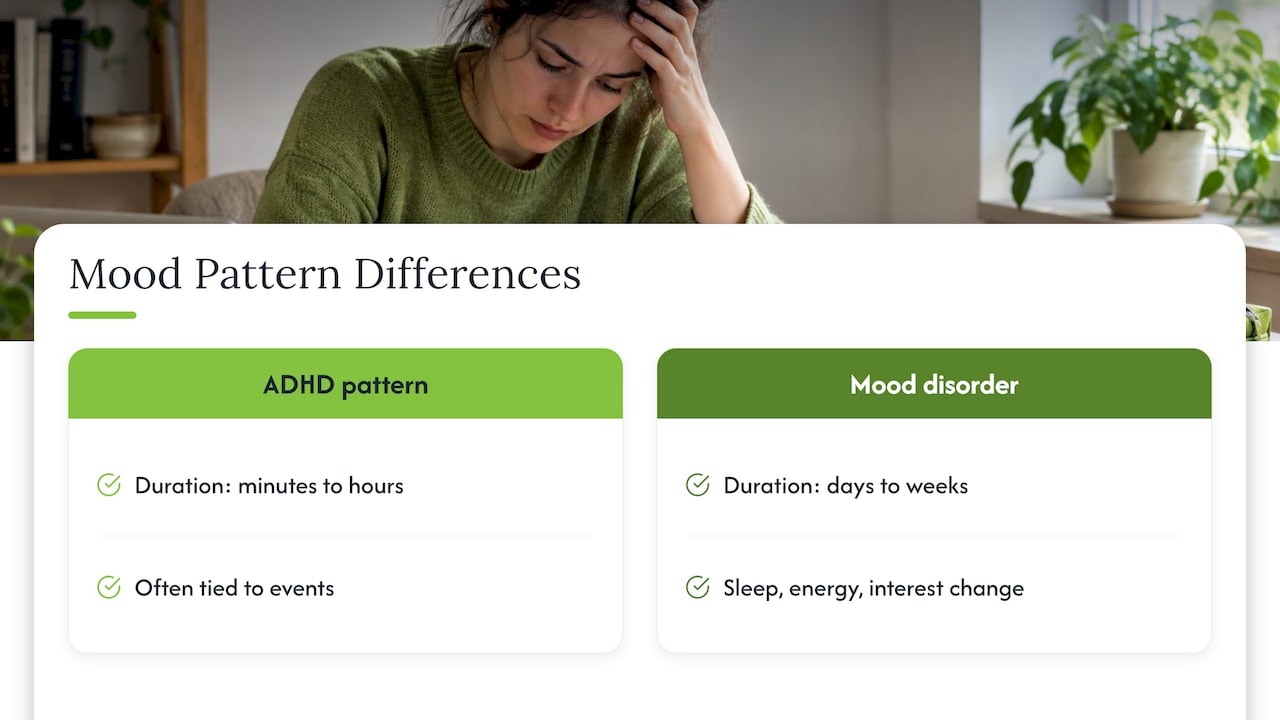
Anxiety, depression, bipolar-spectrum conditions and trauma can all produce irritability and mood shifts. They also commonly appear alongside ADHD. This is the reason we take time sorting the timeline: when did the swings begin, how long do they last, and do they have triggers? Adults with ADHD often have a pattern of minutes to hours, tied to events. A mood disorder usually looks more like days to weeks with changes in sleep, energy and interest.
If you want to prepare, our guide on what to bring for an anxiety versus ADHD evaluation is a practical start. Our piece on recognizing mental health symptoms in adults can help you describe what you are noticing, and anxiety and ADHD management steps covers the overlap in more depth.
If you ever have thoughts of harming yourself or someone else, call or text 988, the Suicide and Crisis Lifeline, or call 911. Do not wait for an appointment.
What helps: a realistic picture
The honest summary is that the evidence on managing emotional dysregulation specifically is still limited. The 2022 management review says so directly. What we can say is that several approaches are used and that they work best together.
Treat the core ADHD first
The VA guide states that medication is first-line for adult ADHD core symptoms that cause impairment, with stimulants (amphetamines or methylphenidate) and atomoxetine as the options. The 2022 review discusses those same medications in the context of emotional symptoms. A 2025 observational study of 56 adults saw some reductions in self-reported emotional dysregulation in several treatment groups, though its authors call the findings preliminary and do not draw causal conclusions.
In practice, we start with careful evaluation, choose a medication plan together, and then check in on how the emotional side is responding, not just focus and productivity. Adjustments are normal. Our pages on ADHD treatment options for adults and medication versus therapy lay out how these pieces fit.
Build skills for the moments that matter
The 2022 review names cognitive behavioral treatment and techniques for anger, frustration and communication as non-medication approaches. The 2020 meta-analysis authors argue that emotion-regulation strategies should be added to standard ADHD treatment, especially for lability and strong negative reactions.
A 2023 systematic review of 22 studies found adults with ADHD more often relied on less adaptive strategies, with more suppression and less reappraisal. It also described one study where suppression, but not acceptance, slowed the return to emotional baseline. Its authors stress that the evidence base is scarce and mixed. Still, the practical lesson is consistent with what we see: pushing a feeling down tends to keep it around longer.
Some habits worth trying:
- Name it early. “I am getting irritated” said to yourself buys a few seconds, and a few seconds is often all you need.
- Leave the room on purpose. A planned break is different from storming out. Tell the other person you will be back in twenty minutes, and then come back.
- Delay big decisions and long texts. Wait until the feeling drops before sending the email.
- Repair quickly. A short, specific apology tends to do more than a long explanation.
- Notice your triggers. Hunger, rushing, noise and criticism are common ones.
For more tactics, see our practical coping strategies for adults with ADHD and coping strategies for mood disorders.
One more thing about the online “1/3/5 rule” and similar shortcuts. They are fine as personal organizing tools, but we are not aware of research showing they change emotional regulation, so treat them as a planning habit rather than treatment.
Protect sleep and lower baseline stress
The VA guide advises addressing sleep, perceived stress and unhelpful coping alongside core ADHD symptoms. We agree, and we see how quickly a poor night turns a manageable day into a short-fuse day. Our guide to fixes for insomnia in adults with ADHD is a good place to begin. Breathing and airway problems can also affect sleep, and some people look into screening for sleep apnea when sleep stays poor despite good habits.
If you are a woman and your emotions swing with your cycle, that pattern is worth tracking too. We cover it in ADHD care for women.
What a first visit looks like
We do not expect you to arrive with a tidy story. Most people do not. A useful first conversation usually covers:
- What you notice and when it started, including childhood.
- How the emotions affect work, home and relationships.
- Sleep, caffeine, alcohol and other substances.
- Anxiety, depression, trauma or mood history, including in your family.
- Everything you currently take, including supplements.
- What you most want to change first.
It can help to ask a partner or close friend what they see. Others often describe the pattern more accurately than we can describe it ourselves. For parents of teens or young adults, the approach is similar, and our guide to medication management for teens explains how we think about it.
How we approach this at Nortex Psychiatry
Nortex Psychiatry is an outpatient practice in Allen, Texas, serving adults and families across North Dallas, including Frisco, McKinney and Plano. We offer psychiatric evaluations and medication management for ADHD, anxiety, depression and mood disorders, with in-person and telehealth visits, which helps if your schedule is already stretched. If emotional swings are the main reason you are reading this, you can book an evaluation through our home page and tell us that up front. Our page on the role of psychiatrists in ADHD care explains what to expect from us over time.
Our perspective
We have learned that most adults with ADHD have spent years explaining their emotions away. They call themselves dramatic, moody, too sensitive. When we ask the right questions, the picture usually gets clearer: a brain that reacts fast and brakes slowly, and a person who has worked very hard to cover for it.
In our work, the best results come when we take the emotional side as seriously as focus. We look at the full story, treat what the evidence supports, and check back often. Some people notice change fairly soon, others need adjustments, and recovery is a journey, not a straight line.
We also keep an open mind about what else may be going on. Anxiety, depression and trauma are common companions, and our practice is set up to evaluate and treat them. If you are not sure where your symptoms belong, that is a good reason to come in, not a reason to wait.
Felix
FAQ
Is emotional dysregulation a symptom of ADHD?
It is a common associated feature, but it is not a required symptom in the DSM criteria. Studies estimate it affects a large share of adults with ADHD, with ranges of roughly 30 to 70 percent. A thorough evaluation should ask about it directly.
Why do I have such intense mood swings with ADHD?
Research points to several interacting factors: differences in how emotional cues are noticed and evaluated, weaker top-down control, and emotional activation systems. Sleep, stress and other conditions such as anxiety can add to it. Tracking when the swings happen helps us find the pattern.
Can ADHD medication help with anger and irritability?
Medication is the first-line treatment for core adult ADHD symptoms, and we watch how emotional symptoms respond as the plan develops. Skills work for anger, frustration and communication is often added. Your psychiatrist can tailor the combination to your health history.
How is ADHD dysregulation different from bipolar disorder?
ADHD-related swings tend to be short, minutes to hours, and tied to events. Bipolar disorder usually involves days to weeks of changed mood, sleep and energy. Because the two can look alike and can occur together, an in-person or telehealth evaluation is the right way to tell them apart.
Can I be evaluated by telehealth in Texas?
Yes, we offer telehealth psychiatry as well as in-person visits at our Allen practice. Either way, you can discuss ADHD, mood swings and treatment options with a psychiatrist.
Sources
- Identification and Management of Attention-Deficit/Hyperactivity Disorder, VA clinician guide
- Emotional dysregulation and Attention-Deficit/Hyperactivity Disorder, 2014
- Attention-Deficit/Hyperactivity Disorder (ADHD) and Emotion Regulation, 2019
- Emotion dysregulation in adults with attention deficit hyperactivity disorder, meta-analysis, 2020
- Management of Emotional Dysregulation in Adult ADHD, 2022
- Evidence of emotion dysregulation as a core symptom of adult ADHD, 2023
- Mood Stabilizers for Treating Emotional Dysregulation in Adults with ADHD, 2025