


Depression in men frequently does not look like sadness. It looks like irritability, a short fuse, exhaustion, poor sleep, aches that never get a clear explanation, or drinking a little more than before. If that sounds familiar, and it has gone on most days for two weeks or longer, it is worth an evaluation. In our work as psychiatrists, we meet many men who have carried these symptoms for months or years before anyone named them.
This guide covers the signs we see most often, how they differ from ordinary stress, what the diagnosis requires, and what to do next. If you are in North Dallas, including Allen, Frisco, McKinney and Plano, you will also find what an evaluation with us looks like.
TL;DR
- Men often show depression as anger, irritability, fatigue, restlessness, sleep changes, physical pain or increased alcohol or drug use, not only as sadness (NIMH).
- A diagnosis generally needs symptoms most of the day, nearly every day, for at least two weeks, with low mood or loss of interest among them (NIMH).
- Thoughts of death or suicide are never something to wait out. Call or text 988, or go to the nearest emergency room.
- Depression is treatable. Medication, talk therapy, or both are the usual starting point, and more options exist if those do not help enough.
Table of Contents
- Why depression in men is so easy to miss
- The signs, grouped the way men describe them
- A quick example of how this looks
- How long is too long? What a diagnosis requires
- Warning signs of suicide in men
- When to get help, and where to start
- What treatment looks like
- Care for men in North Dallas
- FAQ
- Sources
Why depression in men is so easy to miss
Most of us picture depression as someone crying, withdrawn and saying they feel worthless. Some men do look like that. Many do not. The National Institute of Mental Health (NIMH) notes that men may seem angry or irritable rather than sad, and that they are more likely to turn to alcohol or drugs to cope.
The American Psychological Association describes a similar pattern: researchers and clinicians increasingly think the classic signs of sadness, worthlessness and guilt may not capture many men’s experience. Fatigue, irritability, anger, loss of interest in work or hobbies and disturbed sleep may come first.
We have learned to listen for what a man does not say. A patient might begin with “I’m just tired” or “work has been rough” or “my wife thinks I’m angry all the time.” Often that is the whole story of the depression, told in his own words.
Harvard Health describes this as depression that gets masked, sometimes behind anger, bodily aches and pains, heavier drinking, or reckless and escapist behavior such as gambling. The mask matters because friends, family and even the man himself tend to treat the mask as the problem.
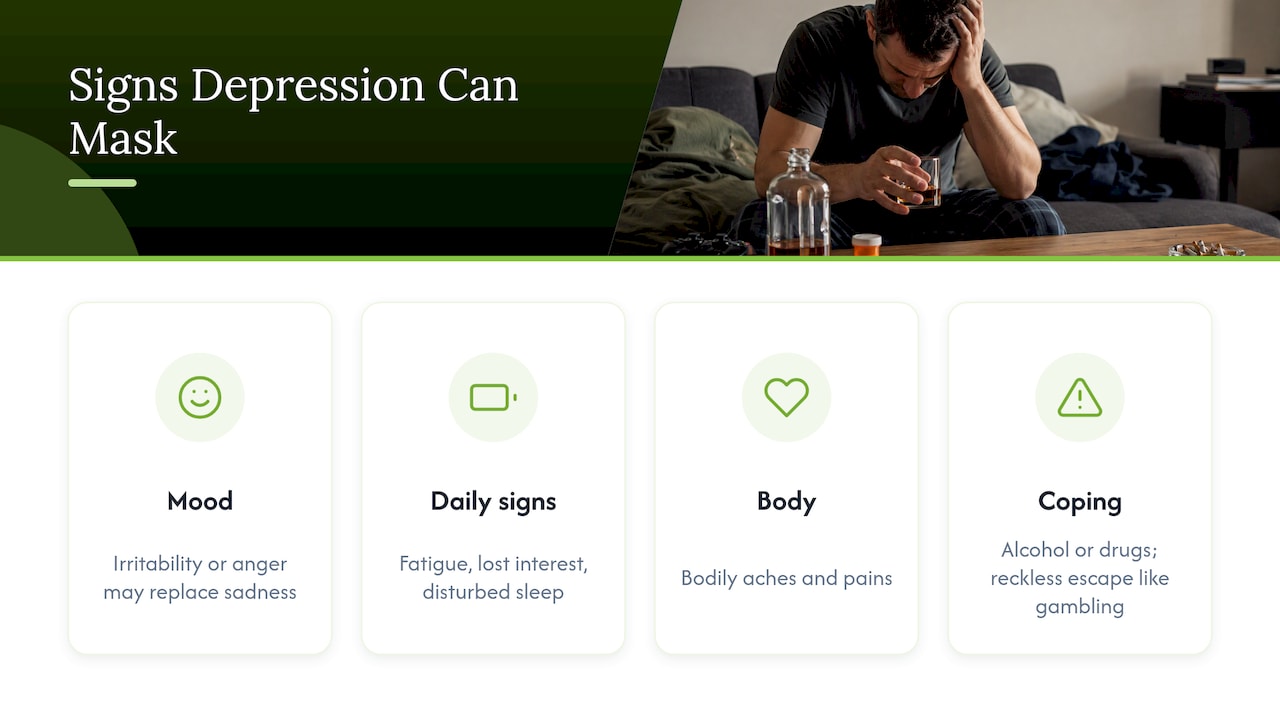
The signs, grouped the way men describe them
The lists published by NIMH and the New York State Office of Mental Health overlap heavily. We group them by how they tend to show up.
Mood and emotional signs
- Anger, irritability or aggressiveness, often out of proportion to what set it off
- Persistent sadness, emptiness or hopelessness, or feeling flat, as if nothing registers
- Feeling anxious, worried, or “on the edge”
- Loss of interest in work, family or hobbies you used to enjoy
- Thoughts of death or suicide
These all appear in the NIMH list for men and in the New York State Office of Mental Health booklet.
Behavior you can see from outside
- Pulling away from friends and family, or isolating
- Using alcohol or drugs more, or needing them to relax or sleep
- Taking risks: reckless driving, gambling, or other high-risk activities
- Difficulty meeting responsibilities at work or home
- Working constantly to avoid being alone with your thoughts
The last item is ours, not from a published list. It is a pattern we notice often, and it can look like ambition from the outside.
Physical and cognitive signs
- Fatigue, low energy, or feeling run down
- Trouble sleeping, or sleeping far more than usual
- Appetite changes: overeating or loss of appetite
- Aches, headaches, cramps or digestive problems with no clear cause
- Trouble concentrating or making decisions, plus restlessness
- Problems with sexual desire or performance
Physical symptoms deserve special attention. NIMH points out that many men are more likely to see a provider about racing heart, chest tightness, chronic headaches or digestive issues than about emotional symptoms. A man may have a normal workup and still feel terrible. When that happens, depression belongs on the list of questions.
A quick example of how this looks
Here is a composite of what we commonly hear, not one specific patient. A 42-year-old project manager in Plano says he has no reason to be down. Work is fine on paper. But he snaps at his kids, lies awake at 3 a.m., has a couple of drinks every night to switch off, and stopped playing golf with friends months ago. He thinks he is burned out. After a careful history, we often find the pattern fits depression, sometimes with anxiety alongside it.
Nothing in that story is dramatic, and that is exactly why it goes unnoticed.
How long is too long? What a diagnosis requires
Everyone has bad stretches. The difference with depression is persistence and impact. According to NIMH, symptoms must be present most of the day, nearly every day, for at least two weeks, and one of them has to be depressed mood or loss of interest or pleasure. The New York State Office of Mental Health gives the same two-week threshold and notes that symptoms can interfere with work, sleep, study, eating and enjoying life.
The American Medical Association, quoting a physician, explains that major depressive disorder involves at least five symptoms lasting two weeks or longer that significantly affect daily life, such as work, social life or relationships. It also says diagnosis happens through a conversation with a licensed health care professional.
So here is a simple way to think about it:
- Duration. Has this been most days for two weeks or more?
- Change. Is this different from how you normally are?
- Impact. Is it affecting your work, relationships, sleep or health?
Three yeses are a good reason to book an appointment. You do not have to be sure it is depression. That is our job to sort out.
Warning signs of suicide in men
This part is difficult, and we would rather say it plainly. Depression in men carries a real risk of suicide, and the signs are not always spoken aloud. The Illinois Department of Public Health lists warning signs that include talking about death or suicide, seeking access to firearms, pills or other lethal means, hopelessness, rage, feeling trapped or in unbearable pain, reckless behavior, increasing alcohol or drug use, withdrawal, and dramatic mood changes.
If you or someone you love shows these signs:
- Call or text 988, the Suicide and Crisis Lifeline, any time. The Illinois page also lists text 838255 as an option.
- Do not leave the person alone. Get them to a doctor or the nearest hospital emergency room.
- Remove access to firearms or other possible tools for suicide, including medications, as the New York State Office of Mental Health advises.
If there is immediate danger, call 911. A crisis is not the time to wait for a routine appointment.
When to get help, and where to start
NIMH says men are less likely than women to have received mental health treatment in the past year, and that a primary care provider is a reasonable first stop who can refer you on to a psychologist, psychiatrist or clinical social worker. The New York State Office of Mental Health adds that friends and family are often the first to notice, and that men who do not see their depression may still agree to go in for being tired or run down.
That is a fine way in. If it takes a physical complaint to get you through the door, we do not mind at all.
You can also go straight to a psychiatrist. A psychiatrist is a medical doctor who diagnoses and treats mental health conditions, including with medication. For men dealing with depression, anxiety, ADHD or mood symptoms that overlap, that can save time.
What an evaluation usually involves
Expect a conversation, not a quiz. NIMH says a provider may ask when symptoms began, how long they have lasted, how often they occur and whether they interfere with usual activities, and may use an exam, interview and lab tests to rule out other causes. The AMA notes that depression can be mistaken for things like thyroid problems, and that screening questionnaires help but a full diagnosis always requires a clinical interview.
The most useful thing you can bring is honesty. The New York State Office of Mental Health specifically asks men to be open about self-medicating with alcohol, non-prescribed drugs, gambling or risky activities, and about family history of depression or other mental disorders. We are not there to judge any of it. It simply changes what we recommend, and how safely.
First appointments are often longer than a typical doctor visit, and a clear answer may take more than one session. That is normal.
What treatment looks like
NIMH describes treatment as typically involving psychotherapy, medication, or both. For milder depression, therapy is often tried first. Moderate or severe depression usually includes medication in the initial plan. Brain stimulation is another option when those do not reduce symptoms enough.
Harvard Health adds something we repeat to patients often: once you feel better, it is important to continue medication as advised to help prevent relapse. Feeling better is a sign the treatment is working, not a signal to stop on your own.
Talk therapy is a strong partner to medication for many men. Some find it easier to start with practical, skills-based counseling, and we are glad to coordinate with a therapist you trust. For example, depression counseling in Tyler, TX is one place men in East Texas can look for in-person or statewide telehealth sessions. If you want to weigh the two approaches, our guide on therapy versus medication for adults walks through the question, and our overview of how psychiatry treats depression explains the usual sequence. For more on pairing the two, see combination therapy for depression.

If the first treatments have not been enough
Some men try one or two medications and still feel stuck. That does not mean nothing will work. It means the plan needs another step. Our page on treatment-resistant depression covers the options. At our practice these include FDA-approved Transcranial Magnetic Stimulation (TMS), Spravato (esketamine) and ketamine therapy.
Care for men in North Dallas
Nortex Psychiatry is a psychiatric practice based in Allen, Texas, serving adults and families across North Dallas, including Frisco, McKinney and Plano. We offer medication management and psychiatric evaluation for depression, anxiety, ADHD and mood disorders, with both in-person and telehealth visits, which helps if you are a busy professional who needs care to fit around a workday.
If standard treatment has not been enough, we also offer TMS therapy, Spravato and ketamine therapy. To book an evaluation, start from our home page.
What we have learned from sitting across from men with depression
Most men do not come in saying they are depressed. They come in saying they cannot sleep, or that they are short with their families, or that a physician told them their labs look fine and they should try to relax. We have learned to take those first sentences seriously.
In our work, the hardest part is rarely the treatment. It is the first appointment. Many men have spent a long time believing they should handle this alone, and some are quietly ashamed that they cannot. We try to make that visit plain and unhurried. We ask what has changed, what a normal day looks like now, and what they have been doing to get through it.
We often notice that relief begins with a name for the problem. After that, the plan is practical: medication management, therapy where it helps, and closer follow-up. For men who have not improved with the usual options, we offer interventional treatments such as TMS, Spravato and ketamine, because we believe nobody should be told there is nothing left to try. Recovery is a journey, not a straight line, and we expect to adjust the plan as we go.
Felix
FAQ
What are the most common symptoms of depression in men?
Anger, irritability, fatigue, trouble sleeping, loss of interest in work or hobbies, and physical aches or digestive problems with no clear cause are all common. Increased alcohol or drug use and risk-taking also show up often. Sadness may or may not be present.
Can depression in men look like anger?
Yes. NIMH notes that men may seem angry or irritable instead of sad. If the anger is new, out of proportion and has lasted for weeks, tell a health professional about it, not only about mood.
How do I know if it is depression or just stress?
Stress usually eases when the pressure does. Depression tends to persist most of the day, nearly every day, for at least two weeks, and it affects work, sleep and relationships. A professional evaluation is the way to tell the two apart, since conditions like thyroid problems can look similar.
Should I see my family doctor or a psychiatrist?
Either is a reasonable start. A primary care provider can check for physical causes and refer you, and a psychiatrist can diagnose and treat depression directly, including with medication. If you live in Allen, Frisco, McKinney or Plano, you can book with us in person or by telehealth.
What should I do if I am having thoughts of suicide?
Call or text 988 right away, or go to the nearest emergency room. If you are with someone who is at risk, stay with them and remove access to firearms and medications. Call 911 if there is immediate danger.
Sources
- Men and Mental Health, National Institute of Mental Health
- Depression, National Institute of Mental Health
- Men and Depression, New York State Office of Mental Health
- Men: A Different Depression, American Psychological Association
- Men: Don’t ignore signs of depression, Harvard Health
- What doctors want patients to know about depression, American Medical Association
- Suicide Prevention, Illinois Department of Public Health