


ADHD and depression travel together more often than most people expect. Adults with ADHD are several times more likely to have depression than adults without it, and the two can look so alike that one hides the other. The good news is that when both are named correctly, they can be treated together, usually in a sensible order.
We see this combination in our Allen, Texas office every week. Someone comes in believing they are “just depressed” or “just unfocused,” and the full picture turns out to be more layered. This article walks through what we have learned about how the two conditions connect, how we separate them, and what treatment tends to look like.
TL;DR
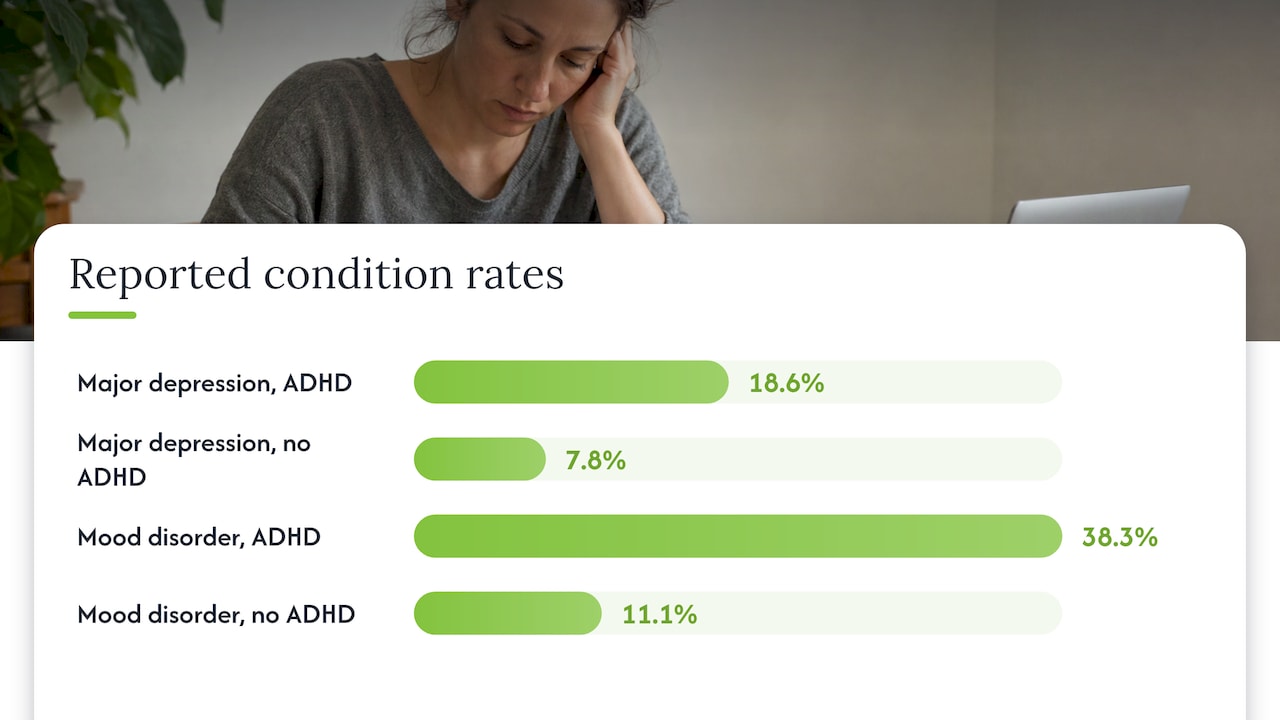
- In a large U.S. survey summarized by CHADD, 18.6% of adults with ADHD had major depression, compared with 7.8% of adults without ADHD.
- The symptoms overlap (poor concentration, restlessness, fatigue, sleep trouble), so a careful history matters more than any single checklist.
- Age of onset is one of the best clues: ADHD symptoms start in childhood, while depression usually arrives in episodes later.
- Treatment is usually sequenced. When depression is moderate to severe, it generally comes first, then we reassess the ADHD.
- If you have had several symptoms most of the day for two weeks or more, or you are having thoughts of suicide, reach out for help now.
Table of Contents
- Why ADHD and depression show up together
- How common is the overlap?
- What depression feels like when you also have ADHD
- How we tell ADHD, depression, or both
- Treating both conditions together
- When depression does not respond to the first treatments
- Signs it is time to get help
- What you can do before your first appointment
- Care for ADHD and depression in North Dallas
- FAQ
- Sources
Why ADHD and depression show up together
There is no single reason, and we are cautious about anyone who offers one. What the research does tell us is fairly consistent.
A 2023 study in Biological Psychiatry compared full siblings and twins in large Swedish registers. It found that people with ADHD had a clearly higher risk of later developing major depression, even after accounting for shared family and genetic factors. In plain terms, this is not only a matter of two conditions that happen to run in the same families.
A 2026 study of 894 adults with ADHD in Translational Psychiatry added a nuance. Genetic risk for depression, rather than genetic risk for ADHD, was associated with having comorbid depression. So the answer may be a mix of inherited vulnerability to mood problems and what living with ADHD does to a person over time.
That second part is the one we hear about most in the room. Years of missed deadlines, forgotten appointments, strained relationships and a quiet sense of “why can’t I just do this” wear on self-esteem. Sharon Saline, Psy.D., describes how long-standing frustrations at school, work and in relationships can erode confidence and contribute to depression. We have watched that happen to capable, thoughtful people who assumed the problem was their character.
How common is the overlap?
Numbers vary by study, and it is worth knowing why. Here is what the better sources report.
| Finding | Figure | Source |
|---|---|---|
| Adults with ADHD who had major depression | 18.6% (vs. 7.8% without ADHD) | CHADD summary of the National Comorbidity Survey Replication |
| Adults with ADHD who had any mood disorder | 38.3% (vs. 11.1% without ADHD) | CHADD summary of the same survey |
| Range of depression among people with ADHD | 18.6% to 53.3% | 2025 review in PMC |
| Adults with ADHD who have another mental health condition | About 70% | 2025 review in PMC |
The wide range, from about 19% to over 50%, mostly reflects who was studied and how depression was defined. We would not read any single figure as your personal odds. What the pattern does tell you is that if you have ADHD and feel low, you are far from unusual, and it deserves attention rather than a shrug.
It also runs the other way. Dr. William Dodson notes that having either condition makes the other about three times more likely.
What depression feels like when you also have ADHD
People rarely describe it the way a textbook does. More often we hear things like: “I can’t get started on anything and I don’t care that I can’t.” Or: “I used to be able to pull things together at the last minute, and now I can’t.”
The trouble is that many everyday symptoms belong to both conditions. A 2025 review points out that adults with depression can show inattention, restlessness and agitation that look like ADHD, but they also have reduced interest, loss of pleasure and fatigue.
Here is how we think about the overlap:
- Shared by both: trouble concentrating, irritability, restlessness, low energy, sleep disruption, changes in appetite.
- More typical of depression: persistent guilt or worthlessness, hopelessness, thoughts of death, a flat loss of enjoyment in things you used to like, slowed movement and speech. Psychiatric Times describes these as the features that best separate depression from ADHD in young patients, and we find them useful in adults too.
- More typical of ADHD: lifelong patterns of distraction, disorganization and impulsivity that were there before any low mood.
Sleep deserves its own mention. The National Institute of Mental Health says sleep problems are especially common in ADHD, affecting up to 70% of adults with it. Poor sleep makes attention worse and mood worse, so it can quietly drive both. If your sleep is heavy, unrefreshing or interrupted by snoring, screening for sleep apnea is worth raising with your doctor before anyone changes a medication plan.
If you want a broader look at what to watch for, our guide on recognizing mental health symptoms in adults goes through the common signs.
How we tell ADHD, depression, or both
This is the part of the work that cannot be rushed. David Goodman, writing in CNS Spectrums, calls the distinction between the two a critical part of the evaluation that often confuses even the treating clinician. We agree. We have learned to lean on a handful of questions.
Age of onset
For an ADHD diagnosis in adulthood, the NIMH says symptoms must have been present before age 12. Depression more often begins in the teens or later. So we ask about grade school: report cards, teacher comments, what your parents remember. Psychiatric Times makes the same point, that the key to diagnosing ADHD in someone with depression is a careful look at childhood history.
Pattern over time
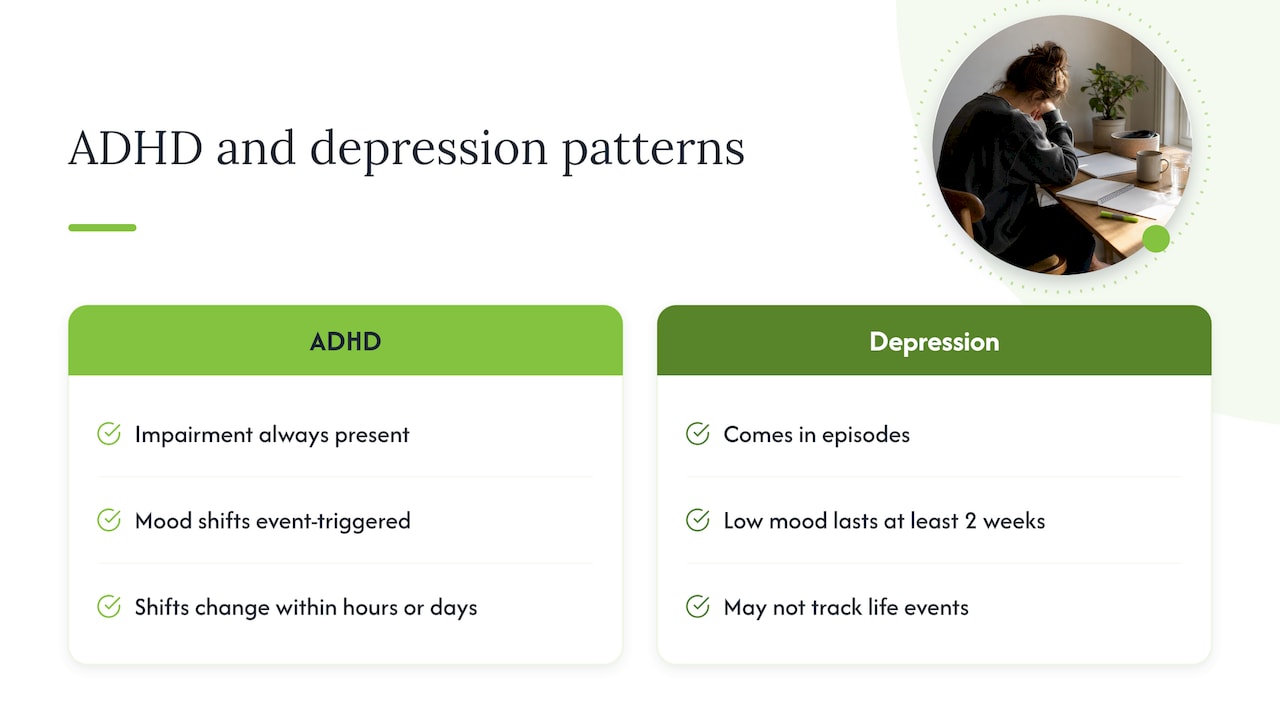
Dr. Dodson lays out a useful contrast. ADHD impairment is always present, while depression comes in episodes. In ADHD, mood shifts tend to be triggered by events and change within hours or days. In depression, the low mood usually has to last at least two weeks and may not track what is happening in your life.
Family history and other conditions
We ask who in your family has had ADHD, depression, bipolar disorder or substance problems. This matters for a safety reason too. The CANMAT guidelines advise that in people with mood disorders, ADHD is best diagnosed when typical symptoms persist during stable mood, and that people with bipolar disorder may need a mood stabilizer before ADHD treatment starts. Missing bipolar disorder is one of the errors we work hardest to avoid.
A full evaluation takes time, and it goes better with records in hand. Our pages on the adult ADHD diagnosis process in North Dallas and the ADHD evaluation timeline explain what to bring. If anxiety is also in the mix, this guide to anxiety versus ADHD evaluations may help.
Treating both conditions together
There is no one script. We start by asking which condition is doing the most harm right now.
A 2025 review summarizes current guidance this way: treat the most severe, impairing and unstable condition first. For ADHD with a mood disorder, that usually means stabilizing mood and then reassessing what ADHD symptoms remain.
The CANMAT recommendations spell it out. With moderate to severe depression, depression is the priority, while in mild depression or stable mood the order may be reversed. Their first-line options include bupropion, an antidepressant paired with a long-acting stimulant, or an antidepressant paired with cognitive behavioral therapy. A 2009 consensus algorithm agrees that when ADHD is the main problem and depression is mild, a long-acting stimulant is the first-line choice.
Can ADHD medication help with depression?
Sometimes, indirectly. It is not an antidepressant, though, and we try to be honest about that.
The evidence is mixed and depends on age. A 2022 meta-analysis of randomized trials in children and teens found no significant effect of ADHD medication on depression symptoms. In adults, a 2025 review notes that SSRIs do not effectively treat ADHD symptoms, but atomoxetine has shown benefit for both ADHD and comorbid anxiety or depression, and that treating ADHD well can ease the related conditions. A 2021 database analysis from Japan found that in people with both, depressive symptoms were managed after add-on ADHD medication without higher antidepressant doses.
In our experience, when someone’s focus improves, daily life gets less punishing, and mood often lifts a little with it. That is a hope, not a promise, and we check in on it.
Medication safety when you take both kinds
Combining antidepressants and ADHD medications is common. The 2009 consensus paper says interactions are infrequent, with no absolute contraindications except giving stimulants or atomoxetine alongside monoamine oxidase inhibitors. That is exactly why you should tell your prescriber about everything you take, including supplements.
We also watch closely after any change. Psychiatric Times advises monitoring for unexpected adverse effects, worsening mood, suicidality and emerging manic or psychotic symptoms, since a bipolar picture may be emerging. If you notice your mood dropping, racing thoughts, or very little need for sleep after starting something new, call your prescriber that day rather than waiting for the next visit.
Therapy matters too
Saline notes that cognitive behavioral therapy along with medication has been found most successful for combined ADHD and depression. Skills for planning, routines and handling the inner critic fit both conditions. Our articles on medication versus therapy for adult ADHD and ADHD treatment options go deeper.
When depression does not respond to the first treatments
Some people with both conditions try a couple of antidepressants and still feel stuck. That is not a personal failing, and it does not mean nothing will help. It is a point where we step back and look at the full picture again: Is the ADHD still untreated? Is sleep a problem? Is there a bipolar pattern we missed?
If depression remains stubborn after adequate trials, there are other options in interventional psychiatry. At Nortex Psychiatry we offer Transcranial Magnetic Stimulation, Spravato (esketamine) and ketamine therapy. Whether any of these suits you depends on your history, and we decide that together after an evaluation, not before.
Our perspective
In our work, the most common mistake is treating the loudest symptom and missing the one underneath. A person arrives low and exhausted, gets an antidepressant, and feels only partly better, because the attention problems they have carried since fourth grade were never named. We have also seen the reverse, someone given a stimulant for “ADHD” when a depressive episode was driving the poor concentration.
What we have learned is to slow down at the start. We take a real history, we ask about childhood, and we ask what has changed and when. Then we pick one thing to treat first and tell you why. We do not think there is anything weak about needing both kinds of help.
We also think people deserve to hear that there are several paths. Medication management and therapy are the foundation for most of the people we see. When depression has not budged, our interventional options, TMS, Spravato and ketamine, give us more to work with, and we describe them plainly, including what we do not yet know about how a given person will respond. Recovery is a journey, not a straight line, and we plan for the detours.
Felix
Signs it is time to get help
Saline’s guidance is simple: if you or someone close to you has several symptoms persistently, most of the day for at least two weeks, seek professional help, starting with your primary care provider. A psychiatrist can take it from there.
Some things should not wait:
- Thoughts of ending your life or of not wanting to be here. Call or text 988, the Suicide and Crisis Lifeline, or go to the nearest emergency room.
- Mood that swings sharply with little sleep, racing thoughts, or reckless behavior, which can point to bipolar disorder.
- A big drop in your ability to work, parent or take care of yourself.
Parents of teens should know this applies to younger people as well. Our page on diagnosing teen ADHD in one or two visits explains what a first appointment looks like.
What you can do before your first appointment
Small preparation makes the visit more useful.
- Write down when your attention problems first showed up, even roughly.
- Note how long the low mood has lasted and whether it comes and goes.
- Gather old report cards or comments from relatives if you can.
- List every medication and supplement, including caffeine and sleep aids.
- Track your sleep for a week or two.
- Jot down family history of mood problems, ADHD, or substance use.
None of this has to be perfect. We would rather see you with partial notes than put off the visit.
Care for ADHD and depression in North Dallas
Nortex Psychiatry is based in Allen and serves adults and families across Frisco, McKinney, Plano and nearby communities, with in-person and telehealth visits. We evaluate for ADHD, depression and mood disorders, manage medication, and offer TMS, Spravato, ketamine therapy and stellate ganglion block when they fit. If you are not sure which problem you are dealing with, that is a fine reason to book. You can start from our home page and see how to reach us.
FAQ
Can you have ADHD and depression at the same time?
Yes, and it is common. A large U.S. survey found that 18.6% of adults with ADHD had major depression versus 7.8% of adults without ADHD. Because the symptoms overlap, it often takes a careful evaluation to see both.
Does ADHD cause depression?
Not directly in every case, but ADHD raises the risk. A large Swedish study found higher later risk of depression even after accounting for family and genetic factors. Chronic stress from untreated ADHD likely plays a part too.
Can ADHD medication help depression?
It may help indirectly when untreated ADHD is feeding low mood, but it is not a depression treatment on its own. Trials in children and teens showed no significant effect on depression. Your prescriber decides the plan based on which condition is more severe.
Which gets treated first, ADHD or depression?
Usually whichever is more severe and disabling. With moderate to severe depression, guidelines generally put depression first, then reassess ADHD. With mild depression, ADHD may come first.
Sources
- ADHD and Co-occurring Conditions, CHADD
- ADHD in Adults: 4 Things to Know, NIMH
- Attention-Deficit/Hyperactivity Disorder and Major Depressive Disorder, Biological Psychiatry 2023
- Adult ADHD with comorbid major depression, Translational Psychiatry 2026
- The Overlap Between ADHD and Depression, Psychology Today
- Treating Depression and ADHD: Related Conditions, Additude
- Adult ADHD and comorbid anxiety and depressive disorders, PMC 2025
- Comorbid ADHD and Depression: Assessment and Treatment Strategies, Psychiatric Times
- Adult ADHD and Comorbid Depressive Disorders, CNS Spectrums
- CANMAT task force recommendations, mood disorders and ADHD
- Adult ADHD and comorbid depression: a consensus-derived algorithm, PMC
- Meta-analytic review of ADHD medications and anxiety or depression, PMC 2022
- Change in antidepressant use after initiation of ADHD medication, PMC 2021
- 988 Suicide & Crisis Lifeline, SAMHSA