


Lamotrigine (brand name Lamictal) is one of the medicines we reach for most often when bipolar disorder shows up mainly as depression. The strongest evidence says it is best at preventing depressive episodes from coming back. Its evidence for treating an active depressive episode is more mixed, and for bipolar II it is thinner than most people expect. It also has to be started very slowly, because the main risk is a serious rash.
If you or someone in your family was just handed this prescription, this article walks through what we tell patients in our own practice, and what the published research supports.
TL;DR
- Lamotrigine’s best-supported job is preventing depressive relapse in bipolar disorder. It is less reliable as a quick fix for a depressive episode already underway.
- The FDA-labeled use is maintenance treatment of bipolar I disorder. Evidence in bipolar II is limited, and that is a conversation to have with your prescriber, not a reason to stop.
- The dose climbs over about seven weeks on purpose. Skipping ahead raises the risk of a serious rash.
- Any new rash, fever, or swollen glands means calling your prescriber the same day. Don’t wait to see if it fades.
- Other medicines, especially valproate and estrogen-containing birth control, change lamotrigine levels. Tell every prescriber what you take.
Table of Contents
- What lamotrigine is actually for in bipolar disorder
- Does it treat an active depressive episode?
- Preventing the next depressive episode
- Bipolar II: where the evidence gets thin
- Why the dose goes up so slowly
- How long until you notice a difference
- Side effects, and the rash you should never wait out
- Interactions and stopping safely
- Our perspective
- When lamotrigine isn’t enough on its own
- Questions worth bringing to your appointment
- Care in North Dallas
- FAQ
- Sources
What lamotrigine is actually for in bipolar disorder
Lamotrigine began as an anti-seizure medicine. Psychiatrists use it for bipolar disorder because of how it behaves over time. One useful way to think about it, described by Goldberg in the Journal of Clinical Psychiatry, is as the mirror image of lithium. Lithium prevents highs more meaningfully than lows. Lamotrigine prevents lows more effectively than highs. He describes this as stabilizing mood from below.
That matters for who benefits. We think of lamotrigine first for people whose illness is depression-dominant: long stretches of low mood, with hypomania or mania that is rarer or milder. It is not the medicine we choose when someone is manic and needs fast control. The FDA label says as much: treatment of acute manic or mixed episodes is not recommended, and its effectiveness in the acute treatment of mood episodes has not been established.
The approved indication is maintenance treatment of bipolar I disorder, to delay the time to the next mood episode in people already treated for an acute episode with standard therapy. Prescribing it for bipolar II or for an acute depressive episode is common, and it is guided by clinical judgment and guidelines, but you should know that is a step beyond the label.
Does it treat an active depressive episode?
Sometimes, modestly. The honest answer is that the research is not consistent, and we try to say so plainly to patients.
A 2025 meta-analysis by Arnone and colleagues pooled 24 randomized trials with 2,257 patients. Lamotrigine alone beat placebo in acute bipolar depression, but the effect was small (SMD 0.155). It was not superior to lithium in the acute phase.
When lamotrigine is added to another treatment, results look a bit better. A 2024 review and meta-analysis by Haenen and colleagues of 20 randomized trials and 20 cohort studies found that add-on lamotrigine during acute depressive episodes was linked to bigger drops in depressive symptoms than placebo (SMD -0.30).
Guidelines reflect the same split. The VA/DoD bipolar disorder guideline suggests lamotrigine combined with lithium or quetiapine for acute bipolar depression (a weak recommendation). It found insufficient evidence for or against lamotrigine alone in that setting.
In practice this means we rarely promise a quick lift from lamotrigine. We more often describe it as a foundation that, over months, makes the lows less frequent and less deep, sometimes alongside another medicine that works faster.
Preventing the next depressive episode
This is where lamotrigine earns its place. The same VA/DoD guideline gives a strong recommendation for lamotrigine to prevent recurrence of bipolar depressive episodes.
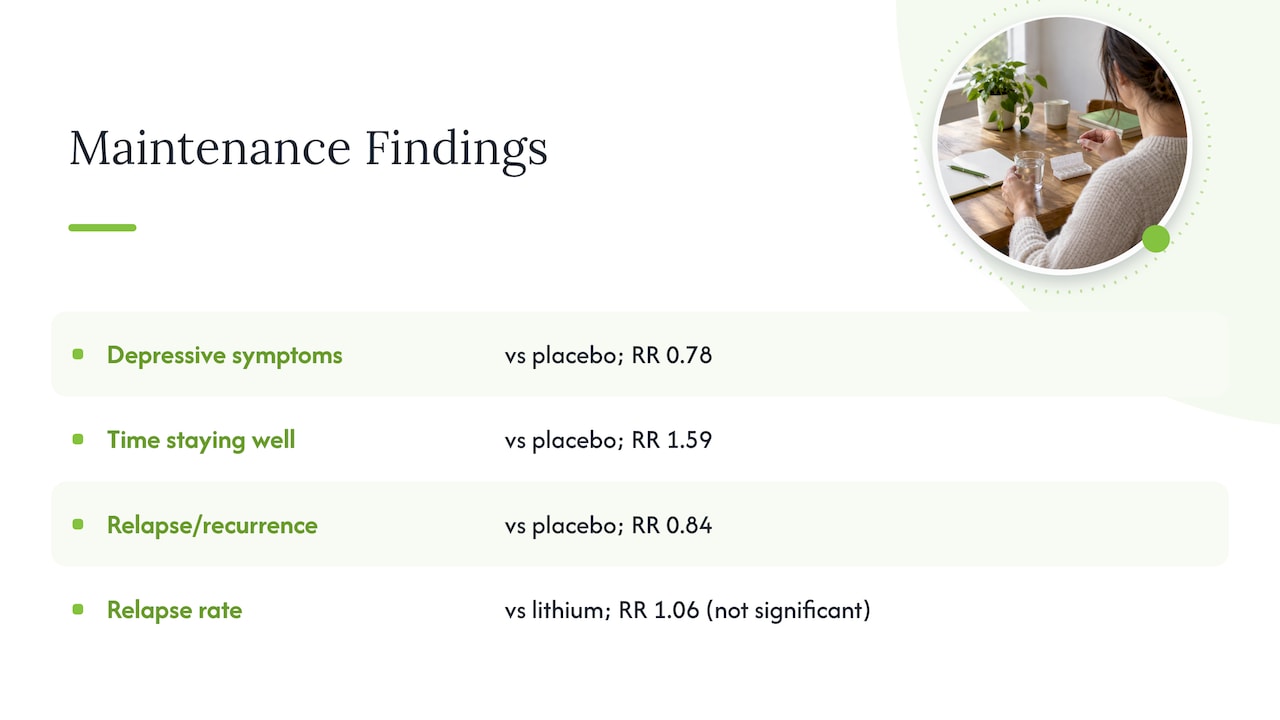
The numbers point the same way. In the Arnone analysis, lamotrigine reduced the emergence of depressive symptoms in prophylaxis compared with placebo (RR 0.78) and prolonged the time people stayed well (RR 1.59). Haenen’s group found a lower relapse or recurrence rate on maintenance lamotrigine than placebo (RR 0.84). Relapse rates did not differ significantly between lamotrigine and lithium (RR 1.06).
A 2021 systematic review by Besag and colleagues reached a similar conclusion: the strongest evidence is for preventing relapse, especially depressive relapse, in people who are already stable. They also noted that, on the balance of efficacy and tolerability, lamotrigine might be considered a first-line drug for bipolar disorder, except for acute mania or when rapid symptom control is needed.
The practical appeal is tolerability. Patients often tell us they like that it does not leave them foggy. The safety review by Bowden and colleagues is not something we cite here, so we will stay with what the label supports: its most common side effects are listed below, and weight gain is not on that list.
Bipolar II: where the evidence gets thin
Many people searching this topic have bipolar II, so we want to be careful here.
Goldberg reports that lamotrigine did not outperform placebo in the bipolar II registration trials. A later single-site outpatient trial of 150 people found potential value in melancholic but not non-melancholic bipolar II depression. Some practice guidelines still support lamotrigine in bipolar II, largely on expert opinion.
Swartz and Thase concluded in 2010 that lamotrigine alone lacks definitive efficacy in bipolar II depression because the one large trial devoted to it did not separate from placebo. They placed quetiapine first-line and lamotrigine, alone or added on, as a second-line option. A 2025 review by Fredskild and colleagues of 10 randomized trials in 645 people with bipolar II described the evidence for lamotrigine as scarce and the certainty as very low.
What does that mean for you? Not that lamotrigine is wrong for bipolar II. Many people with bipolar II do well on it, and clinical experience matters alongside trial data. It means the choice should be individual. We look at your history, how often depression returns, whether hypomania has ever been a problem, what else you take, and what you have already tried. If you want to understand how the two diagnoses differ, our page on bipolar I versus bipolar II signals goes through it, and our piece on the line between bipolar disorder and depression covers a mistake we see often: bipolar depression treated as plain depression.
Why the dose goes up so slowly
Lamotrigine is the medicine where patience is a safety measure. The FDA label states that the recommended starting dose and later increases should not be exceeded, to avoid raising the risk of rash.
For adults not taking valproate or enzyme-inducing drugs, the labeled schedule for bipolar disorder is:
| Weeks | Daily dose |
|---|---|
| 1 to 2 | 25 mg |
| 3 to 4 | 50 mg |
| 5 | 100 mg |
| 6 to 7 | 200 mg (target) |
The schedule changes with other medicines:
- Taking valproate: 25 mg every other day for weeks 1 to 2, 25 mg daily for weeks 3 to 4, 50 mg daily for week 5, then 100 mg daily for weeks 6 to 7. The target is 100 mg a day.
- Taking carbamazepine, phenytoin, phenobarbital, or primidone (without valproate): 50 mg daily for weeks 1 to 2, then 100 mg, 200 mg, 300 mg, and up to 400 mg daily across the following weeks, in divided doses.
These are the labeled schedules, not your prescription. Your prescriber sets yours. If a pharmacy hands you a starter pack, follow the pack and the written plan exactly.
Two things we see go wrong. First, someone feels nothing at 25 mg and wants to “catch up.” Please don’t. Second, someone misses a stretch of days and restarts at the old dose. NAMI advises that if you miss a dose, you take it when you remember unless the next dose is close, and never double up. If you miss more than three days, call your prescriber, because the dose may need to be adjusted.
How long until you notice a difference
Longer than most people hope. In a small 2017 pilot study of 12 patients with bipolar II depression, median time to remission was 6 weeks, with a range of 4 to 7.5 weeks. The authors suggested considering other options if there is no improvement after about six weeks. The same study found no link between blood levels and improvement in acute bipolar II depression, so pushing the dose higher just to treat an acute episode was not supported.
This is a very small study, so we use it as a rough guide only. What we do is plan a check-in every few weeks during the climb, which is similar to the rhythm described in our article on 2 to 4 week check-ins for bipolar depression treatment. If depression is heavy and not lifting, we would rather adjust the plan than wait quietly.
Side effects, and the rash you should never wait out
The most common side effects in adults taking lamotrigine for bipolar disorder, per the FDA label, are nausea, insomnia, sleepiness, back pain, fatigue, rash, runny nose, abdominal pain, and dry mouth. Most are mild and settle.
The rash is the one that matters. According to the prescribing information on DailyMed, serious rashes, including Stevens-Johnson syndrome, occurred in about 0.08% of adults starting on lamotrigine alone and 0.13% of those on it as add-on therapy. Nearly all life-threatening rashes appear within 2 to 8 weeks. The label directs that lamotrigine be stopped at the first sign of rash unless the rash is clearly unrelated to the drug.
So here is how we put it to patients:
- Any new rash in the first two months: call your prescriber that day. Don’t take the next dose until you have spoken to someone.
- Rash with fever, swollen glands, facial swelling, or sores in the mouth or eyes: go to urgent care or the emergency room. The same label warns that a multiorgan reaction (DRESS) can start with rash, fever, and swollen lymph nodes and can be life-threatening.
- Not every rash is dangerous, and most are not. But neither you nor we can tell by looking, which is why the rule is simple.
The label also carries warnings about blood disorders, aseptic meningitis, and suicidal thoughts or behavior. It advises close monitoring for clinical worsening and suicidal thinking, especially early in treatment or when the dose changes. If your mood darkens suddenly, or thoughts of suicide appear, contact your prescriber right away. In the US you can also call or text 988, the Suicide and Crisis Lifeline, at any hour.
Interactions and stopping safely
Lamotrigine levels move with other drugs, and the FDA label is specific about it. Valproate raises lamotrigine concentrations by more than twofold. Carbamazepine, phenytoin, phenobarbital, primidone, rifampin, estrogen-containing products, and the protease inhibitor combinations lopinavir/ritonavir and atazanavir/ritonavir lower them.
Two real-life consequences:
- If you take combined hormonal birth control and start or stop it, tell your prescriber. Your lamotrigine level can shift, and the dose sometimes needs attention.
- If another prescriber adds or removes valproate or an enzyme-inducing medicine, the lamotrigine plan needs to change too.
Stopping works the same way as starting: slowly. The label calls for a taper over at least two weeks, roughly 50% a week, unless a safety concern requires faster action. Stopping suddenly is not something we want anyone to do on their own.
Our perspective
In our work, lamotrigine is a medicine we respect more than we rush. Patients arrive hoping for relief this month, and what lamotrigine offers is steadier: fewer deep lows over the coming year. We have learned to say that out loud at the first visit, so nobody feels the medicine has failed at week three.
We also see people who have taken lamotrigine faithfully and still feel stuck. That is not a personal failing and it is not the end of the road. Bipolar depression can be stubborn, and the answer is often a combination or a different tool, not more of the same. We look at the whole picture: diagnosis, sleep, other medicines, and what has and hasn’t helped before.
That is why our practice includes interventional options alongside careful medication management. Depending on the person, we may discuss TMS, Spravato, or ketamine, and we explain how each fits with the medicines you already take. Recovery tends to be a journey, not a straight line, and we would rather walk it with you at a calm pace than promise a shortcut.
Felix
When lamotrigine isn’t enough on its own
If you have given lamotrigine a fair run and depression persists, several paths are worth discussing with your psychiatrist. Which one is right depends on your diagnosis and history.
- Adding or switching a medicine. Guidelines suggest lamotrigine with lithium or quetiapine for acute bipolar depression. We cover how clinicians think about antipsychotic augmentation and combination therapy in separate guides.
- Brain stimulation. For people who have not responded to medications, we can talk through whether TMS therapy is a fit, since it works without a daily pill.
- Rapid-acting treatments. For treatment-resistant depression, Spravato and ketamine therapy are options we offer, and our guide to how ketamine works in bipolar disorder explains the thinking.
Mood disorders rarely respond to one lever. Our mood disorder treatment guide lays out how we build a plan step by step.
Questions worth bringing to your appointment
A short list helps, especially in the first weeks:
- Is my diagnosis bipolar I or bipolar II, and does that change why you chose this medicine?
- What is my exact titration schedule, and what do I do if I miss days?
- Do any of my current medicines or birth control change the plan?
- What would you want me to report right away, and who do I call after hours?
- When will we reassess, and what is the next step if I am not better?
Care in North Dallas
Our practice is in Allen, Texas, and we see patients from Frisco, McKinney, Plano, and the surrounding area, in person or by telehealth. If you are weighing lamotrigine, switching from it, or finding that your depression has not lifted, we can review your history and build a plan with you. You can start on our home page and request a visit.
FAQ
Is lamotrigine good for bipolar II depression?
Some people with bipolar II do well on it, but the trial evidence is limited. A 2025 review found the certainty of evidence for bipolar II to be very low, and earlier registration trials did not beat placebo. Guidelines and clinicians still use it, so the decision should rest on your history and what you have already tried.
How long does lamotrigine take to work for bipolar depression?
Often several weeks. One small study in bipolar II depression found a median of about six weeks to remission. Because the dose rises over roughly seven weeks, many people don’t reach the target dose until the second month.
Can lamotrigine cause a dangerous rash?
Yes, though serious rashes are uncommon. The label reports about 0.08% in adults starting on lamotrigine alone, with most life-threatening cases within the first 2 to 8 weeks. Call your prescriber the same day about any new rash, and seek emergency care if it comes with fever, swollen glands, or mouth sores.
Can I stop lamotrigine if I feel better?
Please talk to your prescriber first. The label advises tapering over at least two weeks, and the benefit of lamotrigine is largely about preventing relapse, so feeling well may mean it is doing its job. If you miss more than three days, call your prescriber before restarting.
What if lamotrigine doesn’t help my depression?
That is common enough that there is a whole set of next steps: adjusting the dose plan, adding a second medicine, or considering options like TMS, Spravato, or ketamine. A psychiatrist can help you decide which fits your diagnosis and history.
Sources
- Arnone et al., 2025, efficacy of lamotrigine meta-analysis
- FDA prescribing information for lamotrigine (Lamictal), 2025
- FDA lamotrigine label, September 2025 revision
- VA/DoD Clinical Practice Guideline for Bipolar Disorder, Quick Reference Guide, 2023
- Haenen et al., 2024, efficacy of lamotrigine in bipolar disorder
- Besag et al., 2021, efficacy and safety of lamotrigine
- Goldberg, 2024, where lamotrigine fits in mood disorders pharmacotherapy
- Swartz and Thase, 2010, pharmacotherapy for acute bipolar II depression
- Fredskild et al., 2025, lithium and lamotrigine for bipolar II
- DailyMed lamotrigine prescribing information
- NAMI, Lamotrigine (Lamictal)
- Kikkawa et al., 2017, lamotrigine efficacy in bipolar II depression
- Bowden et al., safety and tolerability of lamotrigine for bipolar disorder