

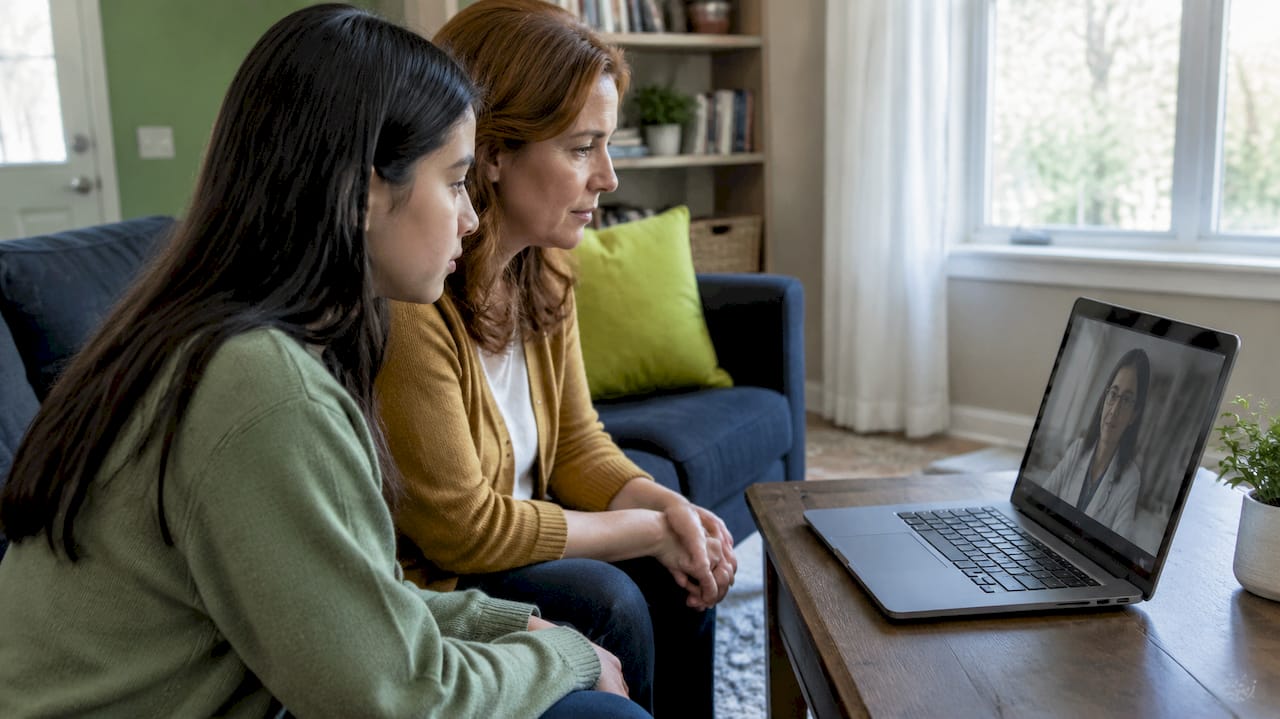
Telepsychiatry for a teenager is a psychiatric evaluation or follow-up visit done over secure two-way video, with a licensed clinician on one screen and your teen (and usually you) on the other. In Texas there are two main doors into it: the free school-based program called TCHATT, and private telehealth practices, ours included, where you book directly. Which one fits depends on your school, your insurance, how complicated things are, and how urgent.
We have sat across from many worried parents, in the room and on screen. The questions are usually the same. Will my teen actually talk through a laptop? Can a doctor really get a clear picture this way? What if it is more than video can handle? This guide answers those as plainly as we can.
TL;DR
- Telepsychiatry uses live video for evaluation, medication management and follow-up. For many teens it works about as well as sitting in an office.
- TCHATT is a free Texas program for pre-K through 12th grade students, run through schools. No insurance is needed, but a parent or guardian must consent and take part in the first assessment.
- If your school is not enrolled, or your teen needs ongoing medication care, start with your pediatrician or a private telepsychiatry practice.
- Video is not for emergencies. If your teen has an immediate plan to hurt themselves or someone else, call or text 988 or go to an emergency room.
Table of Contents
- What teen telepsychiatry actually is
- What a first video appointment looks like
- TCHATT: the free school-based route in Texas
- Does it work as well as seeing someone in person?
- When video is not the right tool
- If your teen’s school doesn’t offer TCHATT
- Our perspective
- Privacy, consent and what your teen can expect
- How to prepare your teen and yourself
- Seeing us
- FAQ
- Sources
What teen telepsychiatry actually is
The American Academy of Child and Adolescent Psychiatry describes telepsychiatry as using videoconferencing for psychiatric evaluation, consultation and treatment. Their family guide says the appointment resembles a regular doctor visit, with two-way video, and that a staff member or therapist may be present too.
One point is easy to miss. AACAP’s clinical update notes that telepsychiatry is not a separate specialty. It is the same psychiatry delivered through a different channel. The standards of care, the questions, the judgment and the responsibility are the same. Only the room is different.
That shapes how we think about it. We don’t treat a video visit as a lighter version of the real thing. We prepare for it the way we would prepare for an office visit, and we expect the same quality from it.
What a first video appointment looks like
Every clinician has their own rhythm, but a first visit tends to go like this.
- Paperwork first. You complete intake forms, consent and insurance details before the visit, so the time on video is spent on your teen and not on forms.
- A short check of the connection. We confirm we can see and hear each other, and we ask for the teen’s location in case we need to reach someone locally.
- A conversation with you and your teen together. We ask about what you have noticed, how long it has been going on, school, sleep, friendships, family history, and what has been tried.
- Time with your teen alone. Many teens say more when a parent is not in the room. We talk about this ahead of time so it doesn’t feel like a surprise.
- A plan. That might be more assessment, therapy referral, a medication discussion, or simply watchful waiting with a check-in date.
We have noticed that some teens open up faster on video than in a waiting room. A familiar bedroom or kitchen lowers the stakes. Others go quiet and give one-word answers, and that is information too. It tells us how to pace things, and sometimes it tells us a different format would serve them better.
Setting up the space
The American Psychiatric Association points out that a good virtual visit needs careful attention to the environment at both ends. For you, that means a few practical things:
- A quiet room with a door that closes. A bedroom with headphones works. A car in the driveway sometimes works better than people expect.
- A device with a working camera and microphone, charged, on a stable surface.
- A plan for where you will be. You stay nearby for the start and the plan, and step out when your teen is speaking alone with the clinician.
- A backup phone number in case the video drops.
Our telehealth setup guide walks through the technical side in more detail.
TCHATT: the free school-based route in Texas
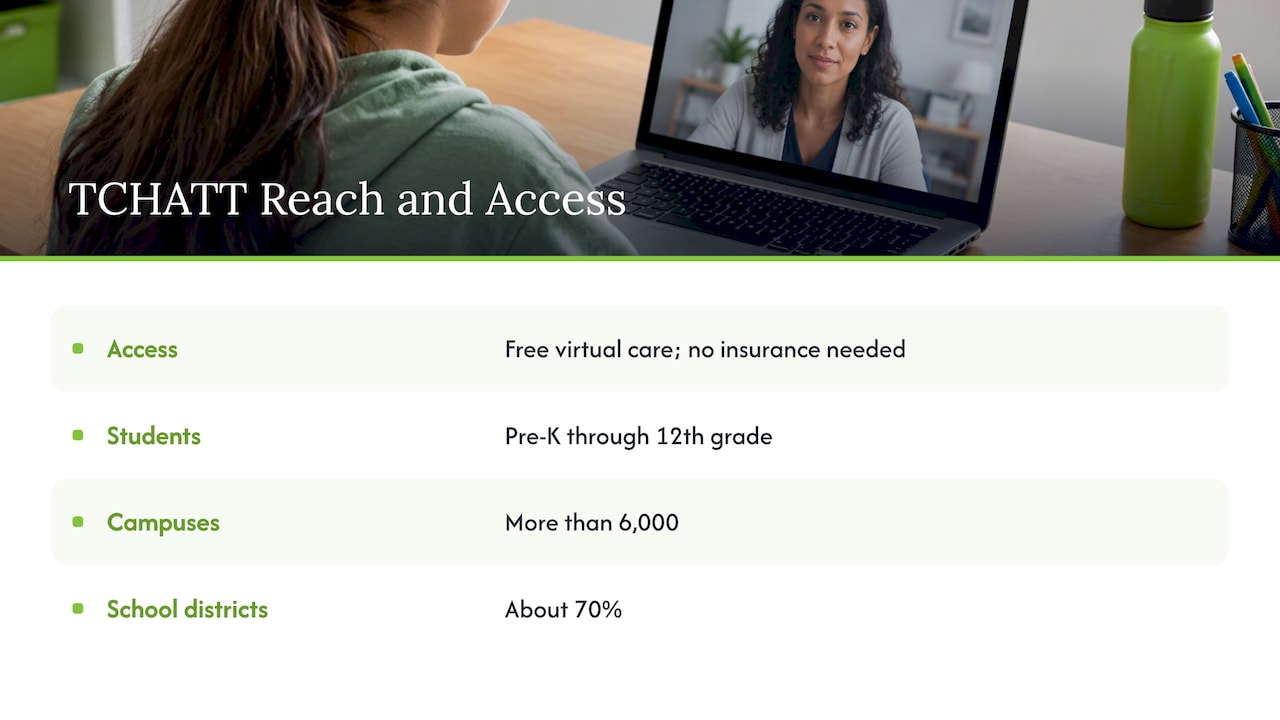
Texas Child Health Access Through Telemedicine, usually shortened to TCHATT, is the state’s school-linked program. According to the program’s own FAQ, it provides free virtual mental health care to pre-K through 12th grade students, and no insurance is needed. The same page says it is available on more than 6,000 campuses and in about 70% of Texas school districts.
Who can use it and how it starts
TCHATT is coordinated through schools and districts. In practice, that means the first step is usually a conversation with a school counselor, nurse or administrator who can refer your teen. Parents or guardians must consent, and they must be part of the initial assessment. That requirement matters. It keeps you in the loop and it means the clinician hears your view as well as your teen’s.
The program is part of a larger state effort. The Texas Child Mental Health Care Consortium, funded by the legislature, also runs the Child Psychiatry Access Network, which gives pediatricians and other primary care providers telehealth-based consultation and training on mental health concerns. If your teen’s pediatrician says they have consulted a child psychiatrist about your child’s care, this is often how.
What stays private
TCHATT sessions are confidential. Information is not shared with schools or districts without a parent’s release. There are exceptions for safety and abuse concerns, as the program’s FAQ explains. We would tell any family the same thing about private care: confidentiality for teens is real, and it has limits when someone’s safety is at risk. Better to know that up front than to find out in the middle of a hard conversation.
What TCHATT is not
TCHATT is not a crisis service. Schools are expected to follow their existing emergency protocols when a student is in active crisis, for example with an immediate plan for self-harm or violence. It also is not designed to be a long-term home for complicated medication management. For many families it works as a fast, free first assessment and a bridge, and then a longer-term plan gets built from there. If you want to understand what long-term medication care looks like for a teenager, our parent’s guide to medication management for teens covers it.
Does it work as well as seeing someone in person?
For a lot of young people, yes. The TCHATT program states that research shows virtual mental health care is as effective as in-person counseling for many children and youth. Note the words “for many.” We would not claim it for everyone, and neither does the guidance.
In our experience, video works well for:
- Initial evaluations of anxiety, depression, attention concerns and mood changes
- Follow-up visits after a medication change, where we are checking sleep, appetite, side effects and mood
- Teens who are hard to get to an office because of school, sports, distance or a parent’s work schedule
- Teens who find a first in-person appointment intimidating
It works less well when a teen cannot take part meaningfully in a telehealth setting, for example if they are too distressed to engage, if there is no private space at home, or if a physical exam is needed. AACAP’s clinical guidance says in-person or urgent care remains necessary for active crises or when a young person can’t take part meaningfully on video. The same guidance says programs should plan for safety and emergencies from the start.
What that looks like for us: before we start, we want your teen’s physical address, a parent’s phone number, and the name of the nearest emergency room. It sounds procedural. It is one of the more important parts of the visit.
When video is not the right tool
Please don’t use a scheduled video visit for a crisis. Go to an emergency room or get immediate help if your teen:
- Has a plan or the means to hurt themselves
- Has talked about wanting to die and you can’t be sure they are safe
- Is threatening someone else
- Is seriously out of touch with reality, or hasn’t slept for days and seems unwell
Texas Health and Human Services notes that you can call or text 988, or chat online, anytime and for free if you or someone you know is in a mental health crisis. You can call on behalf of your teen. If there is immediate danger, call 911.
If your teen’s school doesn’t offer TCHATT
This is a common situation. Roughly 70% of districts participating still leaves many that aren’t, and private schools and homeschool families may be in a different position. A few things to try, in rough order.
- Ask the school anyway. Ask the counselor whether the district participates or has plans to. Participation can change, and a counselor can sometimes point you to another school-linked resource.
- Call your pediatrician. Many Texas pediatricians have access to child psychiatry consultation through the Child Psychiatry Access Network mentioned above. A pediatrician can do an initial screen, start a conversation about next steps, and refer you.
- Check your insurance. Look for behavioral health telehealth benefits on your plan, and ask what is covered for a teen. Coverage varies by plan, so a phone call to the number on your card will give you a more reliable answer than any article can.
- Contact a private telepsychiatry practice. If your teen needs a full evaluation or ongoing medication management, a practice that sees patients directly may be the better fit.
When you call any practice, ask a few things: which ages the psychiatrists see, whether they prescribe and manage medication, how they handle emergencies, whether they coordinate with a therapist, and what the first visit costs with and without your insurance.
Our perspective
We have learned a few things from this work that don’t always show up in guides.
First, the best predictor of a good telepsychiatry visit with a teen is not the technology. It is whether the teen feels they have some say. We often notice that when a fifteen-year-old is told “you’re going to talk to a doctor,” the visit starts badly. When they have been asked, even a little, what they want to get out of it, it starts better. Tell your teen what the visit is, who will be there, and what will stay between them and the clinician.
Second, medication is rarely the first or only answer, and we are slow to reach for it with young patients. A careful evaluation often shows sleep, school pressure, a lost friendship, or an undiagnosed attention problem sitting underneath what looked like pure anxiety. Sometimes therapy alone is right. Sometimes medication helps a good deal, and we are glad to have it. We would rather take an extra visit to understand than rush.
Third, the recovery isn’t a straight line. Teens have good weeks and bad ones, and a rough week after a change does not mean the plan has failed. Video follow-ups make it easier to check in sooner, which is one of the real advantages.
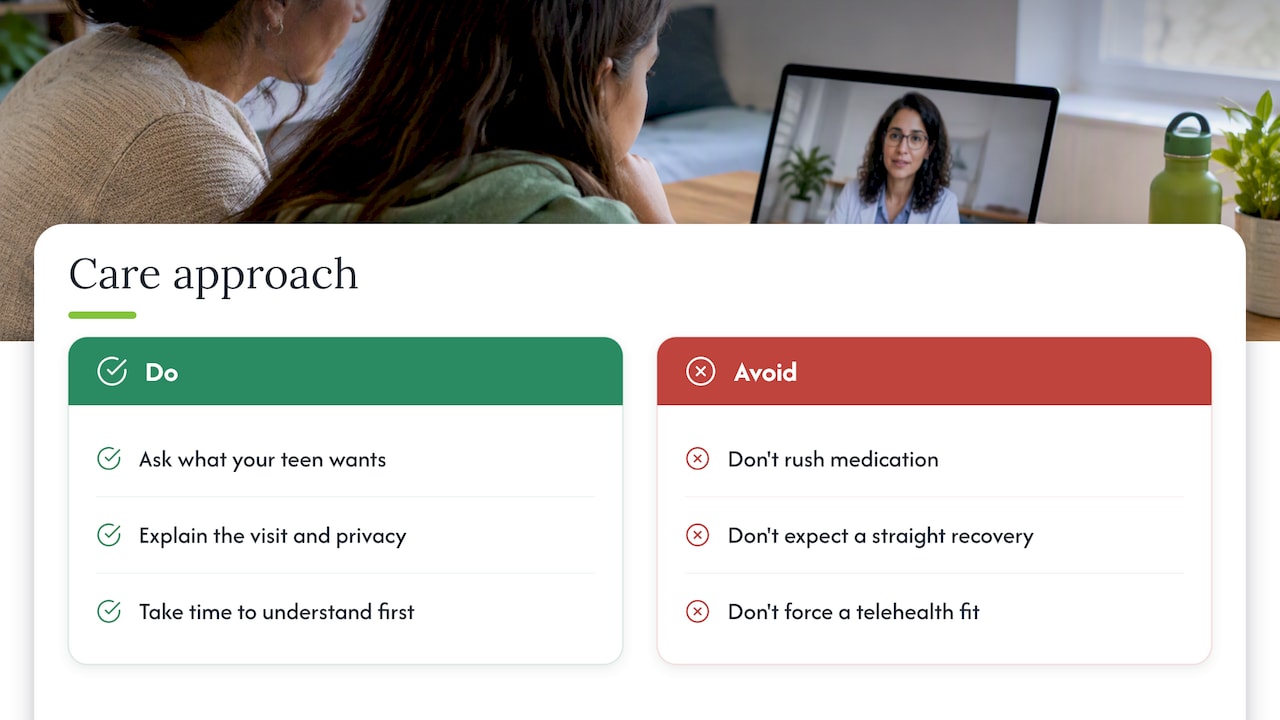
Fourth, we are honest about fit. Not every teen belongs in a telehealth visit, and not every concern belongs in our practice. If we think your child would be better served by a different level of care, we will say so and help you get there.
Our practice is based in Allen and serves families across North Dallas, including Frisco, McKinney and Plano, with both in-person and telehealth options. If you have questions about whether we are the right fit for your teen, we are glad to talk it through.
— Felix
Privacy, consent and what your teen can expect
Parents often ask whether a teen will be able to speak freely, and whether the information will end up with the school. A few principles apply broadly.
- Consent. For minors, a parent or guardian generally has to consent to care. With TCHATT that consent is required, and a parent must take part in the first assessment.
- Confidentiality. Sessions are private, with exceptions for safety or abuse concerns. Good clinicians explain this to teens in the first visit, in plain words.
- Privacy of the platform. A telehealth platform used for patient care should be built for health information. Our write-up on telepsychiatry privacy and HIPAA explains what clinicians are expected to do, and it is also a useful list of things to ask any provider.
- Sharing with the school. In the school-based program, information is not passed to the school or district without your release. If your teen might need accommodations, we can talk about what to share and with whom, and it is your choice.
How to prepare your teen and yourself
A little preparation changes the first visit more than most families expect.
- Write things down. Dates, examples, changes in sleep or grades, what has been tried, and any family history of mental health conditions or substance use.
- Bring the medication list. Everything your teen takes, including supplements and over-the-counter products, with doses.
- Talk to your teen first. Say why you are booking the visit and what you are hoping for. Ask what they would like the doctor to know.
- Plan for privacy. Find a space where your teen can talk without siblings or others listening, and agree on when you will step out.
- Decide what you’ll do afterward. A walk, a snack, a quiet hour. The visit may stir things up.
If attention concerns are part of the picture, our post on what you can and can’t get done remotely for ADHD in Texas is worth a read before you book. We explain what a thorough evaluation should include.
Seeing us
At Nortex Psychiatry, we offer telehealth psychiatry alongside in-person visits, and we work with individuals and families across North Dallas and Texas. If you are a parent and are not sure where to start, begin with a conversation. You can reach us through our main site and ask whether we are the right fit for your teen’s situation, what the first appointment involves, and how insurance works for your plan. We would rather answer questions before you book than after.
FAQ
Is telepsychiatry for teens covered by insurance in Texas?
Often it is, but coverage depends on your plan, so call the number on your insurance card and ask specifically about behavioral health telehealth for a minor. TCHATT is separate: it is free for pre-K through 12th grade students and doesn’t need insurance. Ask any private practice about its fees and which plans it accepts before the first visit.
Can a teen get medication through telepsychiatry?
Telepsychiatry can include medication management as well as evaluation and follow-up. Whether a prescription is right depends on the evaluation, your teen’s history and your family’s preferences, and for some medications there are additional rules your clinician will explain. Many clinicians start with the least invasive option and review closely after any change.
Does my teen need a parent in the room?
A parent or guardian must consent and take part in the first assessment in the school-based program, and most private practices ask for the same. After that, we usually spend part of each visit with the teen alone, because many teens speak more openly that way. Your clinician will explain how that works up front.
What if our school doesn’t participate in TCHATT?
Ask the school counselor whether that may change, then talk to your pediatrician, who may have access to child psychiatry consultation. If your teen needs a full evaluation or ongoing care, a private telepsychiatry practice is another route. Check your insurance benefits before you book.
What should I do if my teen is in crisis during a telehealth care plan?
Don’t wait for the next appointment. Call or text 988, or call 911 if there is immediate danger or you can’t keep your teen safe. Tell the treating clinician afterward so the plan can be adjusted.
Sources
- Frequently Asked Questions, Texas Child Health Access Through Telemedicine (UT Health San Antonio)
- Telepsychiatry and Your Child, AACAP
- Clinical Update: Telepsychiatry With Children and Adolescents, AACAP
- Developing a Virtual Therapeutic Space, American Psychiatric Association
- Texas Child Mental Health Care Consortium, JPS Health Network
- 988 Suicide and Crisis Lifeline, Texas Health and Human Services