


If you need medication for moderate-to-severe anxiety during pregnancy, SSRIs are typically the first-line choice, with sertraline and escitalopram most often favored for those starting treatment for the first time. Benzodiazepines are generally avoided or used only sparingly, and only under close supervision. The right decision depends on your history, your symptoms, and a conversation between you, your OB, and your psychiatrist, not a blanket rule.
TL;DR:
- SSRIs like sertraline and escitalopram remain the safest first-line medications during pregnancy, with the most extensive safety data and good tolerability.
- Neonatal adaptation syndrome caused by medication exposure is usually mild and temporary, with risks of PPHN and preterm birth being low and manageable.
- Untreated moderate-to-severe anxiety during pregnancy leads to worse outcomes, including higher NICU admissions and increased risk of preterm birth.
- Continuing pre-pregnancy effective medications is typically safer than switching, as dose adjustments and relapse risks are minimized with a planned approach.
- Close collaboration with obstetric providers and monitoring, including blood pressure and breastfeeding questions, are essential parts of managing anxiety medication during pregnancy.
Table of Contents
- Which Anxiety Medications Are Considered First-Line During Pregnancy?
- What Are the Real Risks to the Baby From Medication Exposure?
- What Happens if Anxiety Goes Untreated in Pregnancy?
- How Do Clinicians Decide on Dosing and Timing?
- Do Therapy and Lifestyle Changes Work Instead of Medication?
- What Should You Know About Registries, Breastfeeding, and Trusted Resources?
- Can Anxiety Medications Affect Fertility or Conception Planning?
- Our Approach to Anxiety Medication During Pregnancy
- How Nortex Psychiatry Supports You Through Pregnancy Planning
- Sources
- FAQ
Which Anxiety Medications Are Considered First-Line During Pregnancy?
SSRIs sit at the top of the list, and for good reason. ACOG’s clinical guidance names sertraline and escitalopram as reasonable first-line options for someone who has never been on psychiatric medication before. They have the deepest safety data of any class we prescribe in pregnancy, and in our experience, patients tend to tolerate them well.
SNRIs like venlafaxine and duloxetine are reasonable alternatives, particularly when a patient hasn’t responded to an SSRI or has comorbid pain or mood symptoms that respond better to a dual-action medication. We do watch blood pressure a bit more closely with SNRIs, since they can nudge it upward in some patients.
Other agents have narrower roles. Bupropion sometimes comes into play for patients with comorbid depression who need something with a different side-effect profile, though it isn’t typically a first pick for anxiety alone. Tricyclic antidepressants (TCAs) are used occasionally, usually when other options have failed or when a patient has a strong prior response to one.
Here’s the rule we lean on most in clinic: if a medication worked well before pregnancy, continuing it is often safer than switching to something “theoretically” cleaner. Switching means a washout period, a new trial-and-error window, and the real risk of relapse while you’re searching for the next option.
- SSRIs (sertraline, escitalopram): first-line, most data, generally well tolerated.
- SNRIs (venlafaxine, duloxetine): solid alternative, requires blood pressure monitoring.
- Bupropion: secondary option, more relevant for mixed anxiety-depression presentations.
- TCAs: reserved for treatment-resistant cases or strong prior response.
One agent worth flagging by name: paroxetine. Mayo Clinic notes it’s generally avoided in pregnancy due to a small increased risk of cardiac defects, which is why it rarely makes the first-line list even though it’s an SSRI.
What Are the Real Risks to the Baby From Medication Exposure?
The risk conversation is where most of the fear lives, so let’s be precise about what the evidence actually shows. Exposure late in pregnancy, particularly in the third trimester, is most associated with what’s called neonatal adaptation syndrome. Babies can be jittery, feed poorly, or show mild respiratory symptoms for a short window after birth.
What the numbers actually say: Neonatal adaptation syndrome symptoms are usually mild and self-limited, typically resolving within one to two weeks without lasting effects. Persistent pulmonary hypertension of the newborn (PPHN) has been studied as a possible association with SSRI exposure, but the absolute risk remains low even where a signal appears in observational data.
Other associations reported in the literature include small upticks in preterm birth, low birth weight, and postpartum hemorrhage. A comprehensive review of SSRI safety data describes these as generally small absolute increases, not the kind of risk that should automatically rule out treatment. Timing and dose both matter here.
- Neonatal adaptation syndrome: transient jitteriness, feeding difficulty, mild respiratory symptoms.
- PPHN: low absolute risk, occasionally flagged in observational studies.
- Preterm birth and low birth weight: small associations, not consistently causal.
- Postpartum hemorrhage: modestly elevated risk reported in some cohorts.
None of this means exposure is risk-free. It means the risks are, in most cases, manageable and worth weighing against the alternative: leaving significant anxiety untreated.
What Happens if Anxiety Goes Untreated in Pregnancy?
Untreated anxiety isn’t a neutral choice. It’s a choice with its own measurable consequences. A secondary analysis of the NuMoM2b cohort found that untreated anxiety was linked to higher rates of adverse perinatal outcomes and increased NICU admissions, while treated anxiety showed no meaningful difference from controls once the data were adjusted for confounders.
That’s a striking finding, and it reframes the whole conversation. The babies of mothers whose anxiety was treated looked, on average, like babies born to mothers without anxiety at all.
- Higher rates of preterm birth and induction in untreated anxiety cohorts.
- Increased likelihood of cesarean delivery.
- More frequent NICU admissions among newborns of untreated mothers.
This is the reason shared decision making so often lands on treatment for moderate-to-severe illness. The medication conversation isn’t between “risk” and “no risk.” It’s between two sets of risks, and untreated anxiety usually carries the heavier load.
How Do Clinicians Decide on Dosing and Timing?
We don’t approach this with a formula. We approach it with a set of principles that flex around your history and your symptoms.
- Start with prior response. If you were stable on a medication before pregnancy, continuing it is usually the safer path. Discuss the specifics with your care team before making any change.
- Dose conservatively at first. When starting fresh, we often begin SSRIs or SNRIs at roughly half the usual starting dose, then titrate up as dosing guidance for perinatal pharmacotherapy recommends, since anxiety sometimes needs a higher eventual dose than depression does.
- Never stop abruptly. Any taper needs to be planned jointly with your psychiatrist and your OB. Sudden discontinuation risks both relapse and withdrawal symptoms.
- Coordinate monitoring. Blood pressure checks matter if you’re on an SNRI. Late-pregnancy monitoring plans for the newborn should be discussed ahead of delivery, not after.
- Loop in a perinatal psychiatrist when things get complex. Multiple diagnoses, prior treatment failures, or high-risk pregnancies usually warrant that extra layer of expertise.
Pro Tip: Bring your medication history to your first OB visit, even before you ask about anxiety treatment specifically. Knowing what’s worked (and what hasn’t) shapes the whole plan faster than starting from scratch.
Do Therapy and Lifestyle Changes Work Instead of Medication?
For mild-to-moderate anxiety, cognitive behavioral therapy (CBT) is genuinely first-line, not a consolation prize for people who don’t want to take medication. It works as a standalone treatment for many patients and as a valuable partner to medication for those who need both.
Self-care carries more weight than people expect. Sleep hygiene, regular movement, and structured relaxation training all reduce symptom burden in measurable ways. Peer support groups help too, particularly for the isolation that often comes with pregnancy-related anxiety.
- CBT: first-line for mild-to-moderate symptoms, effective alongside medication for severe cases.
- Sleep hygiene and exercise: modest but real reductions in symptom intensity.
- Peer support: helps with the isolation anxiety often brings.
When symptoms are significant enough to interfere with daily function, we don’t recommend waiting to see if therapy alone will be enough. Combining therapy and medication from the start tends to work better than delaying pharmacologic treatment until things get worse.
What Should You Know About Registries, Breastfeeding, and Trusted Resources?
A few practical steps make this whole process feel less like guesswork. Ask your clinician about enrolling in a pregnancy exposure registry. These programs track outcomes for people taking specific medications during pregnancy, and your data helps refine the safety picture for the next patient.
Breastfeeding deserves its own conversation, since transfer into breastmilk varies by medication. Bring this up with your prescriber and your pediatrician before delivery, not after you’re home with a newborn and a decision to make.
- FDA guidance recommends checking medicine labels and discussing pregnancy-specific risks and registries with your provider.
- MotherToBaby’s fact sheets offer patient-friendly summaries of specific medications and are worth reviewing before your appointment.
- Your OB and psychiatrist together should sign off on any breastfeeding plan involving psychiatric medication.
Can Anxiety Medications Affect Fertility or Conception Planning?
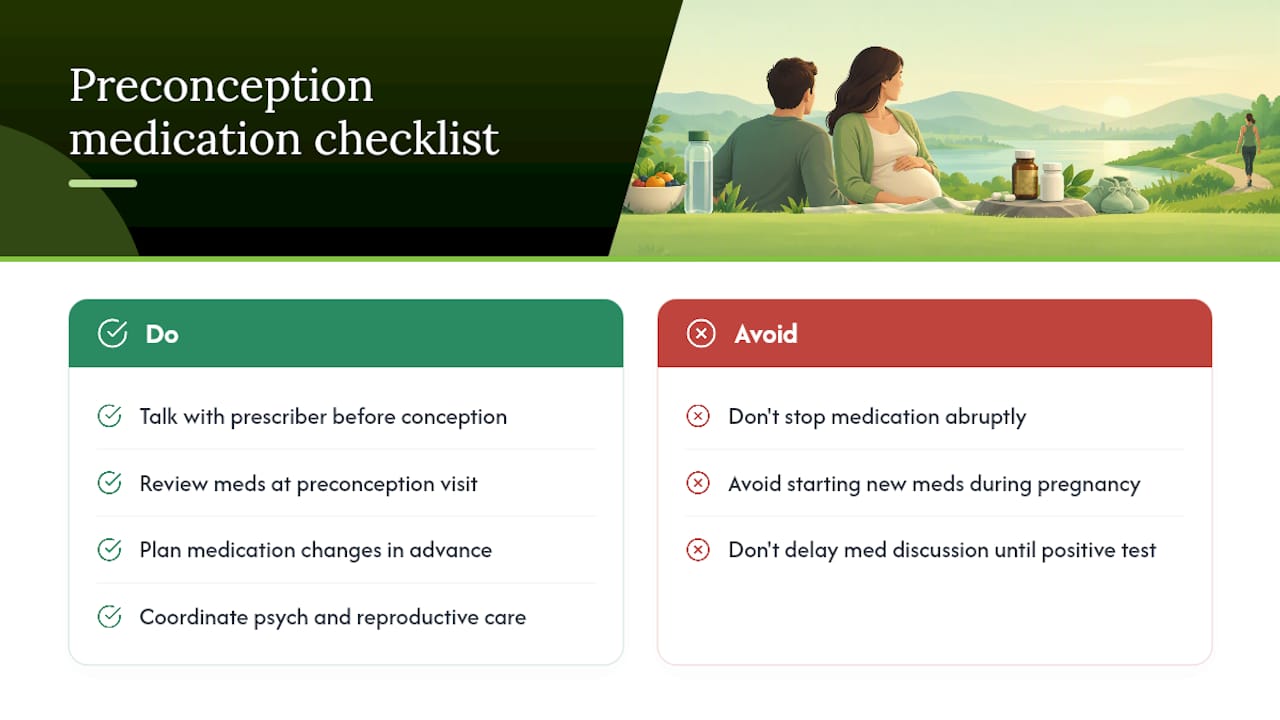
This question comes up more than people expect, usually from patients who are planning a pregnancy rather than already in one. The honest answer: for most SSRIs and SNRIs, there isn’t strong evidence of a meaningful effect on fertility itself. The bigger issue tends to be timing and preparation, not the medication’s direct effect on conception.
If you’re planning to conceive, this is the moment to have the medication conversation early, not after a positive test. Stopping a medication abruptly out of fear can trigger relapse right when you need stability the most, and starting a new medication from scratch mid-pregnancy means navigating that early-titration period during a time when nausea, fatigue, and hormonal shifts are already complicating the picture.
We generally recommend using preconception visits to review your current medication, discuss whether it’s a reasonable one to continue, and talk through what monitoring will look like once you conceive. This is also the time to raise questions about switching, since any change works better as a planned transition than a rushed one.
Anxiety itself can complicate conception indirectly. Chronic stress affects sleep, appetite, and overall health, all of which play into fertility and pregnancy readiness. Treating anxiety well before conception, rather than during a crisis mid-pregnancy, tends to set up a smoother transition into prenatal care. If fertility concerns intersect with medication questions, that’s worth raising directly with both your psychiatrist and your reproductive health provider, since the answer depends heavily on your specific history and the medication in question.
Our Approach to Anxiety Medication During Pregnancy
We start from the same place with every pregnant patient: what has worked for you before, and what does your current life actually look like? We coordinate closely with OBs and pediatricians because these decisions rarely belong to psychiatry alone. When a medication has been effective pre-pregnancy, we generally favor continuing it over switching, and we build in telehealth follow-up so adjustments don’t require an office visit every time something shifts. If you’re considering a consultation, we’ll walk through your prior response, any comorbidities, and build a plan around your specific pregnancy, not a generic protocol.
— Felix
How Nortex Psychiatry Supports You Through Pregnancy Planning
Nortex Psychiatry gives pregnant patients something a general practice often can’t: psychiatric care that actually coordinates with your obstetric team instead of operating in a separate lane. We offer medication management, psychiatric evaluation, and telehealth follow-up built around the realities of pregnancy planning and perinatal anxiety, not a one-size-fits-all prescription pad. We’ll talk through pregnancy exposure registries, breastfeeding transfer questions, and how your specific medication history should shape the plan going forward. If you’re weighing whether to start, continue, or adjust anxiety medication during pregnancy, request a consultation and we’ll help you build a plan that actually fits your situation.
This article is general information, not a substitute for advice from a qualified doctor. Consult a qualified healthcare professional about your own circumstances before acting on anything here.
Sources
- ACOG Clinical practice guidance / related PubMed entry
- Benzodiazepine neonatal effects study (PubMed)
- NuMoM2b secondary analysis on anxiety and pregnancy outcomes
- Medicine and pregnancy | FDA
- MotherToBaby anxiety fact sheet
FAQ
Is It Safe to Take Anxiety Medication While Pregnant?
For moderate-to-severe anxiety, SSRIs such as sertraline and escitalopram are generally considered reasonable first-line options by ACOG. Safety depends on the specific medication, dose, and timing, which is why decisions should always involve your OB and psychiatrist together.
Is Hydroxyzine Safe to Use for Anxiety During Pregnancy?
Hydroxyzine is sometimes used short-term for acute anxiety or nausea in pregnancy, but it isn’t typically a first-line long-term option compared to SSRIs. Discuss any antihistamine-based anxiety treatment with your prescriber, since dosing and duration matter more than the drug class alone.
Are Benzodiazepines Ever Appropriate During Pregnancy?
Generally, no, or only in limited, short-term situations under close supervision. ACOG guidance recommends avoiding benzodiazepines or using them sparingly because of risks including neonatal sedation and withdrawal.
What Happens if I Stop My Anxiety Medication Cold Because I’m Pregnant?
Stopping abruptly risks relapse and, depending on the medication, withdrawal symptoms for you. Any taper should be planned with your psychiatrist and coordinated with your OB, not done on your own out of fear.
Does Nortex Psychiatry Offer Medication Management for Pregnant Patients?
Yes. Nortex Psychiatry provides medication management, psychiatric evaluation, and telehealth follow-up designed to coordinate with your obstetric care throughout pregnancy. Current pricing and appointment details are available directly on the Nortex Psychiatry website.