


Yes, you can get an ADHD diagnosis and medication through ADHD telehealth in Texas, but there is one rule that changes everything about how you should shop for care: outpatient stimulant prescriptions must come from a Texas-licensed MD or DO. Nurse practitioner led platforms that market themselves nationally often cannot legally prescribe Schedule II stimulants to Texas patients for ongoing outpatient care, no matter how slick the app looks.
The other date to circle is December 31, 2026. Federal flexibilities from HHS and the DEA currently allow prescribers to issue controlled substances, including ADHD stimulants, via telemedicine without requiring an initial in-person visit, and that policy is set to run through the end of this year, according to HHS’s telemedicine extension guidance. Nobody knows yet whether it gets extended again.
- Telehealth ADHD care is legal and available across Texas today, from Frisco to El Paso.
- The prescriber’s license type matters more than the platform’s brand name.
- Federal telemedicine flexibilities for controlled substances currently sunset December 31, 2026.
Quick fact: Under current federal policy, a remote-only relationship with a DEA-registered prescriber can be enough to start controlled-substance treatment, without a prior in-person exam, through the end of 2026.
Key Takeaways
Telehealth can legally deliver ADHD diagnosis and medication in Texas, but only a Texas-licensed MD or DO can prescribe stimulants for ongoing outpatient care.
| Point | Details |
|---|---|
| Physician-only rule | Outpatient Schedule II stimulant prescriptions in Texas require an MD or DO, not just any licensed prescriber. |
| Federal deadline to track | Telemedicine flexibilities for controlled substances currently run through December 31, 2026. |
| Evaluation quality matters | A legitimate assessment includes childhood history, validated scales, and a real clinical interview, not a quick screening call. |
| Costs vary by depth | Cash-pay evaluations commonly range from $100 to $400, with insurance and Medicaid coverage varying by plan. |
| Nortex Psychiatry option | Offers Texas-licensed physician evaluation, medication management, and telehealth or in-person visits across North Dallas. |
Table of Contents
- How Does an Online ADHD Evaluation Work in Texas?
- What Are the Texas Rules for Prescribing ADHD Medication by Telehealth?
- Is Telehealth Right for Your ADHD Care, or Should You See Someone in Person?
- What Does an ADHD Telehealth Assessment Cost in Texas?
- How Do You Choose a Good ADHD Telehealth Provider in Texas?
- Nortex Psychiatry: Telehealth ADHD Care Built Around These Exact Standards
- Where Telehealth ADHD Advice Usually Goes Wrong
- Ready to Talk to a Texas-Licensed ADHD Specialist?
- Sources
- FAQ
How Does an Online ADHD Evaluation Work in Texas?
A rushed fifteen-minute video call that ends with a stimulant prescription is not an evaluation. It is a liability, both for you and for whoever signed the script. We have seen patients come to us after exactly that experience, frustrated that their “diagnosis” felt more like a subscription signup than a medical assessment.
A legitimate online ADHD evaluation in Texas typically follows a sequence, and it takes real time.
- Intake and screening. You will usually complete a validated tool like the ASRS v1.1, along with questions about medical history, sleep, mood, and substance use.
- Clinical interview. A licensed clinician talks with you directly, not just reads your intake form, and asks about how symptoms show up at work, at home, and in relationships.
- Childhood and developmental history. Because ADHD is a developmental condition, a thorough evaluator asks about elementary school report cards, early impulsivity, and family history, since adult ADHD diagnosis relies on this longitudinal view to separate real ADHD from anxiety, sleep disorders, or burnout that mimics it.
- Collateral input when possible. A parent, spouse, or old school records can sharpen the picture, especially for adults who never had clear documentation as kids.
- Documentation. Texas rules require clinicians to record medical history and a mental status exam before starting a psychoactive medication, a standard laid out in Texas Administrative Code §320.209.
- Treatment planning. This covers stimulant options, non-stimulant alternatives like atomoxetine or guanfacine, therapy referrals for coexisting anxiety or executive-function struggles, and a monitoring schedule.
Pro Tip: If a platform offers you a prescription before it has asked a single question about your childhood or your sleep habits, that is a signal to slow down, not speed up.
Some situations call for stepping outside the telehealth model entirely. If your history is complicated by a possible learning disability, a traumatic brain injury, or symptoms that overlap heavily with bipolar disorder, an in-person evaluation with neuropsychological testing may serve you better than any video call.
What Are the Texas Rules for Prescribing ADHD Medication by Telehealth?
Here is the part most telehealth marketing glosses over. Texas law draws a hard line around who can prescribe Schedule II controlled substances, which includes Adderall, Vyvanse, and Ritalin, for outpatient use. That prescriber has to be a physician, an MD or DO, licensed in Texas. This is not a technicality. It shapes which platforms can actually help you if stimulants end up being the right treatment.
Texas telemedicine law, under Tex. Occ. Code §111, does allow a valid practitioner-patient relationship to form entirely through telehealth consent processes, and it holds that relationship to the same standard of care as an in-person visit. The flexibility is real. It just is not unlimited.
Federal guidance currently permits a DEA-registered practitioner to prescribe Schedule II through V controlled substances via telemedicine without a prior in-person visit, a temporary extension that Telehealth confirms runs through the same December 2026 deadline.
Before you pay for an assessment, run through this short checklist:
- Confirm the prescriber holds an active Texas medical license, verifiable through the Texas Medical Board.
- Ask directly whether the person diagnosing you is an MD, DO, or a nurse practitioner, since that determines whether they can legally prescribe stimulants to you afterward.
- Ask what happens if you need medication changes after December 2026, when current federal flexibilities are due to expire.
- Confirm the platform documents its evaluations to the same standard as an in-person visit, not a lighter version of it.
Is Telehealth Right for Your ADHD Care, or Should You See Someone in Person?
Telehealth solved a real access problem in Texas. If you live two hours from the nearest psychiatrist, or you cannot take half a day off work for a follow-up, a video visit is not a compromise. It is often the only realistic path to care.
The advantages are concrete:
- Geographic reach. Rural Texas counties with no psychiatrist within driving distance can now access specialists based in Dallas, Houston, or Austin.
- Scheduling flexibility. Follow-up visits, which often just involve a check-in and a prescription renewal, fit into a lunch break instead of a half-day absence.
- Coverage parity. Many commercial plans and Texas Medicaid managed-care organizations now reimburse telehealth visits similarly to in-person ones, though the details vary by plan.
The limitations deserve equal weight. Evaluation depth varies wildly between platforms, and the Justice Department has pursued enforcement actions against telehealth companies for prescribing practices that cut corners on assessment quality. NP-focused platforms, however convenient, run into the physician-only wall the moment stimulants come up. And if your case involves substance use history, complex mood symptoms, or prior medication failures, in-person psychiatric assessment still tends to catch things a screening call can miss.
What Does an ADHD Telehealth Assessment Cost in Texas?
Cash-pay ADHD evaluations in Texas commonly vary in cost depending on evaluation depth, the clinician’s credentials, and whether follow-up visits are bundled into the initial fee. A thorough physician-led evaluation with rating scales and a full history tends to sit at the higher end of that range, and that is generally worth it.
Insurance changes the math, sometimes significantly. A few things worth checking before you book:
- Texas Medicaid covers telehealth for many behavioral health services, but managed-care organizations vary in which video modalities they require, and audio-only visits are not always reimbursed the same way, per Texas HHSC’s telemedicine handbook.
- Commercial insurance often covers psychiatric telehealth similarly to in-person visits, but preauthorization requirements for stimulant prescriptions can still apply.
- HSA and FSA funds typically apply to psychiatric evaluations and medication management, which can soften the cash-pay hit.
Before paying anything, ask the platform directly whether it bills insurance or requires cash payment upfront, whether it is in-network with your specific plan, and what its refund policy looks like if the evaluation doesn’t result in a diagnosis.
How Do You Choose a Good ADHD Telehealth Provider in Texas?
Not every platform advertising ADHD telehealth in Texas is built the same way, and the differences matter more here than almost any other area of psychiatric care because of the controlled-substance rules.
- Verify Texas licensure first. Check the Texas Medical Board’s public lookup for any prescriber’s name before you book. A nursing license or an out-of-state medical license is not a substitute.
- Ask about evaluation structure. A provider who can describe, without hesitating, how they gather childhood history, apply validated rating scales, and rule out mimicking conditions is following the standard CHADD and clinical guidelines recommend.
- Confirm who signs the prescription. If stimulants might be part of your treatment, ask outright whether the clinician you meet is an MD or DO, since that determines whether they can legally write the script themselves.
- Ask about the follow-up cadence. Good ADHD medication management includes a monitoring plan, not a one-time prescription and silence.
- Check privacy practices. Confirm the platform is HIPAA compliant and ask how records are stored and shared, a question our telehealth setup guide for mental health walks through in more detail.
- Ask about diversion safeguards. Because ADHD stimulants carry misuse risk, reputable clinicians build in pill counts, pharmacy checks, or periodic reassessment rather than auto-refilling indefinitely.
Pro Tip: Ask the scheduling coordinator, before you ever meet a clinician, “If I need a stimulant, who on your team is licensed to prescribe it in Texas?” A hesitant or vague answer tells you almost everything you need to know.
Nortex Psychiatry: Telehealth ADHD Care Built Around These Exact Standards
We built our telehealth ADHD services around the standards this article just walked through, not around a marketing checklist. Every evaluation includes a real clinical interview, developmental history, and validated rating scales, conducted by clinicians licensed in Texas.
- Evidence-based psychiatric evaluation and medication management for ADHD, anxiety, depression, and mood disorders.
- Both telehealth and in-person visits available for patients across North Dallas, including Allen, Frisco, McKinney, and Plano.
- A monitoring and follow-up structure designed for continuity, not one-off prescriptions.
Before your first visit, our telehealth setup guide for mental health and our breakdown of best telepsychiatry platforms for ADHD can help you know what to expect. If you are ready to talk to someone, our guide on why to seek psychiatric care explains what a first visit with us actually looks like.
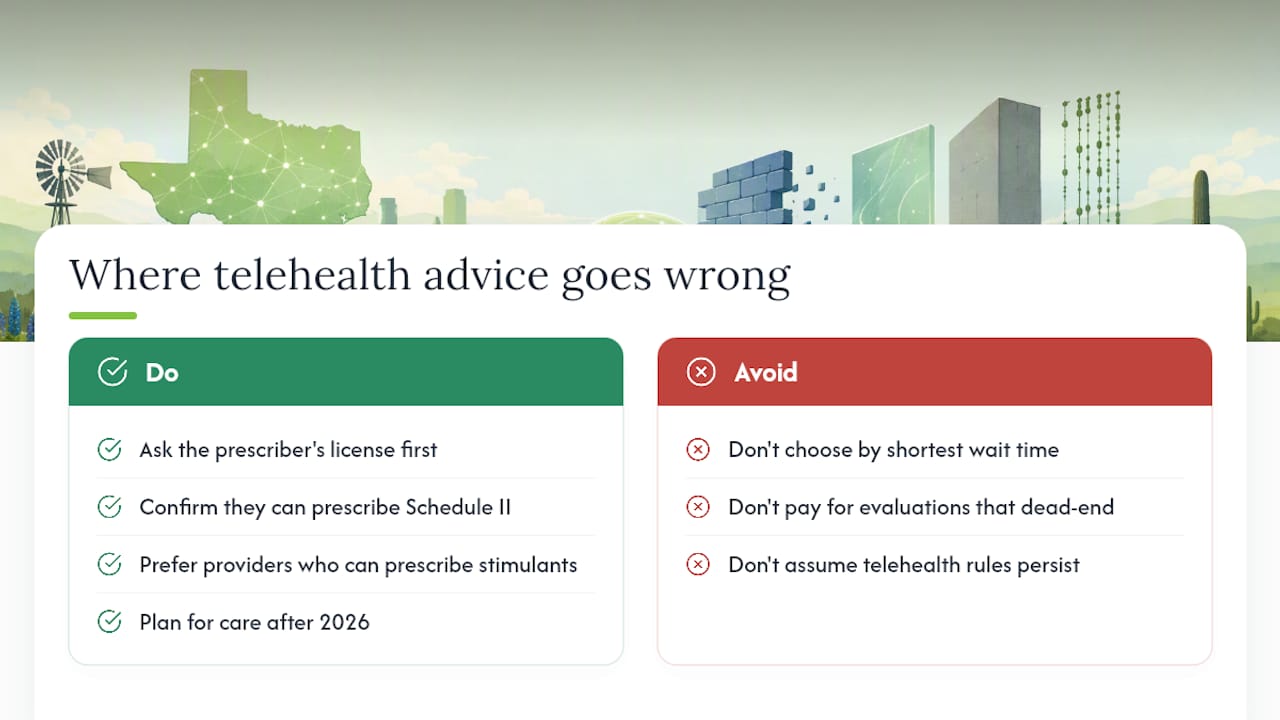
Where Telehealth ADHD Advice Usually Goes Wrong
Most guidance on this topic treats telehealth ADHD care as a pricing and convenience question. It isn’t. It’s a licensing question first, and everything else, cost, speed, app design, sits downstream of whether the person on your screen can legally write you a prescription if you need one.
The conventional advice to “just book whoever has the shortest wait time” ignores that the shortest wait time often belongs to platforms built around nurse practitioners, who cannot prescribe Schedule II stimulants for outpatient use in Texas. That gap surfaces later, usually after you’ve paid for an evaluation and been told you need a second appointment with someone else entirely.
What we’d prioritize differently: ask about the prescriber’s license before asking about price. A $150 evaluation that dead-ends at the stimulant question costs you more, in time and frustration, than a $300 evaluation that gets it right the first time. The federal flexibilities expiring at the end of 2026 add urgency here too. If you’re mid-treatment when that deadline hits and your provider’s telemedicine model depends on those flexibilities, continuity of care becomes your problem to solve, not theirs.
Ready to Talk to a Texas-Licensed ADHD Specialist?
Everything in this guide points to the same practical conclusion: the prescriber’s license type decides what telehealth can actually do for you. Nortex Psychiatry is staffed by Texas-licensed clinicians who can both diagnose and prescribe when stimulant medication is the right call, so you’re not left mid-treatment discovering your provider can’t finish what they started.
Unlike large national platforms built around volume and short visits, our evaluations follow the same documentation and history-taking standard as an in-person appointment, whether you’re joining us from Allen or from three hours away in West Texas. We also handle the parts patients tend to worry about most: insurance verification, medication monitoring, and follow-up scheduling that doesn’t disappear after the first prescription.
If you’re weighing whether telehealth fits your situation, start with our page on why adults seek psychiatric care, which walks through what to expect at a first evaluation and how to book one with our team.
Sources
FAQ
Can You Get Diagnosed With ADHD Over Telehealth in Texas?
Yes. Texas telemedicine law allows a valid clinical relationship, including diagnosis, to form entirely through video visits, as long as the evaluation meets the same documentation standard required for in-person care.
Can a Nurse Practitioner Prescribe Adderall via Telehealth in Texas?
Generally, no, for outpatient use. Texas requires outpatient Schedule II stimulant prescriptions to come from a Texas-licensed MD or DO, which limits what NP-only telehealth platforms can offer if stimulants are appropriate.
What Happens After the Federal Telehealth Prescribing Flexibilities Expire?
Current federal policy allows remote prescribing of controlled substances without a prior in-person visit through December 31, 2026. Ask any provider now how they plan to handle continuity of care if that flexibility isn’t renewed.
How Much Does an ADHD Telehealth Evaluation Cost in Texas?
Cash-pay evaluations typically range from $100 to $400, depending on the clinician’s credentials and evaluation depth, with insurance and Texas Medicaid coverage varying by plan.

Does Nortex Psychiatry Offer ADHD Telehealth in Texas?
Yes. Nortex Psychiatry provides physician-involved ADHD evaluation, medication management, and both telehealth and in-person appointments for patients across North Dallas, including Allen, Frisco, McKinney, and Plano.