


Party anxiety is anticipatory social anxiety you can reduce right now with three steps: a 3-minute diaphragmatic breathing reset, an early-arrival plan, and a short exit strategy. Pre-event anxiety can start days before an event, showing up as racing thoughts, nausea, and a strong pull toward canceling. That reaction is your brain running a threat simulation for a situation that is, objectively, low-risk. It is uncomfortable, but it is manageable.
Quick-start checklist before you read further:
- Do a 3-minute breathing reset: inhale for 4 counts, hold for 2, exhale for 6
- Decide your arrival time (earlier is easier than walking into a full room)
- Write one exit line you can use if you need to leave: “I have an early morning tomorrow”
- Set a micro-goal: stay 20 minutes and speak to one person
- Keep a friend’s number ready, but plan to manage the first 20 minutes on your own
Table of Contents
- ## What party anxiety actually feels like
- How to tell normal nerves from clinical social anxiety
- How to prepare in the days and hours before a party
- Skills you can use during the event itself
- How to process the event after you get home
- When to consider professional help and what treatment looks like
- A psychiatrist’s view on working with party anxiety
- Key Takeaways
- What we have learned from patients who dread parties
- Nortexpsychiatry can help you move forward
- Useful sources
- FAQ
## What party anxiety actually feels like
Recognizing your own symptoms is the first step toward managing them. Social anxiety at parties tends to cluster into four categories, and most people experience a mix.
| Category | Common examples |
|---|---|
| Cognitive | “Everyone will notice I’m nervous,” “I’ll say something embarrassing,” worst-case spiraling |
| Physical | Racing heart, nausea, trembling, sweating, shortness of breath, dizziness |
| Emotional | Dread in the days before, irritability, a sense of impending humiliation |
| Behavioral | Canceling last-minute, arriving late to avoid attention, pre-drinking, constant phone-checking |
The physical symptoms deserve a note. Your amygdala treats a crowded living room the same way it treats a genuine threat, triggering a full fight-or-flight response. That is why your heart races before a birthday party, not just before a job interview.
Pro Tip: Safety behaviors — pre-drinking, texting a friend every 10 minutes, telling the host you’re nervous — feel protective but actually keep anxiety alive. They prevent your brain from learning that the situation is safe. We will come back to this throughout the article.
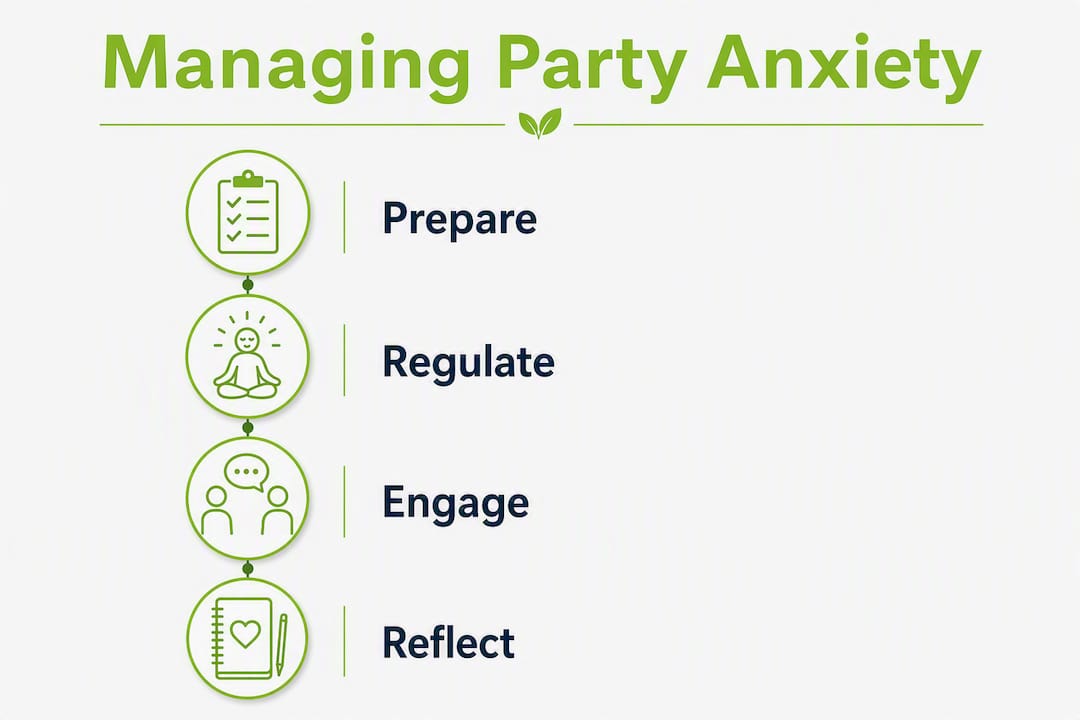
How to tell normal nerves from clinical social anxiety
The honest answer: the difference is duration, degree of avoidance, and how much your daily life is affected.

Most people feel some nervousness before a social event. That is normal. Clinical social anxiety disorder (SAD) is different. The DSM-5 criteria require that fear or avoidance lasts at least 6 months and causes significant impairment in work, school, or relationships.
Ask yourself these questions:
- Has fear of social situations lasted more than 6 months?
- Do you regularly cancel plans, avoid parties entirely, or endure them with intense distress?
- Has it affected your job performance, friendships, or sleep?
- Do you rely on alcohol or other substances to get through social events?
- Do you spend days or weeks dreading an upcoming gathering?
If you answered yes to two or more, your experience may go beyond ordinary nerves.
“Avoiding situations that cause anxiety may feel helpful in the short term, but the anxiety is likely to remain without treatment.” — National Institute of Mental Health
Avoidance gives immediate relief and reinforces the anxiety loop at the same time. Each canceled invitation teaches your brain that the party was genuinely dangerous. That pattern compounds over time, and conflict avoidance in relationships follows a similar logic: the short-term relief makes the long-term cost harder to see.
Consult a clinician if: anxiety affects your daily function, disrupts sleep, strains relationships, or you are using substances to cope.
How to prepare in the days and hours before a party
The best preparation combines realistic, small-step exposure with nervous-system regulation. Not white-knuckling it. Not avoiding. Small, specific steps.
Days before the event
- Worry dump. Set a timer for 10–20 minutes. Write every anxious thought about the event without editing. Close the notebook. This externalizes the worry and limits rumination to a contained window.
- Plan your arrival time. Arriving early, when the room is still quiet, is genuinely easier than walking into a packed space. Commit to a specific time.
- Sleep and caffeine. Cut caffeine after noon the day before. Poor sleep and excess caffeine both amplify physical anxiety symptoms.
- Memorize two conversation openers. You do not need to be witty. “How do you know [host’s name]?” and “Have you been here before?” are enough.
The evening before
- Review your micro-goal. Write it down: “I will stay 20 minutes and say hello to at least one person I don’t know well.”
- Prepare your exit line. One sentence. Practice saying it out loud once.
The hour before
- Do a 3-minute breathing reset. Diaphragmatic breathing reduces stress within minutes by engaging the parasympathetic nervous system. Inhale for 4 counts, hold for 2, exhale for 6. Repeat for 3 minutes.
- Bring one trusted friend if possible. The goal is to use them as a soft backup, not a constant companion. Plan to spend at least part of the event on your own.
Pro Tip: Bringing a friend is fine. Using them as a shield the entire evening is a safety behavior. The goal is to collect evidence that you can manage the situation yourself, even briefly.
Six conversation starters worth memorizing:
- “How do you know [host]?”
- “What have you been up to lately?”
- “Did you try the food? What do you recommend?”
- “Are you from around here originally?”
- “What do you do for work?”
- “I love this playlist — do you know who this is?”
| Preparation step | When | Purpose |
|---|---|---|
| Worry dump | 2–3 days before | Contain rumination to a timed window |
| Arrival plan | Day before | Reduce the shock of entering a full room |
| Sleep/caffeine plan | Night before | Lower baseline physiological arousal |
| Breathing reset | 1 hour before | Activate parasympathetic nervous system |
| Micro-goal + exit line | 1 hour before | Give the brain a clear, achievable target |
Skills you can use during the event itself
When anxiety spikes mid-party, you need something fast. A 60–180 second routine is enough to interrupt the fight-or-flight response and bring you back to the room.
The breathing and grounding sequence
- Breathe first. Inhale through your nose for 4 counts, hold for 2, exhale slowly through your mouth for 6. Do this three times. This alone will lower your heart rate noticeably.
- Ground with the 3-3-3 rule. Name 3 things you can see, 3 sounds you can hear, and 3 things you can physically feel (your feet on the floor, the glass in your hand, the fabric of your shirt). This pulls attention out of the threat-simulation loop and back into the present moment. You can find a fuller grounding wellness checklist if you want to practice this before the event.
- Set a micro-goal. “I will stay here for 20 more minutes.” Graded exposure works by giving the brain small, repeated wins. Staying 20 minutes without relying on safety behaviors is a genuine therapeutic step.
Conversation management
- To open: “Hey, I don’t think we’ve met — I’m [name].”
- To exit gracefully: “It was great talking to you. I’m going to grab a drink and say hi to a few more people.”
- To buy time: Step outside for 2–3 minutes, do the breathing sequence, then return.
Pro Tip: A microbreak outside is not failure. It is a regulation strategy. The difference between a microbreak and avoidance is whether you go back in.
When you notice yourself checking your phone constantly, hovering near the exit, or speaking only to the one person you already know, those are safety behaviors. They feel like coping, but they prevent the exposure from working. Try to catch one and drop it.

How to process the event after you get home
Replace rumination with a brief, structured review. Rumination replays the worst moments on a loop. A balanced review asks different questions.
Three-question post-event template:
- What went OK? (Name at least two things, even small ones.)
- What surprised me? (Something that went better than expected.)
- One micro-goal for next time: what is one thing I want to try differently?
Write the answers down. This is not journaling for its own sake. It is deliberately building an accurate memory of the event, which tends to be more balanced than what anxiety would have you remember.
Recovery ideas after a hard event:
- A short walk, a familiar TV show, or a meal you enjoy
- Telling one trusted person one thing that went OK
- Avoiding a lengthy post-mortem conversation that night
Pro Tip: Set a 10-minute review window. When the time is up, close the notebook and do something deliberately different. Rumination has diminishing returns after the first few minutes and tends to amplify distress rather than resolve it. Good mental health self-care includes knowing when to stop processing.
When to consider professional help and what treatment looks like
Seek professional care when avoidance causes functional impairment, when distress is severe, or when you are relying on substances to get through social situations.
Social anxiety disorder affects roughly 12% of people over a lifetime, and many more experience subclinical anticipatory anxiety that still disrupts daily life. You are not unusual for struggling with this.
Signs it is time to book an appointment:
- You have declined multiple invitations in the past month due to anxiety
- Anticipatory worry is affecting your sleep or work
- You are drinking before social events to manage symptoms
- Anxiety has lasted more than 6 months and is not improving
- You are avoiding situations beyond parties (work events, family gatherings, dating)
Evidence-based treatments
Cognitive behavioral therapy (CBT) is the gold-standard first-line treatment for social anxiety disorder. It targets the distorted thought patterns that drive avoidance and includes structured exposure exercises. Research consistently shows CBT produces longer-lasting results than medication alone, though the two are often combined.
Medication options include SSRIs (sertraline, paroxetine) and SNRIs (venlafaxine), which are FDA-approved for social anxiety disorder. Beta-blockers such as propranolol can reduce acute physical symptoms like trembling and rapid heart rate for performance-specific anxiety, used on an as-needed basis. The NHS also recommends guided self-help alongside CBT and antidepressants as first-line options.
For a detailed look at how medications are selected and personalized, the anxiety medication overview at Nortexpsychiatry walks through the options clearly.
| Treatment | Best for | Notes |
|---|---|---|
| CBT | Most presentations of social anxiety | First-line; longer-lasting effects |
| SSRIs / SNRIs | Ongoing, generalized social anxiety | FDA-approved; takes several weeks to work |
| Beta-blockers | Performance-specific physical symptoms | As-needed; no dependence risk |
| Guided self-help | Mild to moderate anxiety | Often combined with CBT |
Safety note: If you are experiencing panic attacks, suicidal thoughts, or are using substances daily to cope, contact a mental health professional or call 988 (Suicide and Crisis Lifeline) immediately.
This article is general information, not professional medical advice. Please consult a qualified clinician for guidance specific to your situation.
A psychiatrist’s view on working with party anxiety
In our work with patients who struggle with social anxiety, we rarely start with the hardest situation. We start with the smallest one.
The clinical process typically looks like this:
- Assessment visit. We take a full symptom history, screen for co-occurring conditions (depression, substance use, panic disorder), and establish a baseline.
- Collaborative goal-setting. Together, we identify two or three specific social situations that matter to you and rank them from least to most anxiety-provoking.
- Skill practice between sessions. Breathing, grounding, and the worry-dump routine are assigned as brief homework before the first exposure.
- Graded exposure homework. Early assignments are specific and modest: attend a 20-minute event, make one comment in a small group, stay by the food table for five minutes without checking your phone.
- Medication discussion when indicated. For patients with significant physical symptoms or when CBT alone is not moving the needle, we discuss SSRIs, SNRIs, or situational beta-blockers as part of a collaborative plan.
What to expect in the first 1–3 visits:
- Symptom tracking (a brief daily log of anxiety levels and situations)
- Introduction to diaphragmatic breathing and grounding
- Safety planning if needed
- A clear, written exposure hierarchy you helped build
Pro Tip: The goal of exposure is not to feel comfortable. It is to stay in the situation without using safety behaviors long enough for your brain to collect disconfirming evidence. Mild discomfort during exposure is expected and is actually part of what makes it work.
The step-by-step anxiety treatment guide at Nortexpsychiatry describes this process in more detail for patients who want to know what to expect before their first visit.
Key Takeaways
Managing party anxiety is most effective when you combine nervous-system regulation skills, graded exposure, and professional support when avoidance starts affecting your daily life.
| Point | Details |
|---|---|
| Breathing reset works fast | Diaphragmatic breathing (4-count inhale, 6-count exhale) reduces acute anxiety within minutes. |
| Arrive early, set a micro-goal | Arriving before the room fills and committing to 20 minutes lowers the barrier to attending. |
| Drop safety behaviors | Pre-drinking and constant phone-checking maintain anxiety; brief exposures without them build real confidence. |
| CBT is the gold standard | Cognitive behavioral therapy produces longer-lasting results than medication alone for social anxiety. |
| Nortexpsychiatry offers a clear path | Assessment, graded exposure support, medication management, and telehealth are all available at Nortexpsychiatry. |
What we have learned from patients who dread parties
What strikes us most, after working with many patients on social anxiety, is how often they assume their experience is unique. It is not. The dread before a party, the rehearsed excuses, the relief when an event gets canceled — these are patterns we see regularly, and they respond well to treatment.
Progress is rarely linear. A patient might attend three events with growing confidence, then have a hard night and feel like they are back at square one. That is not failure. That is how anxiety treatment works. The trend over months matters more than any single evening.
What we have also noticed is that the patients who improve fastest are not the ones who push hardest. They are the ones who set small, honest goals, practice the breathing and grounding tools consistently, and come back to the clinic when they hit a wall rather than disappearing. Small steps, repeated, change the brain’s threat response over time. That is not a motivational claim. It is the mechanism behind exposure therapy.
Nortexpsychiatry can help you move forward
If party anxiety is causing you to miss events that matter, affecting your sleep, or pushing you toward alcohol as a coping tool, a psychiatric evaluation is a practical next step, not a last resort.
At Nortexpsychiatry, we see patients across North Dallas, including Allen, Frisco, McKinney, and Plano, for exactly this kind of concern. A first visit covers your symptom history, a safety screen, and a collaborative plan that may include short-term medication, CBT referrals, or graded exposure support. Telehealth appointments are available for patients who prefer to start from home.
Why seek psychiatric care is a question worth answering before anxiety narrows your life further. Book a consultation at Nortexpsychiatry and find out what a structured, personalized plan looks like for your situation.
Useful sources
| Source | What it covers |
|---|---|
| StatPearls / NCBI — Social Anxiety Disorder | Comprehensive clinical overview of DSM-5 criteria, epidemiology, and treatment evidence including CBT and pharmacotherapy. |
| NIMH — Social Anxiety Disorder | Patient-facing overview of symptoms, diagnosis criteria, and treatment options from the National Institute of Mental Health. |
| Merck Manual — Social Anxiety Disorder | Professional-edition clinical reference covering CBT as first-line treatment and medication options including SSRIs, SNRIs, and beta-blockers. |
| NHS — Social Anxiety | UK health system guidance recommending CBT, guided self-help, and antidepressants; useful for treatment framework comparison. |
| Mayo Clinic — Social Anxiety Disorder | Clear symptom list and cause overview, including the role of the amygdala in heightened fear responses. |
| Healthline — Going to a Party with Social Anxiety | Practical coping guide with evidence-based breathing and grounding techniques for acute anxiety reduction. |
| Newport Institute — Pre-Party Anxiety | Describes anticipatory anxiety patterns, including cognitive and physical symptoms that begin days before an event. |
| Neurolaunch — Anxiety Before Going Out | Explains the threat-detection misfire model and the role of avoidance in reinforcing social anxiety over time. |
| ABC News — Coping with Social Anxiety at Parties | Expert guidance from Professor Ron Rapee on graded exposure and reducing safety behaviors in social settings. |
FAQ
Why do I get so anxious at parties?
Your brain’s threat-detection system treats social evaluation as a genuine danger, triggering fight-or-flight even in low-risk settings. This is the core mechanism of social anxiety, and it can be retrained with repeated, structured exposure.
What is the 3-3-3 rule for anxiety?
The 3-3-3 rule is a grounding technique: name 3 things you can see, 3 sounds you can hear, and 3 things you can physically feel. It interrupts anxious thought loops by redirecting attention to the present moment.
How do I calm down in a crowd?
Step away briefly, do three slow diaphragmatic breaths (4-count inhale, 6-count exhale), then use the 3-3-3 grounding sequence before returning. A 2–3 minute reset is usually enough to lower acute symptoms.
When does party anxiety need professional treatment?
Seek help when avoidance affects your work, relationships, or sleep, or when you rely on alcohol to cope. CBT and, when indicated, SSRIs or SNRIs are effective first-line treatments. Nortexpsychiatry offers evaluations, medication management, and telehealth appointments across North Dallas.