


You have tried one medication, then another. Maybe you felt better for a few weeks, then slipped back. Or perhaps you are just starting out and want to avoid the trial-and-error cycle that so many people describe. Living with a mood disorder is hard enough without feeling like treatment is a guessing game. The good news is that evidence-based, individualized care genuinely changes outcomes. This guide walks you through each step, from understanding your options to tracking your progress, so you can move forward with clarity and confidence.
Table of Contents
- Understanding mood disorders and your treatment options
- Preparing for your personalized treatment plan
- Step-by-step guide to medication management and response monitoring
- Special consideration: Bipolar disorder and safety precautions
- Verifying progress and what to expect from treatment
- What most guides get wrong about mood disorder treatment
- Next steps: Personalized care with Nortex Psychiatry
- Frequently asked questions
Key Takeaways
| Point | Details |
|---|---|
| Track symptoms weekly | Regular symptom tracking helps detect early signs of response and guides treatment adjustments. |
| Personalize your plan | Treatment decisions should be tailored based on your history, preferences, and early progress. |
| Bipolar disorder requires caution | Antidepressants should not be used alone in bipolar disorder to avoid triggering mania. |
| Adjust if no improvement | Switch or adjust medications if symptoms don’t improve by week 4 to maximize chances for remission. |
| Telehealth extends access | Telehealth allows North Dallas residents personalized, evidence-based care for mood disorders. |
Understanding mood disorders and your treatment options
Mood disorders are conditions that cause persistent, disruptive changes in emotional state. The most common include major depressive disorder (MDD), bipolar I and II disorder, cyclothymia, and persistent depressive disorder (also called dysthymia). Each one affects brain chemistry, daily functioning, and quality of life in different ways, which is exactly why a one-size-fits-all approach rarely works.
Treatment generally falls into four main categories. Medications target brain chemistry directly. Psychotherapy, such as cognitive behavioral therapy (CBT) or interpersonal therapy, helps you change thought patterns and build coping skills. Neuromodulation treatments like Transcranial Magnetic Stimulation (TMS) use magnetic pulses to stimulate specific brain regions. Emerging options like ketamine infusions are used for treatment-resistant depression when other approaches have not worked.
First-line medications for MDD include SSRIs (selective serotonin reuptake inhibitors) and SNRIs (serotonin-norepinephrine reuptake inhibitors), chosen based on your history, prior responses, and preferred side-effect profile. Understanding the full range of depression treatment options before your first appointment helps you ask better questions and make more informed decisions.
| Treatment type | How it works | Best for | Typical timeline |
|---|---|---|---|
| SSRIs/SNRIs | Adjust serotonin and norepinephrine levels | First-line MDD, anxiety | 4 to 8 weeks |
| Mood stabilizers | Regulate mood cycling | Bipolar disorder | Ongoing |
| Psychotherapy (CBT) | Reframe negative thought patterns | MDD, bipolar, anxiety | 8 to 20 sessions |
| TMS | Magnetic stimulation of brain circuits | Treatment-resistant MDD | 4 to 6 weeks |
| Ketamine | Rapid glutamate modulation | Severe, refractory depression | Days to weeks |
Key factors that shape your treatment plan include:
- Your specific diagnosis and symptom severity
- Previous medications and how you responded to them
- Family history of mood disorders or medication responses
- Other medical conditions and current prescriptions
- Your personal preferences, lifestyle, and treatment goals
Pro Tip: Before your first psychiatric appointment, write down every medication you have tried, the dose, how long you took it, and why you stopped. This single step saves significant time and helps your provider avoid repeating approaches that did not work for you.
Having clarified the overall landscape of mood disorder treatments, let’s move to getting prepared for a personalized approach.
Preparing for your personalized treatment plan
Good preparation is not just about showing up with a list. It is about becoming an active partner in your own care. When you walk in organized and informed, your provider can spend less time gathering basic history and more time actually planning your treatment.

Start by keeping a symptom diary for at least one to two weeks before your appointment. Note your mood on a simple 1 to 10 scale each day, along with sleep quality, energy levels, concentration, and any anxiety or irritability. This baseline data is genuinely valuable. It gives your provider a concrete starting point rather than a vague description of “feeling bad.”
Choosing the right treatment also depends on how your symptoms compare to other conditions. For example, depression that includes long periods of elevated mood or decreased need for sleep may point toward bipolar disorder rather than MDD, which changes the treatment approach entirely. Knowing how therapy comparisons factor into your plan can help you advocate for the right combination.
What to bring to your first appointment:
- A written symptom diary covering the past one to two weeks
- A list of all current medications, including supplements and over-the-counter drugs
- A history of past treatments, doses, duration, and outcomes
- Family history of depression, bipolar disorder, or suicide
- Your top concerns and questions written down in advance
Early response monitoring is a cornerstone of good psychiatric care. If you show less than about 20% symptom reduction by week four of a new medication, the likelihood of achieving full response by weeks eight to twelve is low, meaning your provider should consider switching or adjusting the dose rather than waiting it out.
| Week | What to track | Why it matters |
|---|---|---|
| Week 1 to 2 | Baseline mood, sleep, energy | Establish starting point |
| Week 3 to 4 | % change in symptoms, new side effects | Early response check |
| Week 6 to 8 | Functional improvement, concentration | Mid-point reassessment |
| Week 10 to 12 | Remission or need for plan change | Full response evaluation |
Pro Tip: Use a free app or a simple paper journal to rate your mood every evening. Consistency matters more than precision. Even rough daily numbers give your provider far more useful data than trying to recall how you felt “over the past month.”
With preparation complete and all key details ready, let’s move step-by-step through common treatment approaches.
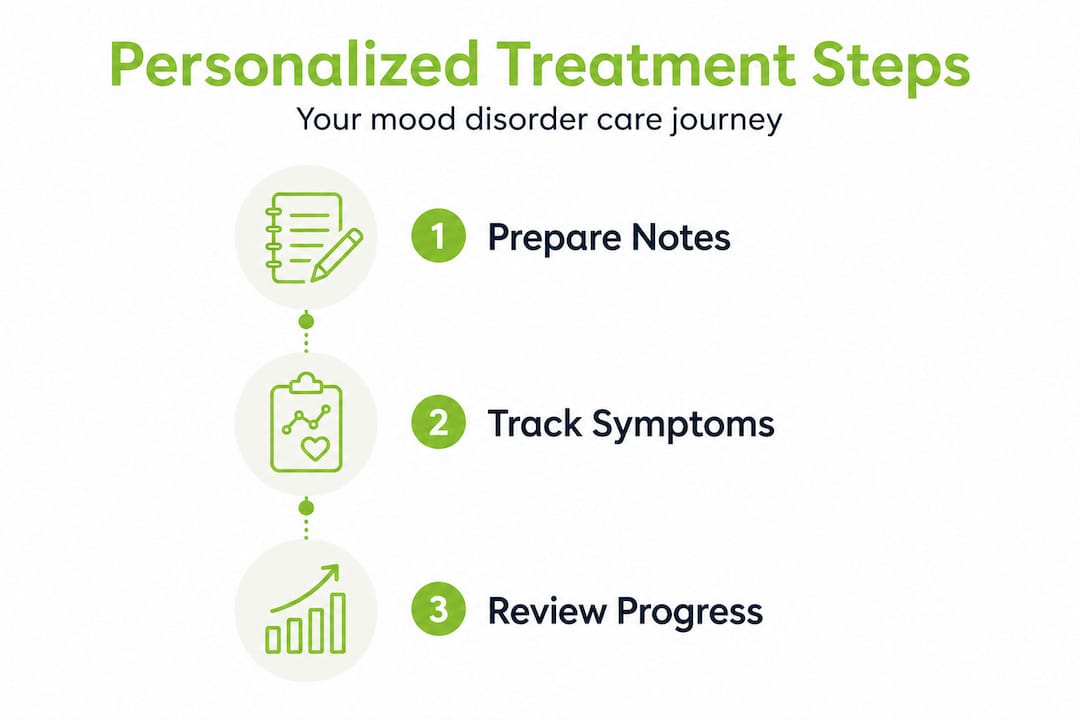
Step-by-step guide to medication management and response monitoring
Starting a new psychiatric medication can feel uncertain. Knowing what to expect at each stage makes the process less stressful and helps you catch problems early.
Step-by-step medication management:
- Informed consent: Before starting, your provider should explain how the medication works, common side effects, what to watch for, and how long before you might notice improvement. Ask questions. This is your treatment.
- Start low, go slow: Most antidepressants begin at a low dose to minimize side effects, with gradual increases based on your response. Do not adjust your dose on your own.
- Track weekly: Use your symptom diary to rate your mood, sleep, energy, and any side effects every week. Bring this record to every follow-up.
- Week four check-in: This is a critical milestone. If you have not noticed at least a 20% improvement in your core symptoms, discuss this with your provider. Early adjustment at this point, whether switching medication or increasing the dose, significantly improves your chances of remission.
- Consider combining treatments: If medication alone is not enough, adding psychotherapy, or exploring antidepressants and TMS together, often produces better outcomes than either alone.
- Plan for maintenance: Once you reach remission, most guidelines recommend continuing medication for at least six to twelve months to reduce the risk of relapse. Strategies for preventing relapse are an important part of any long-term plan.
Signs that your current medication may not be working:
- Less than 20% symptom improvement by week four
- Significant side effects that affect your daily life
- New or worsening symptoms, including increased anxiety or sleep disruption
- No change in energy or concentration after six weeks at a therapeutic dose
Safety note: Never stop a psychiatric medication abruptly without talking to your provider first. Stopping suddenly can cause withdrawal symptoms or a rapid return of depression. If you are concerned about side effects or lack of progress, call your provider before making any changes.
Pro Tip: Keep a simple weekly symptom rating, such as a number from 1 to 10 for mood, energy, and sleep, in a notes app on your phone. Show this to your provider at every visit. It removes guesswork and makes medication decisions much more precise.
Once medication and symptom tracking are underway, it is important to consider nuances, especially if bipolar disorder may be present.
Special consideration: Bipolar disorder and safety precautions
Bipolar disorder is frequently misdiagnosed as depression, sometimes for years. This matters enormously because the treatment approach is different, and using the wrong treatment can actually make things worse.
Mood stabilizers and atypical antipsychotics are the cornerstone of bipolar disorder treatment. Lithium, valproate, and medications like quetiapine or lamotrigine are commonly used. Antidepressants prescribed alone, without a mood stabilizer, can trigger mania or rapid cycling in people with bipolar disorder, which is why accurate diagnosis is so critical before starting any medication.
Understanding bipolar disorder treatment options, including newer approaches like ketamine for bipolar, is worth discussing with your provider if standard treatments have not been effective.
Signs that bipolar disorder may be present, rather than MDD alone:
- Periods of unusually elevated mood, increased energy, or decreased need for sleep
- Impulsive behavior, rapid speech, or grandiose thinking during “up” periods
- Rapid cycling between depression and elevated mood within weeks
- Family history of bipolar disorder
- Previous antidepressants that caused agitation, mania, or made things worse
When to seek specialty psychiatric care:
- You experience rapid mood changes that are difficult to manage
- Multiple antidepressants have failed or caused worsening symptoms
- You have had any episode of mania or hypomania
- Suicidal thoughts are present or intensifying
- Your current provider is uncertain about your diagnosis
Pro Tip: When you meet with your provider, share every mood episode you can remember, including the high periods, not just the lows. Many people only describe depression because that is what brought them in. But a history of elevated mood periods changes the entire treatment picture.
With the major edge cases covered, let’s review what to expect after following this guide.
Verifying progress and what to expect from treatment
Progress in mood disorder treatment is not always linear. Some people feel significantly better within four to six weeks of starting the right medication. Others need multiple adjustments before finding the right fit. Knowing what benchmarks to look for keeps you from giving up too soon or staying on an ineffective treatment too long.
Key benchmarks to watch:
- Response: At least 50% reduction in symptom severity from your baseline
- Remission: Minimal or no symptoms, with a return to normal daily functioning
- Recovery: Sustained remission over several months
Less than 20% symptom reduction by week four is a clear signal to reassess. Do not wait until week twelve to bring this up with your provider.
| Stage | What it means | Action to take |
|---|---|---|
| Week 4: less than 20% improvement | Early nonresponse | Switch or adjust medication |
| Week 8: partial response | Some improvement but not enough | Add therapy or increase dose |
| Week 12: no remission | Treatment-resistant pattern emerging | Consider TMS, ketamine, or specialty referral |
| Remission achieved | Symptoms minimal | Plan maintenance and relapse prevention |
Telehealth is a practical option for ongoing monitoring, especially if you are managing a stable condition and do not need in-person procedures. Regular video check-ins allow your provider to review your symptom diary, adjust medications, and catch early warning signs before they become a crisis. For more complex interventions, comparing options like TMS vs ECT or exploring mood instability solutions becomes relevant when standard treatments are not enough.
Having completed the step-by-step process, here is our perspective on what truly matters in mood disorder treatment.
What most guides get wrong about mood disorder treatment
Most treatment guides focus heavily on protocols: which medication to try first, which therapy to pair it with, and when to escalate. Protocols matter. But in our experience, the guides that stop there miss the two factors that actually predict whether someone gets better: consistent measurement and genuine patient involvement.
We see it regularly. Someone follows a protocol correctly but never tracks their symptoms between appointments. Their provider is essentially flying blind, adjusting treatment based on a brief conversation rather than real data. Or a patient feels hesitant to mention that a medication is making them feel worse because they do not want to seem difficult. These gaps, not the protocol itself, are often what stall progress.
“Individualized care is not just about choosing the right drug. It is about building a feedback loop between the patient and provider that makes every decision smarter than the last.”
The other thing most guides underplay is the emotional weight of this process. Recovery from a mood disorder is a journey, not a straight line. There will be weeks that feel like setbacks. That does not mean the treatment is failing. It means you are in a process that requires patience, honest communication, and a provider who is paying close attention. Tracking expert mood insights and bringing that data to every appointment is one of the most powerful things you can do for your own care.
Next steps: Personalized care with Nortex Psychiatry
If you are ready to move from uncertainty to a clear, evidence-based plan, we are here to help. At Nortex Psychiatry, we serve adults across North Dallas, including Allen, Frisco, McKinney, and Plano, with both in-person and telehealth appointments designed to fit your life. Whether you are exploring medication management for the first time, considering options like TMS vs neurofeedback, or wondering whether ketamine for bipolar might be appropriate for your situation, our team will work with you to build a personalized plan grounded in current evidence. You do not have to figure this out alone.
Frequently asked questions
How quickly should I see improvement with mood disorder treatment?
If you do not notice at least a 20% symptom reduction by week four of starting a new medication, the likelihood of full response by weeks eight to twelve is low, and your provider should consider switching or adjusting treatment at that point.
Are antidepressants safe for bipolar disorder?
Antidepressants used alone can trigger mania or rapid cycling in people with bipolar disorder, so mood stabilizers or atypical antipsychotics should form the core of any bipolar treatment plan.
What should I track to help my provider choose the right treatment?
Track your daily mood, sleep quality, energy levels, side effects, and any significant life events each week, and bring those written notes to every appointment so your provider has real data to work with.
What are the signs that my depression treatment needs to be changed?
If you have minimal symptom improvement at week four or are experiencing new side effects that affect your daily functioning, your provider may recommend switching medication, adjusting the dose, or adding a complementary therapy like CBT or TMS, based on early response guidelines.
Is telehealth as effective as in-person care for mood disorders?
For most mood disorders, telehealth can deliver personalized medication management, symptom monitoring, and treatment adjustments that are comparable in quality to in-person visits, making it a practical option for ongoing care.
Recommended
- Can TMS Therapy Improve Mood Instability? Expert Insights & Results – Nortex Psychiatry
- Can TMS Therapy Help with Bipolar Disorder? Expert Insights & Evidence – Nortex Psychiatry
- TMS Therapy vs. Medication: Which One Wins in Treating Depression? – Nortex Psychiatry
- TMS Therapy vs. Medication: Which One Is Right for You? – Nortex Psychiatry