


Bipolar disorder is a mood disorder built around distinct episodes of mania or hypomania and depression. Borderline personality disorder (BPD) is a personality disorder built around unstable relationships, self-image and emotions, with mood shifts that tend to follow what is happening between people. They look alike from the outside, they can occur together, and they are treated differently. In our work, getting that distinction right is often the most useful thing an evaluation does.
If you are reading this because you or someone you love has been given one of these labels, or fears one of them, we hope this helps you walk into an appointment with better questions.
TL;DR
- Bipolar disorder shows up as episodes: days to weeks of unusually high or irritable mood and energy, or of depression, with stretches of relative stability between.
- BPD shows up as a long-standing pattern: fast mood shifts, often set off by relationships, with fear of abandonment and impulsive behavior.
- The two can be diagnosed together, and each can be mistaken for the other, which is why a careful evaluation matters.
- Treatment differs: medication is the foundation for bipolar disorder, while structured psychotherapy is the core of BPD care.
- Neither is a character flaw. Both respond to the right plan, and we can help you start with an evaluation.
Table of Contents
- Why people mix them up
- The core difference: episodes versus a pattern
- A side-by-side view
- Triggers and relationships
- Can someone have both?
- How an evaluation sorts it out
- How treatment differs
- When to get an evaluation
- Where we can help
- Our perspective
- FAQ
- Sources
Why people mix them up
Part of the confusion is simply the abbreviation. “BPD” gets used for both bipolar disorder and borderline personality disorder, so a search for one often lands on the other.
The larger part is overlap. Both conditions can involve intense emotion, irritability, impulsive choices, sleep trouble and relationship strain. A review by Paris and Black notes that the two are frequently confused because of this symptomatic overlap, and that the difference matters clinically because a wrong label can leave a person without the treatment that would actually help.
The clinical guidelines say the same thing from the other direction. The CANMAT/ISBD bipolar guidelines warn that borderline personality disorder, substance use disorder and ADHD all overlap significantly with hypomania and mania, and that people with these conditions are often misdiagnosed with bipolar disorder.
The core difference: episodes versus a pattern
Think of bipolar disorder as weather that changes in seasons, and BPD as a climate that runs through a person’s whole life. That is a loose picture, but it holds up reasonably well in the office.
What bipolar disorder looks like
Bipolar disorder requires at least one episode of mania or hypomania. According to a 2023 JAMA review, mania is an elevated, expansive or irritable mood lasting at least a week with significant consequences. Hypomania, the milder form that defines bipolar II when paired with a depressive episode, lasts at least four consecutive days with elevated or irritable mood and increased energy.
During those periods the change is usually noticeable to other people. Someone sleeps three hours and feels fine, talks faster, takes on projects, spends money they do not have. Then, at another point, a depressive episode arrives. Between episodes, many people return to something close to their usual selves.
If you want the finer distinctions inside the bipolar family, we have written about bipolar I versus bipolar II and about cyclothymia versus bipolar disorder.
What BPD looks like
The National Institute of Mental Health describes BPD as a mental illness that severely affects a person’s ability to regulate emotions. The CANMAT/ISBD guidelines describe instability in relationships, self-image and mood, marked impulsivity, intense fear of abandonment, early onset and a long-standing course.
The mood shifts in BPD tend to be brief and reactive. In the Paris and Black review, BPD is characterized by transient mood shifts in response to interpersonal stressors, while bipolar disorder involves sustained mood changes. A canceled dinner, an unanswered text or a sharp tone can move someone from fine to devastated within hours. Then the mood moves again.
The CANMAT/ISBD guidelines add a useful detail: true euphoria and long, well-functioning stretches are extremely rare in BPD.
A side-by-side view
| Bipolar disorder | Borderline personality disorder | |
|---|---|---|
| Category | Mood disorder | Personality disorder |
| Mood pattern | Distinct episodes lasting days to weeks or longer | Rapid shifts, often within hours or a day |
| Typical trigger | Often arises with little outside cause; sleep loss can contribute | Often follows a real or perceived relationship stress |
| Energy and sleep | Mania or hypomania brings less need for sleep and high energy | Sleep and energy change with distress, not as a sustained high |
| Relationships | Strained during episodes | Central to the condition, with fear of abandonment |
| Between episodes | Often a return to baseline | Emotional sensitivity tends to continue as a pattern |
| Treatment foundation | Mood-stabilizing medication, with psychotherapy | Structured psychotherapy, with medication used selectively |
No row of this table diagnoses anyone. Real people mix and blur these columns, which is exactly why clinicians look at the whole history.
Triggers and relationships
One of the more helpful questions we ask is: what was happening right before the shift? When someone can trace the mood to an event, especially one involving another person feeling distant or rejecting, that points toward BPD. When a stretch of high energy or deep low mood came on over days with no clear reason, we think harder about bipolar disorder.
This is not a clean rule. A person with bipolar disorder can certainly be upset by a fight with a partner, and a person with BPD can have a long depression. We use the question as a pointer, not a verdict.
It also helps to remember that a hurtful comment in the middle of a manic or irritable episode, or in the middle of a BPD-related surge of anger, is usually the illness talking in a moment of distress. That does not make it painless for the person on the receiving end. It does mean the conversation about treatment is often more productive when everyone is calm.
Can someone have both?
Yes. The CANMAT/ISBD guidelines state that BPD can occur alongside bipolar disorder. The JAMA review reports that roughly 65% of people with bipolar disorder have at least one other psychiatric condition, including a personality disorder in about 36%, an anxiety disorder in about 71% and substance use in about 56%. It also lists BPD with affective dysregulation as a common alternative diagnosis to consider.
The American Psychiatric Association’s 2024 guideline on BPD makes the same point from the BPD side: people with BPD commonly have co-occurring conditions such as major depression, bipolar disorder and PTSD.
If both are present, the plan usually addresses both. That is one reason we do not like to rush a label in the first visit.
How an evaluation sorts it out
A good psychiatric evaluation is mostly careful listening. We have learned that the most telling information is rarely a checklist score. It is the timeline.
Expect questions along these lines:
- When did you first notice these shifts, and how long has the pattern run?
- How long does a high or low last: hours, days or weeks?
- During a high, do you need less sleep and still feel energetic?
- What was going on just before your mood changed?
- Have family members had bipolar disorder, depression or substance problems?
- Have you used alcohol, cannabis or other substances, or taken stimulants or antidepressants?
- Have you ever hurt yourself or thought about suicide?
The APA guideline recommends that an initial assessment review the core features of personality disorders and the common co-occurring conditions, along with a risk assessment for suicide, self-injury and aggression. It also suggests using a quantitative measure to gauge symptom severity and functional impairment.
It helps enormously if you bring a loose mood diary, or a family member’s observations, and a list of past medications and how you responded. Our guides on the bipolar diagnosis process and on what to bring when depression versus bipolar is the question walk through this in more detail. If depression has been your main complaint, the diagnostic line between bipolar and depression is worth reading too, because it changes which medications make sense.
How treatment differs
Bipolar disorder
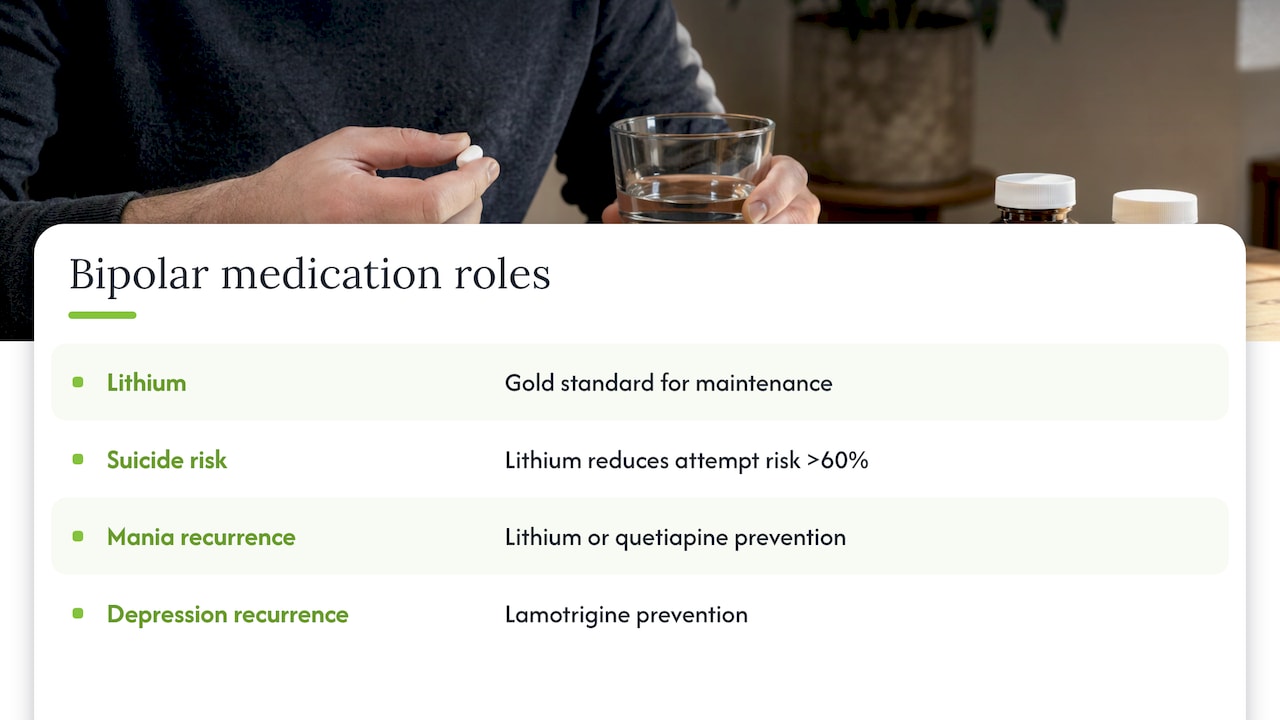
Medication is the backbone. A 2025 update from Massachusetts General Hospital and Harvard by Roy H. Perlis, MD, describes lithium as the gold standard for maintenance treatment. The same update points to a 2013 analysis finding that lithium reduces suicide attempt risk by more than 60%. A VA/DoD and NICE guideline comparison notes that U.S. guidance recommends lithium or quetiapine to prevent recurrence of mania, and lamotrigine to help prevent depressive recurrence.
Dosing and monitoring are individual, and they belong in a conversation with your prescriber, not in an article. If you want to understand the roles these medicines play, we explain them in mood stabilizers for adults and caregivers, and in what regular check-ins look like during bipolar depression treatment.
Antidepressants deserve a particular mention. When bipolar disorder is missed and depression alone is treated, an antidepressant by itself can sometimes stir up mood instability. This is one more reason the diagnosis comes first.
BPD
The APA guideline puts structured psychotherapy at the center, aimed at the core features of the condition. It lists dialectical behavior therapy (DBT), cognitive behavioral therapy, mentalization-based treatment, transference-focused psychotherapy, schema-focused therapy and dynamic deconstructive psychotherapy as approaches clinicians may discuss. The guideline’s implementation section notes that fidelity, intensity and duration of treatment can affect how much someone benefits. Learning more about psychotherapy in clinical practice can help you picture what regular sessions involve.
Medication has a supporting role. The guideline suggests it be time-limited, aimed at a specific measurable symptom, used alongside psychotherapy and reviewed at least every six months. That is where a psychiatrist is useful: sleep, severe anxiety, depression or co-occurring conditions can be treated while the therapy does the deeper work.
When to get an evaluation
Consider booking one if any of this sounds familiar:
- Moods that swing enough to disrupt work, school or home, and that have for months
- Several days of little sleep and high energy that feel unlike you
- Repeated depression that has not responded well to antidepressants
- Intense fear of being left, with relationships that keep ending in crisis
- Self-harm, risky behavior or thoughts of suicide
If you are in crisis or thinking about ending your life, call or text 988. The 988 Suicide & Crisis Lifeline offers free, confidential support 24 hours a day, 7 days a week. For immediate danger, call 911.
Parents of teens and young adults often ask whether a teen’s mood swings are “just adolescence.” Some are. If the pattern is intense, lasts, or comes with self-harm, an evaluation is reasonable, and a calm conversation beats waiting.
Where we can help
Nortex Psychiatry is a practice in Allen, Texas, serving adults and families across North Dallas, including Frisco, McKinney and Plano. We offer psychiatric evaluations and medication management for mood disorders, anxiety, depression and ADHD, with in-person and telehealth visits available. For depression that has not eased with standard treatment, we also offer TMS therapy, Spravato and ketamine therapy. Our mood disorder treatment guide describes how we think about building a plan, and you can start from our home page.
Our perspective
We do not start with the label. We start with the story: when it began, how long the lows and highs last, what sets things off, and what has already been tried. The label usually becomes clearer over a few visits, and sometimes we change our minds as we learn more.
What we have learned is that people are relieved by a more accurate explanation, even when it is a hard one. A person who has been told for years that they are “just moody” often hears, for the first time, that what they live with has a name and a plan.
We also try to be honest that recovery is not a straight line. Whether the answer is bipolar disorder, BPD, both, or something else such as ADHD or anxiety that looked like one of them, the work is steady and collaborative. We would rather take the time to get it right than hand over a quick answer.
Felix
FAQ
Is borderline the same as bipolar?
No. Bipolar disorder is a mood disorder defined by episodes of mania or hypomania and depression. Borderline personality disorder is a personality disorder marked by unstable relationships, self-image and emotions. They share a nickname and some symptoms, which is why they are confused.
Can bipolar disorder be mistaken for BPD, or the reverse?
Yes, in both directions. The CANMAT/ISBD guidelines say BPD, substance use and ADHD are often misdiagnosed as bipolar disorder because their symptoms overlap with hypomania and mania. A detailed timeline of mood, sleep and triggers is the best way to separate them.
Which one has faster mood swings?
BPD is usually associated with quicker shifts, often within hours and often tied to interpersonal events. Bipolar episodes tend to last longer, from days to weeks, and the mood change is sustained rather than fleeting.
Is one treated with medication and the other with therapy?
That is the general pattern. Medication is central for bipolar disorder, while the APA recommends structured psychotherapy as the core of BPD treatment, with medication used in a limited, targeted way. People with both conditions often need both approaches.
How do I start if I am not sure which one I have?
Book a psychiatric evaluation and bring a mood timeline, a medication history and any family history you know. If you live in the North Dallas area, you can reach us through our website, and telehealth visits are available.
Sources
- Borderline Personality Disorder and Bipolar Disorder (Paris and Black, 2015)
- CANMAT/ISBD guidelines for bipolar disorder (2018)
- Diagnosis and Treatment of Bipolar Disorder: A Review (JAMA, 2023)
- APA Practice Guideline for Borderline Personality Disorder (2024)
- APA guideline statements and implementation (2024)
- Long-Term Treatment in Bipolar Disorder (Perlis, 2025)
- VA/DoD and NICE bipolar guideline comparison (2026)
- NIMH: Borderline Personality Disorder
- About 988 Suicide & Crisis Lifeline