

Some people gain weight on an SSRI and many do not. The amount depends on which medication you take, how long you take it, and your own body. Across large studies the average difference between one SSRI and another is small, often under a pound or two in the first six months. But it is real for some people, and it is a fair reason to speak up. If the scale is moving and you are worried, you do not have to choose between your mood and your health. There are ways to adjust, and we would rather hear about it early than have you quietly stop a medication that is helping.
TL;DR
- Weight change on antidepressants is real but varies a lot from person to person, and it tends to show up more with longer use than in the first weeks.
- In a large U.S. study, escitalopram, paroxetine and duloxetine users gained a little more than sertraline users at six months, while bupropion users gained less.
- Fluoxetine, bupropion, vortioxetine, and some other agents are usually described as lower weight impact. Paroxetine and mirtazapine are more often linked to gain.
- If you notice a change, do not stop the medication on your own. Tell your prescriber, who can review the dose, the drug, and your other options.
- Tracking your weight early, in the first month or two, gives you and your prescriber something concrete to work with.
Table of Contents
- How much weight do antidepressants actually add?
- Why it happens
- Early weight loss, later weight gain
- Which antidepressants carry more or less risk
- Weight-neutral options and what “neutral” means
- Who is more likely to gain
- What to do if you notice weight gain
- When medication is not the only path
- Perspective
- Getting care in North Dallas or by telehealth
- FAQ
- Sources
How much weight do antidepressants actually add?
The honest answer is: usually not a lot, but not nothing. A 2024 study in Annals of Internal Medicine followed 183,118 new antidepressant users in the United States. At six months, people taking escitalopram gained about 0.41 kg (roughly 0.9 lb) more than people taking sertraline. Paroxetine users gained about 0.37 kg more, and duloxetine users about 0.34 kg more. Bupropion users gained about 0.22 kg less than the sertraline group.
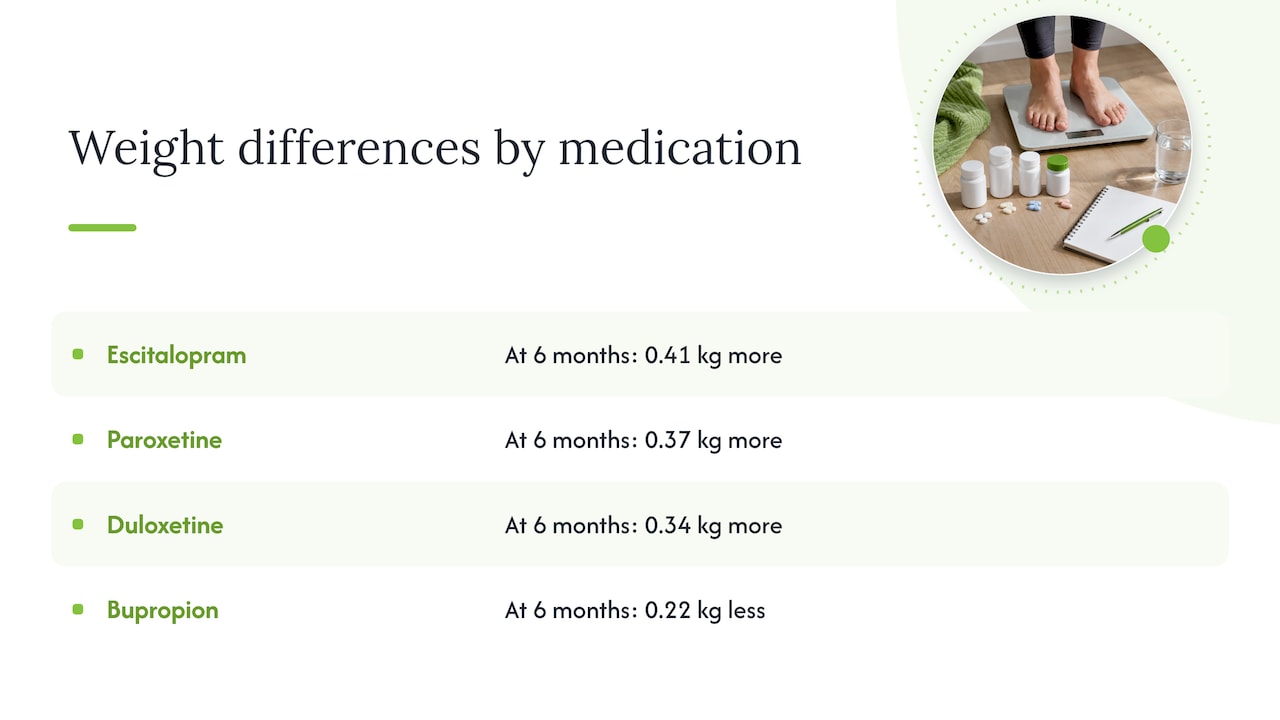
Those averages sound tiny, and for the group as a whole they are. What matters more is the spread. In the same study, escitalopram, paroxetine and duloxetine carried a 10% to 15% higher chance of gaining at least 5% of starting body weight, while bupropion carried a 15% lower chance. For a person who weighs 180 pounds, 5% is nine pounds. Averages hide the people at the edges, and those people are often the ones who end up in our office.
Another analysis, from the GUIDED study, looked at people being treated for depression and found that 18.0% had gained at least 3% of their body weight by 12 weeks, and 25.3% by 24 weeks. In that analysis, antipsychotics and tricyclic antidepressants were the drug types most often tied to gain.
A 2011 review reported that an average gain of 1 to 3 kg occurs in about 10% to 20% of patients on antidepressants. In our work, that range fits what we notice: most people see little change, a smaller group sees a modest change, and a few see a lot.
Why it happens
There is no single cause, which is part of why it is hard to predict. A 2026 literature review describes several mechanisms: effects on histamine, muscarinic and serotonin 5-HT2C receptors, and changes in appetite-regulating signals such as leptin and ghrelin. Put plainly, some medications can make you hungrier, make you crave carbohydrates, or slow how you burn energy.
There is also a part that has nothing to do with the pill. Depression itself can suppress appetite. When you start to feel better, appetite often returns, and sleep and energy change too. Some of the weight you see in month four may be recovery rather than a side effect. We cannot always separate the two, and we do not pretend to. That is one reason we like to know your starting weight and check in over time.
Early weight loss, later weight gain
Timing matters. The same 2026 review notes that short-term treatment may cause some initial weight loss, while long-term use often leads to gradual gain. An older meta-analysis in the Journal of Clinical Psychiatry found the same pattern for some drugs. Fluoxetine was associated with some weight loss, but that effect seemed limited to the early phase. A clinical summary of the 116 studies adds that paroxetine showed marginal weight loss early on but significant gain after eight months.
That has a practical meaning. If you are six weeks into a medication and your weight is flat, that is good news but not the final word. Weight is worth watching at three, six and twelve months. Long-term medication effects are not limited to the scale either. If you want to read about another effect that can show up with long-term use, this overview of SSRI bone loss research is worth a look.
Which antidepressants carry more or less risk
No antidepressant is guaranteed to be free of weight effects, and individual response varies. Still, the groups are fairly consistent across sources. Here is how the main ones line up.
| Medication group | Examples | Weight tendency in the evidence |
|---|---|---|
| Lower weight impact | Bupropion, fluoxetine, vortioxetine, trazodone, desvenlafaxine, venlafaxine, duloxetine | Bupropion is associated with weight loss; the others are generally favored when weight is a concern |
| Middle ground | Sertraline, citalopram, escitalopram | Modest gain in some people, more often with longer use |
| Higher weight impact | Paroxetine, mirtazapine, tricyclics, MAOIs | More likely to be linked with gain |
This table follows the VA/DoD clinical guideline on medications and weight (March 2026 version), which advises favoring minimal-weight-impact antidepressants such as bupropion, fluoxetine, trazodone, vortioxetine and some SNRIs. It lists paroxetine, sertraline, citalopram, escitalopram, tricyclics, MAOIs and mirtazapine among those linked with weight gain. The “middle ground” row is our own simplification of how the sources compare sertraline, citalopram and escitalopram with the others.
A few details are worth knowing:
- Paroxetine is the SSRI most often named as weight-promoting in the 2026 review, while fluoxetine is described as the most favorable SSRI.
- Mirtazapine has weight gain in its label. In its U.S. prescribing information, 7.5% of patients gained at least 7% of body weight versus 0% on placebo, and 8% of patients in long-term open-label studies stopped it because of weight gain.
- Bupropion held its weight advantage over time. In the 2024 study, bupropion users gained less than sertraline users at 12 months (0.71 kg less) and at 24 months (0.91 kg less).
- Duloxetine and venlafaxine showed less 24-month gain than sertraline in the same study, by 0.69 kg and 0.59 kg.
- Vortioxetine and vilazodone are described in the 2026 review as promising for limiting metabolic burden.
When people ask us which antidepressant causes the least weight gain, we tell them the question is a good starting point but not the final answer. The medication that is easiest on your weight is no help if it does not treat your symptoms, or if it worsens your sleep or anxiety. Bupropion, for example, is not the right fit for everyone. The choice depends on what you are treating, what has worked before, what else you take, and your medical history.
Weight-neutral options and what “neutral” means
People search for weight-neutral antidepressants hoping for a clean answer. A more accurate phrase is “lower weight impact.” Bupropion is the clearest case: the 2011 review states it may be the only modern antidepressant that lowers weight, and the clinical summary of the 116-study analysis found it was the only one to keep a significant weight-lowering effect beyond the acute phase.
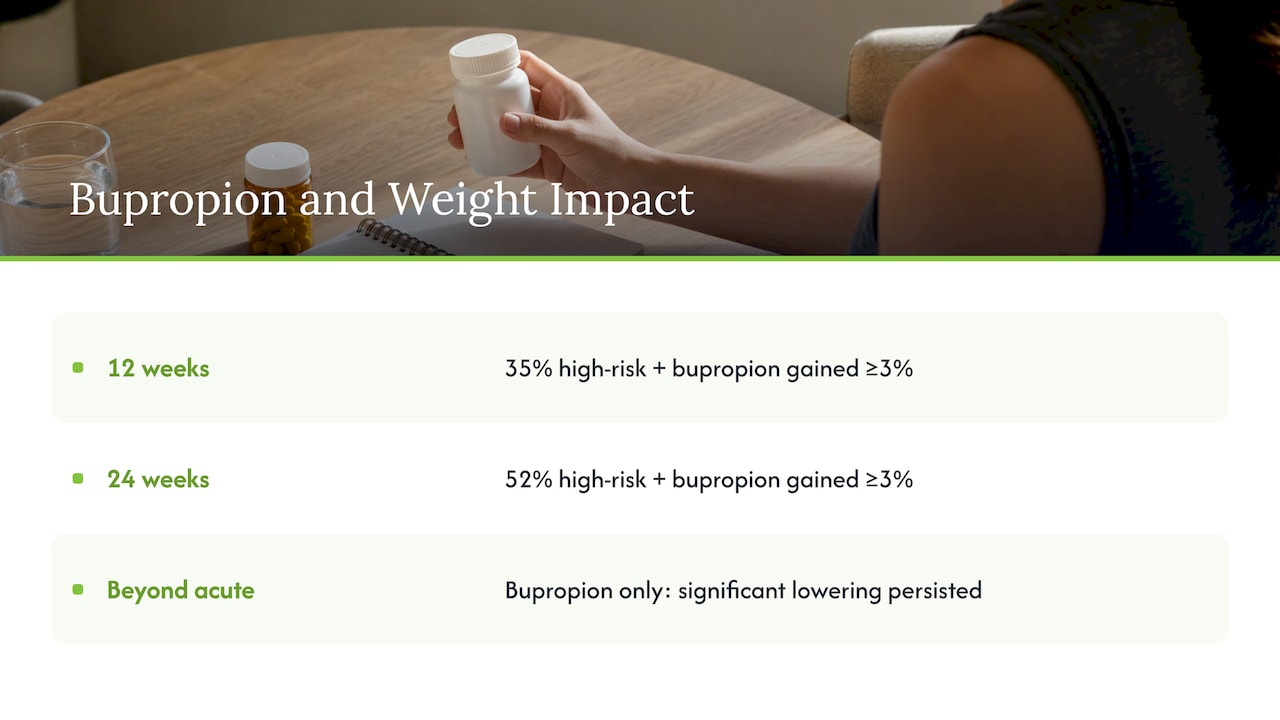
A caution from the research: adding bupropion on top of a medication known to cause gain does not reliably cancel it out. In the GUIDED analysis, among people on high-risk drugs who also took bupropion, 35% gained at least 3% of body weight at 12 weeks and 52% at 24 weeks. Their risk at week 24 was higher than in high-risk patients not on bupropion. So the combination is not a weight fix by itself, and it is a decision for a prescriber, not a do-it-yourself one.
The same clinical summary also advises thinking about how long you expect to be on treatment when choosing a drug, and not assuming all SSRIs share one weight profile. We agree with both points.
Who is more likely to gain
We cannot predict this perfectly, but some things shift the odds. A 2025 review names genetics, including CYP2C19 metabolizer status (how quickly your liver enzymes break down certain medications), along with baseline BMI and diet. It also reports that long-term antidepressant use is tied to weight gain in up to 55% to 65% of patients, with tricyclics, MAOIs and mirtazapine causing the largest increases and SSRIs typically causing gain after prolonged use. Those figures come from a review pooling many kinds of studies, so we read them as a ceiling on what is reported rather than a typical outcome.
A few other things we pay attention to in the room:
- A history of weight changes on past medications.
- Sleep that has changed, either too much or too little.
- Other medications that can affect weight, such as certain mood stabilizers and antipsychotics.
- Thyroid, blood sugar or other medical conditions that overlap with depression.
The 2026 review also points to something we think is useful: a 5% weight increase in the first month of treatment was linked to a 5.5-fold higher risk of metabolic syndrome by month six. Metabolic syndrome is a cluster of conditions, including higher blood pressure, blood sugar and waist size, that raise heart and diabetes risk. We would not panic over one reading. But it supports checking early, not waiting a year.
What to do if you notice weight gain
Start by not stopping the medication on your own. Stopping an antidepressant suddenly can cause discontinuation symptoms and can bring the depression or anxiety back. If you are considering a change, switching antidepressants should be planned, with a taper that fits the drug and your history.
Here is the order we usually suggest.
- Write down your numbers. Note your weight before you started, if you know it, and your weight now. A home scale is fine. Weigh at the same time of day, once a week at most, so you are not chasing daily noise.
- Note what else changed. Appetite, cravings, sleep, activity, alcohol, stress. This helps separate a drug effect from a life effect.
- Tell your prescriber. Be specific: how much, over how long, and how it affects you. If it is hurting your willingness to keep taking the medication, say that too. That is exactly the kind of information that changes our recommendations.
- Talk through the options. These usually include adjusting the dose, changing to a lower weight impact medication, adding something, or working on nutrition and activity alongside treatment. The 2025 review lists switching medications, adding metformin or GLP-1 receptor agonists, and behavioral interventions as mitigation strategies. Whether any of those fits you is a clinical decision made with your prescriber and, for some of them, your primary care doctor.
- Give a change time. A new medication needs several weeks before you can judge it. We would rather you hold steady and call us than judge it after ten days.
If you are looking at how food might change while you are on any weight-related medication, these GLP-1 diet guidelines show how people track eating and body changes. Keep any new diet or medication discussion in the same conversation with your prescriber, so nothing conflicts.
The American College of Physicians, as summarized in the 2025 review, recommends considering weight-gain potential when first choosing an antidepressant, and switching to a less weight-inducing option when necessary. That is a sensible principle, and it is how we approach the first prescription: ask about weight history up front, not after the problem starts.
If your antidepressant is not helping enough on top of the weight concern, our page on what to do when your antidepressant isn’t working walks through the next steps. For a broader look at what to expect, see our guides to SSRI side effects and antidepressant side effects.
When medication is not the only path
Some people come to us after more than one medication, with side effects that wore them down. For depression that has not responded well to standard antidepressants, there are treatments that work differently. We offer TMS therapy, Spravato and ketamine therapy at our Allen, Texas practice, in addition to medication management and telehealth visits across Texas. If you are wondering whether TMS changes the weight picture, we have written about TMS therapy and weight gain. Spravato has its own place in the picture, which we compare in Spravato versus traditional antidepressants.
We are not saying these are the answer for everyone. Many people do well on a well-chosen SSRI or bupropion and never need anything more. But it helps to know the options exist.
Perspective
When someone tells us they have gained weight on an antidepressant, we notice that they often apologize first. They say they know it is a small thing compared with feeling better. It is not a small thing. Body image, energy and trust in a medication are all tied up in it, and people who feel dismissed tend to stop treatment quietly.
What we have learned is that weight deserves a place in the very first conversation. We ask about past weight changes, sleep, appetite and what matters most to you, then we choose a starting medication with that in view. We check in early, because early changes tell us more than a late surprise does.
We also lean on a wider toolkit than a single prescription. Our practice treats depression, anxiety, ADHD and mood disorders with medication management, and also offers TMS, Spravato, ketamine and stellate ganglion block therapy. Our approach is personalized and evidence-based, and we want you to leave a visit feeling heard, not hurried. Recovery is a journey, not a straight line, and adjusting the plan is part of the work.
Felix
Getting care in North Dallas or by telehealth
If you live in Allen, Frisco, McKinney, Plano or nearby, you can see us in person. If your schedule is tight, telehealth is available for patients in Texas, which is often easier for follow-up weight and side-effect check-ins. If you are already on an antidepressant and the scale concerns you, or you are about to start one and want to pick it with weight in mind, you can book through our site. Bring your medication list and your weight history if you have it. If insurance is a question, mention it when you book and we will go from there.
FAQ
Which SSRI causes the most weight gain?
Paroxetine is the SSRI most often named as the most weight-promoting in the research. In the 2024 U.S. study, escitalopram and paroxetine users also gained more than sertraline users at six months. Individual response varies a great deal, so a name on a list does not predict what you will experience.
Which antidepressant causes the least weight gain?
Bupropion is the one most consistently associated with weight loss or less gain, and fluoxetine is generally the most favorable SSRI. Vortioxetine, trazodone and some SNRIs are also listed as lower impact in the VA/DoD guidance. The best choice still depends on your symptoms and history, so it should be made with your prescriber.
How can I avoid weight gain on an SSRI?
The most useful steps are choosing a medication with weight in mind, noting your starting weight, and checking in during the first months. Regular movement, steady sleep and attention to eating patterns support that, though they do not guarantee anything. If gain starts, talk to your prescriber before changing or stopping the medication.
Do antidepressants cause weight gain right away?
Not usually. Some people lose a little weight early, and gain tends to appear gradually with longer use. That is why checking at three, six and twelve months is more informative than a single early reading.
Sources
- Medication-Induced Weight Change Across Common Antidepressant Treatments (Annals of Internal Medicine, 2024)
- Obesogenic Medications and Weight Gain Over 24 Weeks (GUIDED analysis)
- Weight Gain, Obesity, and Psychotropic Prescribing (2011 review)
- From pills to pounds: prospective insights into the weight effects of antidepressants (2026 review)
- Antidepressants and Body Weight: A Comprehensive Review and Meta-Analysis
- Clinical Summary: Antidepressants and Body Weight
- VA/DoD guideline: Medications and their Effect on Weight (March 2026)
- Mirtazapine prescribing information, DailyMed
- Impact of Antidepressants on Weight Gain: Underlying Mechanisms (2025 review)
- SSRI bone loss research
- GLP-1 diet guidelines