Accelerated TMS is transcranial magnetic stimulation given several times a day instead of once a day, so a course that usually takes about six weeks can be compressed into days or a couple of weeks. The best-known version is the SAINT protocol, which is FDA-cleared for treatment-resistant depression. The research is encouraging, but the schedules are not standardized, and the details matter more than the label. Below we walk through what we know, what is still unsettled, and how to decide whether TMS makes sense for you.
TL;DR
- Accelerated TMS means more than one session per day. Published protocols range from 2 to 10 sessions daily over 2 to 30 days.
- SAINT (now called SNT) is the version the FDA cleared in 2022: 10 short sessions a day for 5 days, with MRI-guided targeting.
- Reviews find accelerated schedules work about as well as once-daily TMS. They have not shown that faster is better.
- Many accelerated protocols are still being studied. Ask any clinic exactly which protocol they use and what evidence sits behind it.
- If you live in North Dallas and want to know whether TMS fits your situation, we can start with an evaluation.
Table of Contents
- What accelerated TMS actually means
- SAINT: the protocol with FDA clearance
- What the evidence shows so far
- Why a faster course might help
- Safety and what a session feels like
- Who may be a candidate
- Questions worth asking about any accelerated program
- Where TMS fits with other treatments
- Perspective
- Starting with an evaluation in North Dallas
- FAQ
- Sources
What accelerated TMS actually means
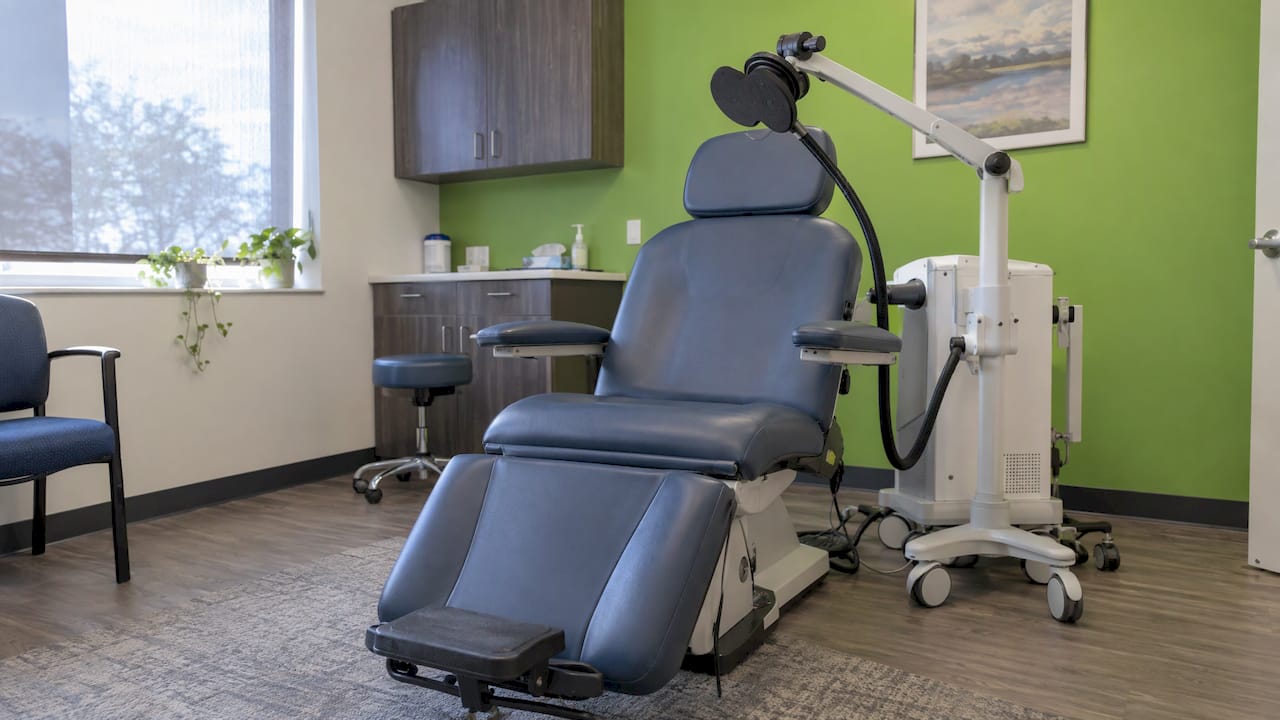
Standard TMS uses a magnetic coil placed against the scalp to stimulate a part of the brain involved in mood, usually the left dorsolateral prefrontal cortex. You sit in a chair, awake, and go home afterward. In the conventional course, you come in once a weekday for about six weeks.
Accelerated TMS keeps the same basic tool and changes the schedule. A review in Neuropsychopharmacology defines it simply as any protocol that delivers more than one TMS session in a day. That is a broad definition, and it is worth sitting with for a moment. “Accelerated TMS” is not one treatment. It is a family of schedules.
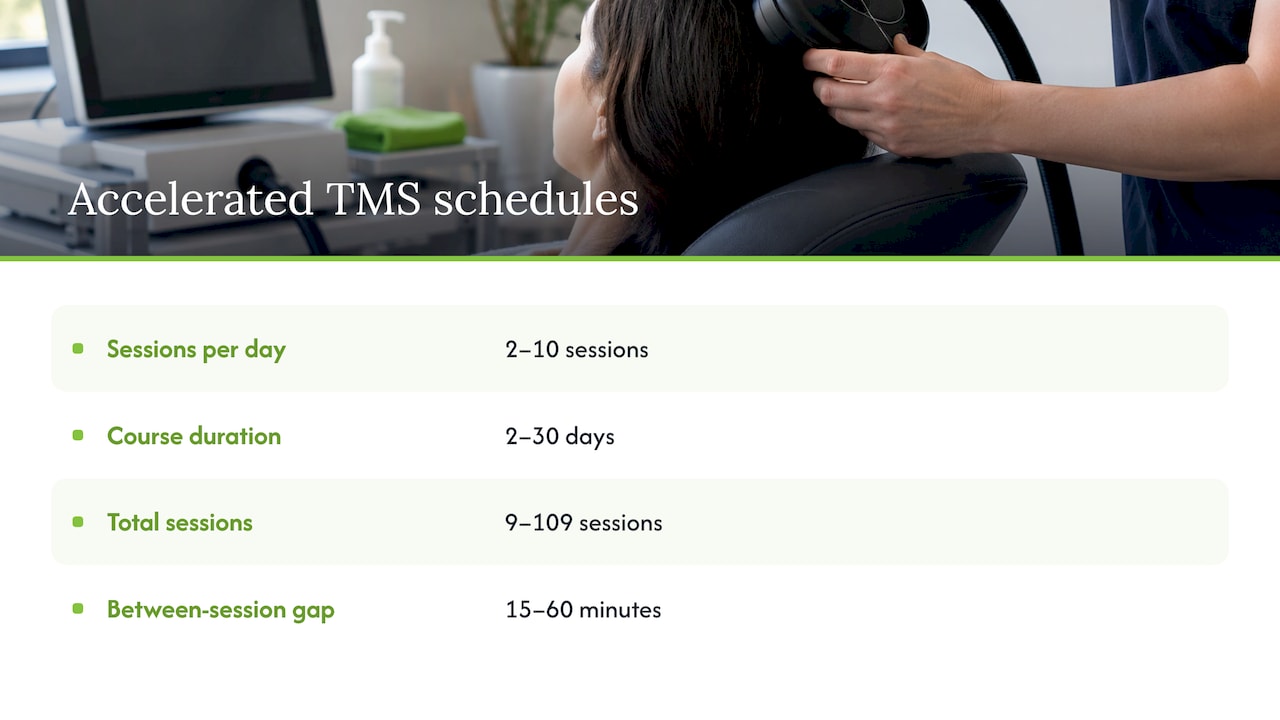
The same review found that these protocols differ across nine core elements, including the stimulation frequency, the total dose, how the target is chosen, and the gap between sessions. The American Journal of Psychiatry’s 2025 clinician’s guide reports the spread: 2 to 10 sessions per day, courses of 2 to 30 days, 9 to 109 total sessions, and 15 to 60 minutes between sessions.
So when a patient says, “I heard there’s a five-day version,” we usually ask which one. The answer changes what you should expect.
SAINT: the protocol with FDA clearance
SAINT stands for Stanford Accelerated Intelligent Neuromodulation Therapy. The device was FDA-cleared on September 6, 2022 for treatment-resistant depression, according to the Clinical TMS Society’s revised statement. The statement describes the protocol this way:
- 10 intermittent theta burst (iTBS) sessions per day
- 1,800 pulses per session
- 50 minutes between sessions
- 5 days in a row
- Targeting through individual functional MRI and neuronavigation
That adds up to 90,000 pulses, which the AJP guide notes is the same total as a six-week once-daily 10 Hz course. Standard FDA-cleared iTBS, by comparison, is one 600-pulse session a day for 36 days, with the target found by scalp measurements.
Two things stand out. First, the dose is much higher per day. Second, the targeting is personalized with brain imaging. Both may matter, and nobody yet knows which matters more.
It is also worth knowing that the system was cleared in 2022 but, according to a December 2024 consensus review endorsed by the National Network of Depression Centers, the Clinical TMS Society and the International Federation of Clinical Neurophysiology, it only became commercially available in 2024. Availability is still limited, and that is one practical reason people hear about it more than they can get it.
What the evidence shows so far
The early results were striking. In the original open-label study published in the American Journal of Psychiatry in 2020, 19 of 21 people who finished treatment (90.5%) met remission criteria, with no serious adverse events and no negative cognitive effects. “Open-label” means everyone knew they were receiving real treatment, and that tends to flatter results. The study was also small.
The randomized, sham-controlled trial behind the FDA clearance was small too: 14 people in the active group and 15 in the sham group. Good signal, modest size.
Broader reviews give a more even picture:
- A meta-analysis of 11 accelerated TMS studies found the treatment improved depression severity. The effect was smaller (g=0.39) when only the three randomized trials were counted, and larger (g=1.27) when open-label studies were included.
- A transdiagnostic review reported an average response of 42.4% and remission of 28.4% across accelerated studies, with a very wide range between studies. Conventional once-daily TMS in the same review landed around 30% remission and 60% response in treatment-resistant samples.
- A large randomized trial of 300 people, cited in the AJP guide, found no significant difference in response between 20 accelerated bilateral theta burst sessions over 10 days and 20 once-daily left-sided sessions over four weeks.
- A 2018 review likewise found no significant differences in remission or response between accelerated and classical daily stimulation of the left prefrontal area.
Put plainly: accelerated schedules appear to be about as effective and about as safe as the once-daily approach, and they get you there sooner. That speed is the real benefit. It is not proof that a faster course produces a better result.
How long benefits last
This is the question we hear most from patients, and it is the one with the least certainty. The 2024 consensus review lists independent replication, targeting reproducibility, long-term durability and head-to-head comparison with other cleared devices as still needed. Anyone who promises you a specific length of relief is going beyond the data. If you want to read more about durability with standard TMS, we cover it in Does TMS Therapy Have Long-Term Benefits?
Why a faster course might help
The thinking behind acceleration is fairly simple. The authors of the meta-analysis note that repeated stimulation within a short interval can produce equal or greater effects on cortical excitability, including when a second session follows within 24 hours of the first. And Cole and colleagues reasoned that standard protocols may simply be underdosed: 61% of rTMS nonresponders in earlier data responded to additional sessions.
The reviewers of the transdiagnostic literature add that rapid onset is most valuable for people who are acutely suicidal, those with serious medical conditions who need a short course, and patients who travel to receive treatment. If you are in crisis, TMS is not the first step. Call or text 988, the Suicide and Crisis Lifeline, or go to the nearest emergency room, and we can talk about longer-term treatment once you are safe.
Safety and what a session feels like
TMS has a long safety record. The National Institute of Mental Health’s overview of TMS safety says the most common side effect is a headache during or just after treatment, and the most serious known one is a seizure, which is rare. Other effects include scalp discomfort and facial muscle twitching during stimulation.
With accelerated schedules, the AJP guide notes reviews show similar safety to once-daily treatment, with more scalp sensations, discomfort and headaches. That makes sense. More stimulation in a day is more to feel. The SAINT study itself reported no serious adverse events and no negative cognitive effects.
What you can expect on the day:
- You are awake and seated. No anesthesia.
- You hear clicking and feel tapping on your scalp.
- Sessions are short, but with accelerated schedules there are several, with breaks between.
- You can usually drive and go back to your day afterward, though a long day of repeated sessions can be tiring.
If scalp discomfort is a problem, tell the technician right away. Intensity and coil position can often be adjusted.
Who may be a candidate
Eligibility for TMS in general is where we begin, because accelerated or not, the same screening applies. A Blue Shield of California medical policy, which is typical of how many insurers frame it, says TMS may be considered for treatment-resistant major depression in people 15 or older who have not responded adequately to two antidepressants, or who cannot tolerate medications, or who responded to TMS before. Absolute contraindications include metal implanted in the head or neck, cochlear implants, MRI-unsafe devices and ferromagnetic tattoos. A pacemaker, a history of epilepsy or a brain lesion are relative contraindications, meaning they call for a careful medical discussion.
Policies differ by insurer, so your own plan’s criteria are what count. We have written more about this in Who Is a Good Candidate for TMS Therapy?
A few practical notes from the kinds of conversations we have:
- Many people arrive after trying two or three medications. If you are unsure what counts as an adequate trial, bring a list with doses and dates. Understanding the SSRI side effects timeline can also help you describe what you experienced, and never stop an antidepressant without your prescriber’s guidance.
- Parents of teens often ask about age. The policy above references age 15 and older for depression, but insurance rules and device clearances vary, so the evaluation is where we sort it out.
- Busy professionals are often drawn to a five-day course. That is understandable. The question to ask first is whether the specific protocol has evidence behind it.
Questions worth asking about any accelerated program
Because the schedules are not standardized, how a clinic delivers treatment matters. The Clinical TMS Society cautions that following the FDA-cleared SAINT protocol requires structural and functional MRI, neuronavigation equipment and expertise, and a proprietary targeting algorithm, and that the effectiveness of SAINT-like schedules delivered without that targeting is not known.
So a useful conversation covers:
- Which protocol, how many sessions a day, and for how many days
- How the treatment site is located
- What your insurance covers and what it does not
- What happens in the weeks after, including follow-up and medication planning
These are fair questions for any prescriber, and we welcome them from our own patients.
Where TMS fits with other treatments
TMS is one option among several for depression that has not responded to medication. Depending on your history, we might discuss it alongside Spravato, ketamine or a medication change. If you want the comparisons, see TMS Therapy vs. Medication and TMS Therapy vs. ECT. For the wider evidence on standard protocols, rTMS for Depression: Evidence, Protocols, and Next Steps is a good place to continue.
Perspective
In our work, the question is rarely “how fast can we do this?” It is usually “what has already been tried, and what is wearing you down?” People come in tired. Some have been through several medications. They want something that works, and sometimes they want it quickly.
We have learned to be careful with the word “accelerated.” The studies are promising, and the idea of a denser schedule makes sense to us. But the research is young, and the protocols differ enough that two clinics can use the same word for different treatments. We would rather explain the evidence plainly than oversell a shortcut.
What we do feel confident about is TMS itself. It is a non-drug, FDA-cleared treatment for depression, it is done awake, and it lets most people return to their day. For many of our patients in Allen, Frisco, McKinney and Plano, it has been a real option after medications fell short. We often notice that the evaluation, listening to the whole story, does as much good as any schedule.
Recovery is not a straight line. We would like to walk through it with you.
Felix
Starting with an evaluation in North Dallas
If you are weighing TMS, the first step is a conversation about your history, your symptoms and what you have tried. We see patients in person in Allen and serve people across Frisco, McKinney, Plano and surrounding areas, and telehealth is available for visits where it fits. Read about our TMS therapy and reach out through our site to book a consultation.
FAQ
Is accelerated TMS the same as SAINT?
Not exactly. SAINT is one specific accelerated protocol: 10 sessions a day for 5 days with MRI-guided targeting. Accelerated TMS is the broader term for any schedule with more than one session per day.
Is TMS a daily treatment?
Conventional TMS is, yes. It is usually given once each weekday for about six weeks, or for 36 days with the standard iTBS schedule. Accelerated protocols give several sessions per day over fewer days.
Is accelerated TMS safe?
Reviews show safety similar to once-daily TMS, with somewhat more scalp discomfort and headache. Seizure is the most serious known risk and is rare. Metal in the head or neck, among other things, can rule TMS out, so screening comes first.
Does accelerated TMS work better than regular TMS?
The evidence so far shows similar results, not better ones. The advantage is time. A large randomized trial found no significant difference in response between an accelerated schedule and standard once-daily treatment.
Can I get accelerated TMS for anxiety?
Most of the evidence is in depression. Research in other conditions is early, so the best step is an evaluation to look at your symptoms and which treatments have support for them.
Sources
- Accelerated TMS: moving quickly into the future of depression treatment (Neuropsychopharmacology, 2023)
- Treating Depression With Repetitive Transcranial Magnetic Stimulation: A Clinician’s Guide (American Journal of Psychiatry, 2025)
- Clinical TMS Society revised statement regarding SAINT protocol (2024)
- Consensus review and considerations on TMS to treat depression (2024)
- Stanford Accelerated Intelligent Neuromodulation Therapy for treatment-resistant depression (2020)
- Accelerated TMS for depression: a systematic review and meta-analysis (2019)
- A transdiagnostic review of safety, efficacy and parameter choice for accelerated TMS (2022)
- Accelerated rTMS: a potential treatment to alleviate refractory depression (Frontiers in Psychology, 2018)
- NIMH: Transcranial magnetic stimulation safety and risk
- Blue Shield of California medical policy: Transcranial magnetic stimulation (2026)
- SSRI side effects timeline