

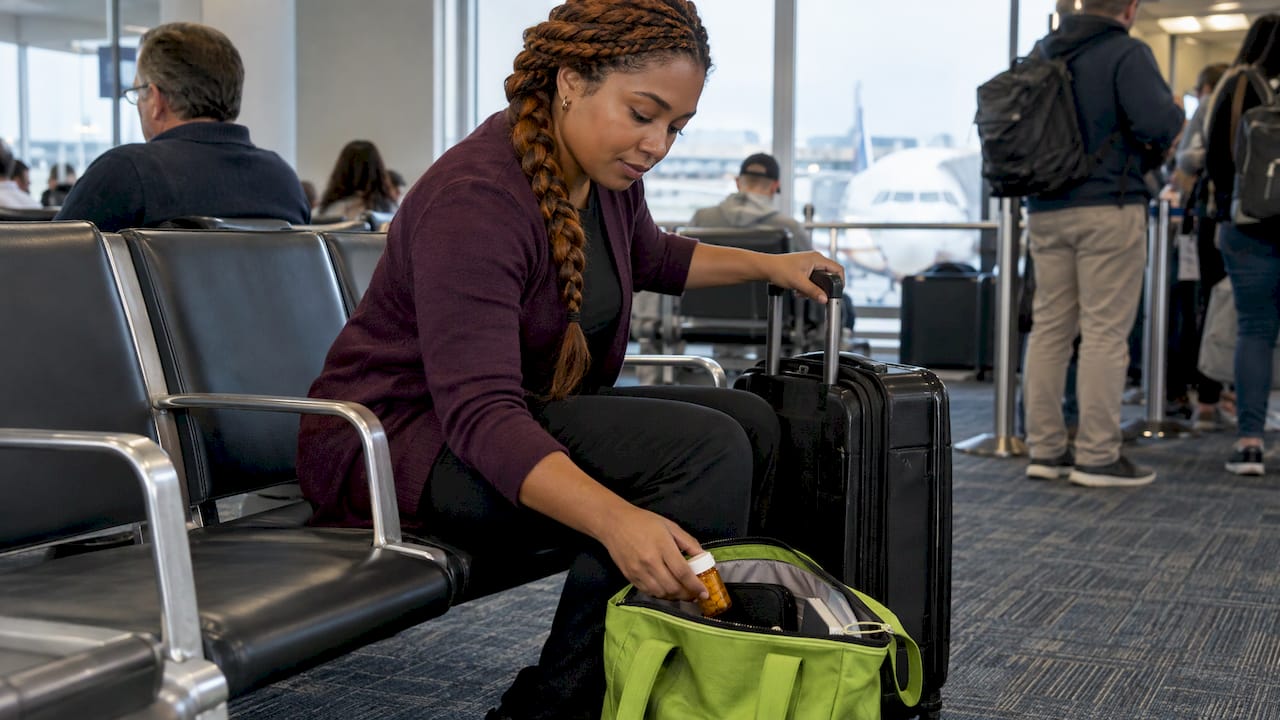
Yes, you can travel with your ADHD medication, and within the United States it is usually uneventful. Keep it in your carry-on, in the original pharmacy bottle, pack a few extra days’ worth, and carry your own supply only. Going abroad is a different matter, because stimulants are controlled substances and other countries make their own rules. In our work, nearly every trip problem we see comes from a skipped step that takes ten minutes to do ahead of time.
TL;DR
- Domestic flights: TSA allows medication in pill form in carry-on and checked bags, but keep it in your carry-on so you can reach it.
- Keep pills in the original labeled pharmacy bottle. TSA does not require it, but some state laws on labeling exist, and it settles questions quickly.
- Pack for the whole trip plus a few extra days, and never hand a family member’s controlled medication to a third party to carry.
- International trips need homework weeks or months ahead: each country has its own laws, and some require approval before you arrive.
- If something goes wrong, call your prescriber’s office early rather than late.
Table of Contents
- Flying within the U.S.: what TSA actually asks of you
- Packing and labeling: the original bottle is the easy answer
- Heat, storage and keeping meds safe on the road
- Time zones and dose timing
- International travel: where the real risk sits
- Perspective
- What to do if medication is lost, delayed or runs out
- Special situations
- How we help you get ready
- FAQ
- Sources
Flying within the U.S.: what TSA actually asks of you
Most people worry about this part more than they need to. TSA states that medication in pill or solid form is allowed in unlimited amounts in both carry-on and checked bags, and that it goes through screening like everything else. It also strongly recommends carrying it on board in case you need it right away.
A few details are worth knowing before you get in the security line:
- You do not have to tell a TSA officer about pills you are carrying. Liquid medication is the exception.
- Labeling the medication clearly helps the screening go faster.
- Medication usually goes through the X-ray. If you would rather it be visually inspected, you can ask, but you must ask before your items go into the X-ray tunnel.
- Medically necessary liquids over 3.4 ounces are allowed in a carry-on, but they must come out of the bag and be screened separately.
The forums will tell you TSA does not care about ADHD medication. That is close to true for domestic flights, though we would not rely on forum confidence for anything involving a controlled substance. The checkpoint is rarely the problem. The problem is the checked bag that ends up in another city.
Why the carry-on matters more than the rules
Bags get delayed. United Airlines advises never putting medication in a checked bag, even if you do not expect to need it during the flight, and removing it from your carry-on before an agent gate-checks the bag. That last point catches people. A full flight, a small overhead bin, a gate agent tags your bag, and your pills ride in the cargo hold. Take the bottle out and put it in a personal item or your pocket before you hand the bag over.
CHADD makes the same point for families: if you fly, pack your child’s medication in your carry-on so a lost suitcase does not mean a missed dose.
Packing and labeling: the original bottle is the easy answer
TSA does not require pills to be in prescription bottles. Healthline notes that individual states may have their own labeling laws, so what is true for the checkpoint may not be true on the road. We tell patients to skip the clever pill organizer for travel days, or at least bring the bottle along too.
Here is how we suggest packing:
- Original pharmacy bottle, label facing out. CHADD says that for travel within the U.S., the original bottle is often enough. A medical officer quoted in a CHADD article adds that the labeled bottle is helpful if questions come up in the security line.
- Clear bag, carry-on, within reach. Not in the bottom of a backpack under a laptop.
- Enough for the trip, plus extra. Healthline suggests your trip plus three extra days in case of delays. The CDC Yellow Book similarly advises packing for the length of travel and several days afterward.
- Leave the rest at home. There is no reason to carry a full 30-day bottle for a long weekend.
- Your own medication only. OSAC advises that third parties should not carry prescription medications designated for someone else, especially controlled substances. If you are traveling with a teen, you can carry the medication for them, but each person’s bottle should carry that person’s name.
One practical note on stimulant refills. Because these are Schedule II drugs, CHADD points out they are subject to tighter regulation, and in many cases you cannot get an early refill the week before you leave. That is why we like to talk about travel at the visit before the trip, not the week of. If you are a patient of ours, bring it up at your medication management appointment. If your refills depend on telehealth visits, check the current telehealth prescribing rules too, since they affect how and when a prescription can be sent.
Heat, storage and keeping meds safe on the road
Most ADHD medications do not need a refrigerator, but heat and sun still matter. Together by St. Jude advises against leaving medicine in a glove compartment or trunk, keeping it out of the sun, and keeping it in a carry-on during air travel to avoid temperature swings. A rental car in a Texas parking lot in July is exactly the situation they mean.
In the hotel, the same source recommends not leaving luggage with medicine unattended, putting it away after each dose, and using a high shelf, cabinet or hotel safe if one is available. This is worth taking seriously with a stimulant, especially when teens or younger children are with you.

Time zones and dose timing
This is the question patients ask us most after the airport one. Do you take your morning dose at home time or local time?
The CDC advises talking to your health care provider about dosing changes if you cross time zones, and taking medicines based on the time since your last dose rather than local clock time. For a stimulant, that matters. A dose taken late in a shifted day can sit awkwardly on top of a sleep schedule that is already off.
What we have learned from patients:
- For a one or two hour shift, most people simply keep their usual routine and move it gradually.
- For a long-haul trip, the plan is worth writing down with your prescriber ahead of time. It depends on the medication, whether it is short- or long-acting, and how you sleep.
- Set phone alarms. This sounds almost too simple for adults with ADHD, but travel strips out routine, and routine is what normally carries the dose.
If you think about the whole trip the way people plan around a treatment calendar, it gets easier. A guide to planning travel around a treatment timeline makes a similar point for another kind of care: the schedule of the treatment comes first, and the itinerary fits around it. The same idea works for medication.
Should you skip medication on vacation?
Some people take a break from their medication on trips. That is a decision to make with your prescriber, not on the plane. Vacations often involve airports, rental cars, unfamiliar cities and tight connections, and many of our patients find those are the days they most want steady focus. Others do fine with a lighter schedule. We would rather talk through your particular medication and your particular trip than give you a rule.
International travel: where the real risk sits
Everything above applies at home. Abroad, the rules change, and they can be severe. The CDC says each country has its own laws on medicines, and that something prescribed or sold over the counter in the U.S. may be unlicensed or controlled elsewhere. Breaking those laws can mean confiscation, fines, or jail.
This is not theoretical. The State Department reported, in a document OSAC published, that a U.S. citizen was arrested and held in Nagoya, Japan for shipping a three-month supply of prescription Adderall into the country. They were released after 18 days, with heavy diplomatic effort. Note that this involved mailing medication, which is a separate mistake from carrying it, but it shows how seriously some countries treat it.
A SAI Programs executive quoted by CHADD puts the European situation plainly: some U.S. prescriptions, including stimulants, are treated as narcotics there, and you can still bring them legally, but you need the right documentation.
Your international checklist
| Step | What to do | Source |
|---|---|---|
| Start early | The State Department advises talking to your treating physician at least two months before departure and getting a list of comparable generic names, with dosage and composition | CHADD |
| Check the destination | Contact the embassy of your destination and of any country where you have a layover | CDC |
| Check for pre-approval | Some countries, such as the United Arab Emirates and the Czech Republic, require approval from the health ministry, and it can take months | CHADD |
| Limit the quantity | Personal-use amounts only, generally up to a 90-day supply and in some countries 30 days | OSAC |
| Carry paperwork | Original labeled container, copies of prescriptions with generic names, and a note from your prescriber | CDC |
The CDC says the label should show your full name, your provider’s name, the generic and brand name, and the exact dosage. It also suggests asking your prescriber for a note if you use controlled substances. Layovers count. A connection through a country with strict rules is easy to forget about, and it is the one that causes trouble.
OSAC also advises that for psychotropic medication in sizable quantities, it can be wise to notify the regional security officer or medical officer at the nearest U.S. embassy or consulate ahead of time, so the right people know if there is an issue at customs.
Two honest limits. We cannot tell you the law in every country, and it changes. The embassy and the International Narcotics Control Board information the CDC points to are where the current answer lives. And if the answer is that your medication is not allowed at all, that is the moment to call your prescriber about a plan for the trip, not to hope for the best at the border.
Perspective
We have learned that travel trouble with ADHD medication is almost never about the medication. It is about the week before the trip, when everything is already crowded and the refill is due, or the bottle is half empty, or nobody remembered to ask about the country on the layover.
In our work we often notice that people who do well on a medication still lose the routine the moment they leave home. That is not a failing. Routine is how most of us take medication, and travel removes it. So we plan around that. We ask when you leave, where you land, how long you will be gone, and whether the dose schedule needs a small adjustment.
At Nortex Psychiatry we provide medication management and evaluations in person in Allen and by telehealth. If a trip is coming up, bring it to your visit. We would rather have the conversation early than solve a lost bottle by phone from a hotel lobby.
Felix
What to do if medication is lost, delayed or runs out
It happens, even to careful people. CHADD advises that if you forget your medication, call your doctor’s office. The doctor may be able to send a prescription to a nearby pharmacy or suggest ways to manage symptoms until you are home.
With a stimulant, a few realities apply. Controlled substance prescriptions have more rules than ordinary ones, so a replacement is not always instant, and some pharmacies may not have your exact dose in stock. If you are in the middle of a supply problem generally, our guide to a 72 hour plan for ADHD medication shortages walks through what to do in the first days.
Here is the order we suggest:
- Check your carry-on, personal item and the gate-check area first.
- Call your prescriber’s office during business hours, and say where you are and which pharmacy chains are nearby.
- If your trip is long, ask about transferring a prescription to a national pharmacy chain.
- Do not accept pills from a friend or relative. It is unsafe and, for a controlled substance, not legal.
- For a short gap, ask your prescriber what to expect and how to manage the day. Missing a dose is uncomfortable, not dangerous, for most people, and the plan usually involves structure, sleep and patience.
Special situations
Teens and young adults
If your teen travels with a school group or relatives, the same carry-on and bottle rules apply, plus a plan for who is responsible for the dose. The State Department recommends, as relayed by CHADD, a letter from the child’s doctor describing the condition, the medications and their generic names, kept with the medication in your carry-on. A teen should know where the bottle is and how to explain it calmly if asked.
Changing medications near a trip
Try not to start or switch a medication right before travel. A new dose can bring side effects in the first week or two, and an airport is a poor place to find out. If a change is due, we usually suggest timing it well before or after the trip. You can read more in our guides on switching ADHD medications and the first weeks of side effects.
Moving, long stays and full-time travel
For long stays, a national pharmacy and electronic prescriptions make refills simpler. The details depend on your state and on telehealth rules. Talk it over before you go, not after.
How we help you get ready
If you live in Allen, Frisco, McKinney, Plano or elsewhere in North Dallas and you have a trip coming, we can go through your medication, your schedule and your destination at a visit, in person or by telehealth. Our home page has the ways to book. If you are not yet diagnosed, our ADHD evaluation timeline explains how to get your records ready.
FAQ
Can I bring Adderall or other stimulants on a plane in the U.S.?
Yes. TSA allows pills in carry-on and checked bags, with screening like any other item. Keep them in your carry-on, in the original pharmacy bottle, so you can reach them and answer questions quickly.
Do I need a doctor’s letter for domestic travel?
Usually not. CHADD notes that the original prescription bottle is often enough within the United States. A letter becomes important for international trips, where the CDC suggests asking your prescriber for a note if you use controlled substances.
How much medication should I pack?
Enough for the whole trip plus a few extra days for delays. Healthline suggests three extra days, and the CDC Yellow Book says to pack for the trip and several days afterward. Leave the rest of the prescription at home.
Which time zone should I follow for doses?
The CDC advises asking your provider, and basing timing on the hours since your last dose, not on the local clock. Plan it with your prescriber before a long-haul flight, and set alarms.
Can I take ADHD medication to another country?
Sometimes, with documentation, and sometimes only with advance approval. Some countries treat stimulants as illegal narcotics. Check with the destination’s embassy, and any layover country, well ahead of the trip.
Sources
- Travel Tips, Transportation Security Administration
- TSA: traveling with medication requirements
- Traveling Abroad with Medicine, CDC
- Travelers with Chronic Illnesses, CDC Yellow Book
- Traveling with Medication, OSAC
- Traveling with ADHD Medication: What to Know, CHADD
- Over the River and Through the Woods: Traveling with ADHD, CHADD
- Know Before You Go: International Travel with ADHD Medications, CHADD
- Traveling with Medication and Medical Equipment, United Airlines
- How to Travel with Medication in the U.S. and Abroad, Healthline
- Traveling with Medications, Together by St. Jude