


Yes, you can get a real ADHD evaluation by video in Texas, and a psychiatrist can prescribe ADHD medication afterward when it is clinically appropriate. The part people worry about is quality: whether a screen visit can be careful enough to give you an accurate answer. It can, if the evaluation is built the way an in-person one is. This article walks through what a sound telehealth evaluation looks like, what Texas and federal rules say about prescribing, and how to tell a thorough visit from a quick one.
TL;DR
- A telehealth ADHD evaluation in Texas is legitimate when it includes a detailed history, standardized rating scales, and input from someone who knows you, not just a short questionnaire.
- Prescribing rules differ by drug schedule. Federal telemedicine flexibilities are currently extended through December 31, 2026, and Texas adds its own limits on top.
- Expect the evaluation to take real time. A visit that ends with a prescription after a few minutes should make you pause.
- Diagnosis is the start. Follow-up visits, dose adjustments, and non-medication support are where most of the benefit comes from.
- We see adults across North Dallas in person and by telehealth, so you can choose the format that fits your week.
Table of Contents
- Is telehealth a reasonable way to be evaluated for ADHD?
- What a thorough ADHD evaluation includes
- How the telehealth process works in Texas, step by step
- Can a psychiatrist prescribe ADHD medication online in Texas?
- Signs the evaluation is too thin
- What happens after the evaluation
- Perspective: what we have learned about remote ADHD care
- When another condition is in the way
- Getting started with us
- FAQ
- Sources
Is telehealth a reasonable way to be evaluated for ADHD?
For most adults, yes. The CDC reported that about half of U.S. adults with ADHD have used telehealth for ADHD-related services, and it points to shorter waits and better access to treatment as the main advantages (CDC, 2024). The same report notes that experts generally agree the benefits of wider access outweigh the risks of leaving ADHD undiagnosed, as long as quality standards are in place and monitored.
That condition matters. Researchers writing about online ADHD services have pointed out that convenience should not push aside evidence-based practice, such as gathering collateral information from people who know the patient (NCBI, 2023). We agree with that. In our work, the video format has rarely been the problem. The problem is when the format is used to shorten the evaluation.
If you want a closer look at how to judge a remote diagnosis, we wrote about five signs a telehealth ADHD diagnosis is legitimate.
What a thorough ADHD evaluation includes
Whether it happens in an office in Allen or on your laptop in Plano, the building blocks are the same. Professional guidance describes a comprehensive adult assessment as in-depth interviews with you and with people who know you, a thorough symptom and bio-psycho-social history, ADHD rating scales, and checks for other conditions that can look similar or travel alongside it (CHADD). It also involves a physical exam and review of DSM-5-TR criteria, with rating scales gathered from more than one informant (CHADD, 2024).
In practice that usually means:
- A long conversation about your life. School, work, relationships, driving, money, sleep, caffeine, alcohol. We ask for examples, not labels.
- Childhood history. ADHD does not appear for the first time at 34. We look for signs that were there earlier, even if no one named them then.
- Rating scales. You fill some out. Often a partner, parent, or longtime friend fills out a version about you.
- A medical review. Thyroid problems, sleep apnea, heart conditions, and medications you already take can all affect attention or affect which treatment is safe.
- A look at mood and anxiety. More on that below.
Our own write-up on this, what to expect from an adult ADHD diagnosis in North Dallas, explains why we plan on two hours or more for the first evaluation rather than a short slot.
How we tell ADHD from anxiety, depression, and poor sleep
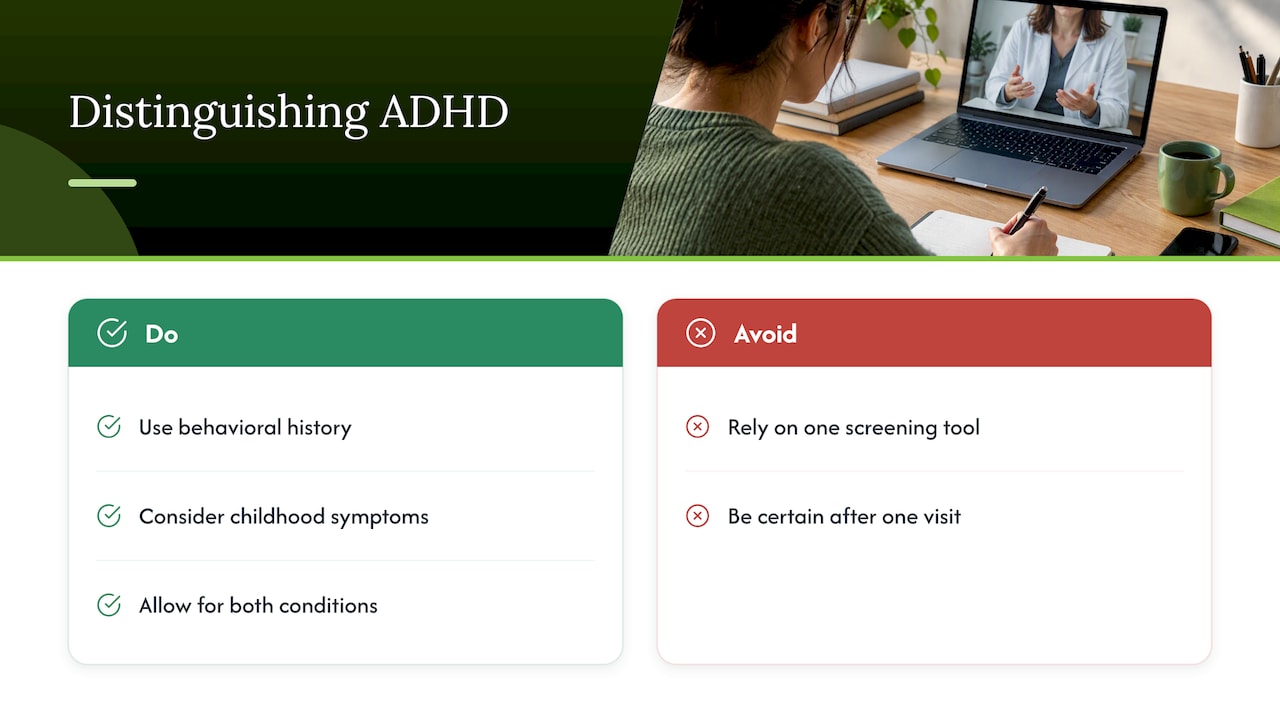
This is the part that takes the most judgment. Restlessness, trouble concentrating, and forgetfulness show up in anxiety, depression, sleep problems, and substance use, too. Clinicians lean on the behavioral history, especially evidence that symptoms have been present since childhood, to separate ADHD from those conditions (CHADD). Adult ADHD can also be overcounted, because many symptoms can be explained by another psychiatric or substance use disorder, which is why the literature urges caution when diagnosing (CHADD, 2021).
The same source describes the work as careful detective work, and warns against leaning too heavily on a single screening tool or a neuropsychological test alone. We have learned to be a little suspicious of certainty after one visit, in either direction.
Sometimes the answer is both. A person can have ADHD and an anxiety disorder, and treating one may change how the other looks. If that sounds like you, our piece on what to bring to an anxiety vs ADHD evaluation will help you prepare.
How the telehealth process works in Texas, step by step
The details differ by practice, but the sequence is fairly consistent.
- Check where you are. Telehealth in Texas generally means the patient is located in Texas at the time of the visit, and the clinician is licensed to practice there. If you travel, tell us before the appointment.
- Gather records before you book. Old report cards, prior testing, past prescriptions, and a list of current medications and supplements all help. Our guide to the ADHD evaluation timeline and records to have ready lists what is worth hunting for.
- Choose someone who can speak to your history. Ask a parent, sibling, or partner whether they would complete a rating scale or join part of the visit.
- Set up a private space. Headphones, a closed door, a stable connection. It sounds small. It changes how honest a conversation can be.
- Do the evaluation. Expect questions that feel repetitive. They are cross-checking your answers.
- Talk through the findings. You should leave knowing whether the picture fits ADHD, something else, or a mix, and why.
- Plan treatment together. Medication, therapy, skills coaching, or some combination, with a follow-up date.
What can and cannot be done remotely
Most of the interview, history, scales, and follow-up work translate well to video. Some things do not: a blood pressure reading, a heart rate, or a physical exam. When a stimulant is on the table, we may ask you to get vitals measured locally or come in. We go through the practical edges of this in ADHD telehealth in Texas: what you can and can’t get done remotely.
Can a psychiatrist prescribe ADHD medication online in Texas?
Yes, with limits that depend on the medication. Two layers of rules apply: federal and Texas.
The federal layer
The DEA and HHS issued a fourth temporary extension on December 31, 2025, which continues telemedicine flexibilities through December 31, 2026. Under it, DEA-registered practitioners may prescribe Schedule II–V controlled medications after an audio-video encounter, without an earlier in-person evaluation, so long as the prescription meets DEA requirements and applicable federal and state law (DEA). Most ADHD stimulants are Schedule II.
Because this is a temporary extension with an end date, check the DEA’s site for what applies when you book, especially if you are reading this near the end of 2026. We keep a running explainer, how to keep your stimulant prescription under the U.S. telehealth rules, so you do not have to track the changes yourself.
The Texas layer
Texas law, as described in the Legislature’s 2023 bill analysis of S.B. 2527, allows telehealth prescribing of non-narcotic Schedule III–V controlled substances without an in-person exam, limited to an initial 30-day supply. It also treats it as unprofessional conduct to set up an arrangement where different professionals prescribe month to month. For Schedule II drugs and narcotics, the analysis describes a general requirement of an in-person examination within the prior 12 months, with specific exceptions (Texas Legislature, 2023).
This is a summary of a legislative analysis, not legal advice, and the way federal and state rules interact has shifted before. If your treatment involves a controlled medication, ask your prescriber directly how they are handling the state requirement for your case. A good clinician will answer plainly.
Why regulators care
In June 2024 the Texas Medical Board disciplined a physician for failing to adequately evaluate a patient before prescribing ADHD treatment, among other cases involving poor monitoring (Texas Medical Board). That is the practical reason to value a slower, more complete evaluation. It protects you as well as the prescriber.
Signs the evaluation is too thin
We have heard enough stories from patients who came to us after an earlier experience to name a few patterns:
- The visit is mostly a checklist, and it ends within minutes.
- Nobody asks about childhood, sleep, mood, or substance use.
- A specific medication is promised before you are assessed.
- No one wants outside input or old records.
- There is no plan for follow-up, only a refill.
None of these proves bad faith. But taken together, they suggest the diagnosis may not hold up, and a diagnosis that does not hold up can cost you months.
What happens after the evaluation
The evaluation ends with one of a few outcomes: an ADHD diagnosis, a different or additional diagnosis, or a finding that something else is driving your symptoms and should be treated first. Each leads to a plan.
If ADHD is confirmed, treatment usually begins with a conversation about options. Stimulant medication is often considered first-line for adults, but it is not sufficient on its own. Effective management also draws on cognitive behavioral therapy, structured routines, and lifestyle adjustments (CHADD, 2021). Our overview of ADHD treatment options for adults and the comparison of medication vs therapy for ADHD go deeper.
Follow-up and medication management
Prescribing a stimulant is not a one-time act. Known risks include misuse, diversion, worsening anxiety, and cardiovascular events, so careful monitoring is part of the job: checking vitals and, in some cases, using controlled substance agreements or urine screens (CHADD, 2021). Nonstimulant options exist too. Atomoxetine, for example, is a nonstimulant option for adults who also have a substance use disorder, and bupropion is sometimes considered when depression and poor concentration occur together.
Here is what follow-up commonly looks like, in our experience:
- A first check-in within a few weeks of starting a medication, to ask about benefit, sleep, appetite, heart racing, and mood.
- Small dose changes rather than big jumps.
- Regular visits afterward, which may be by video and sometimes in person for vitals.
- A willingness to switch if the first choice does not fit. This is common, and nothing has gone wrong when it happens. We explain it in how switching ADHD medications works.
Progress is rarely a straight line. A good week and a bad week can both happen on the same dose.
Perspective: what we have learned about remote ADHD care
We did not expect video visits to become such a large part of our work, and we still have mixed feelings about some of it. What we have learned is that the screen is not the risk. Rushing is.
We often notice that adults come in having lived with attention problems for decades and with a lot of private shame about it. They were told they were lazy, or disorganized, or “not trying.” A careful evaluation can be the first time someone takes the whole story seriously. That is hard to do in fifteen minutes, and it is not what telehealth is for.
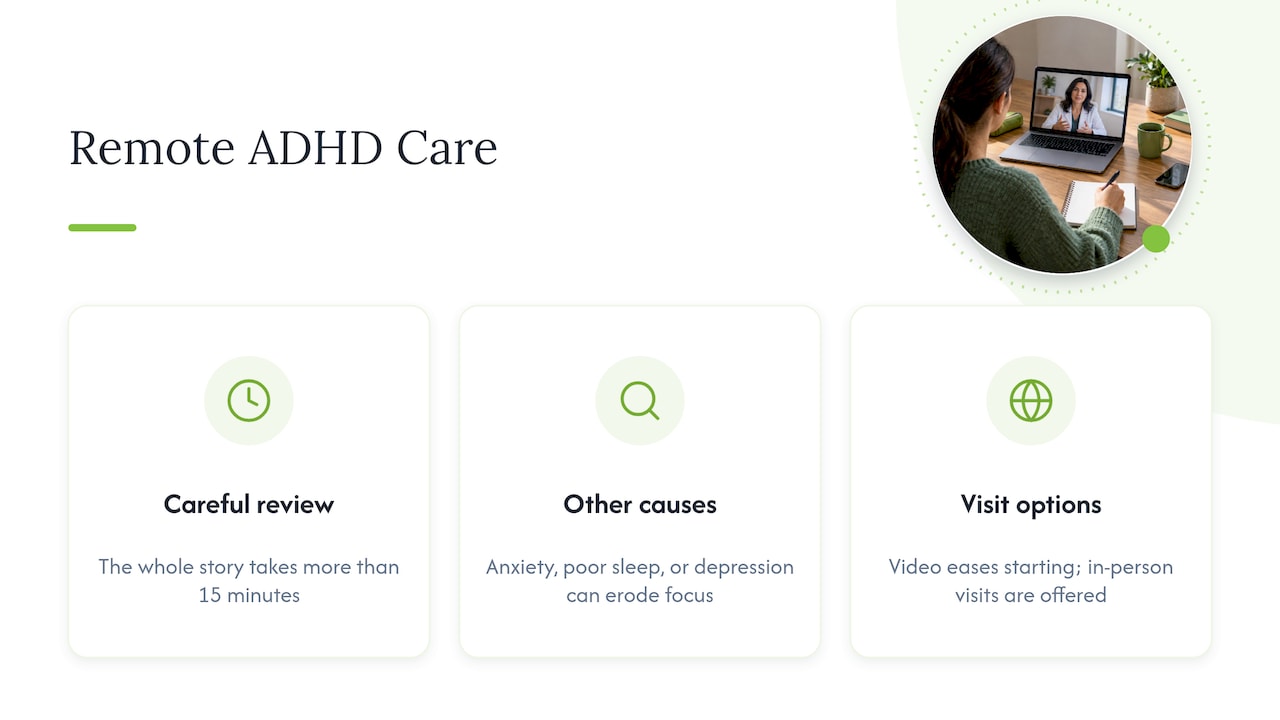
We also see people who are fairly sure they have ADHD and turn out to have significant anxiety, or poor sleep, or depression that has been quietly eroding focus. Treating that first sometimes clears most of the picture. Other times it does not, and ADHD is clearly there beneath it. We would rather take the extra visit and be right.
For busy professionals in Frisco or McKinney, video makes it easier to start. For others, the in-person option feels better, and we offer both. Neither is a shortcut. If something about your case needs to be seen in the room, we will tell you.
— Felix
When another condition is in the way
Sometimes the evaluation shows that ADHD is only part of the story, or not part of it. Persistent low mood, treatment-resistant depression, or trauma can make focus nearly impossible, and those call for different care. Our practice also offers TMS therapy, Spravato, and other interventional options for conditions that have not responded to standard medication. These are not treatments for ADHD itself. We mention them because a thorough evaluation sometimes reveals a different priority, and it helps to know we can address it under the same roof.
Getting started with us
Nortex Psychiatry is based in Allen and serves adults and families across North Dallas, including Frisco, McKinney, and Plano, with in-person and telehealth visits. If you are looking for a careful ADHD evaluation and ongoing medication management, you can reach us through our main site. Bring your questions, whatever records you can find, and the name of someone who knows you well. We will take it from there, at a pace that lets us get it right.
FAQ
How long does a telehealth ADHD evaluation take?
The first appointment is typically long, often an hour or more, and a full evaluation can stretch past that, sometimes across more than one visit. Time goes to history, rating scales, and ruling out other causes. A very short visit is a reason to ask questions.
Do I need to see someone in person first in Texas?
It depends on the medication. Federal telemedicine flexibilities are currently extended through December 31, 2026, but Texas has its own requirements for Schedule II drugs, including a general in-person exam within the prior 12 months, with exceptions. Ask your prescriber how they handle it for your situation.
Can I be diagnosed with ADHD without medication being involved?
Yes. The evaluation and the treatment decision are separate. Some adults choose therapy, skills coaching, and routine changes first or alongside medication, and effective management usually includes those anyway.
Can anxiety or depression look like ADHD?
Often, yes. Poor concentration and restlessness occur in both, which is why clinicians look for symptoms dating back to childhood and screen for co-occurring conditions. It is also possible to have ADHD and another condition at the same time.
Sources
- CDC, ADHD diagnosis and treatment via telehealth (MMWR, 2024)
- NCBI, Revisiting best practices: online ADHD evaluation (2023)
- CHADD, The ADHD Diagnostic Process
- CHADD, Adult ADHD Lunch-Learn (2024)
- CHADD, Diagnosis and Treatment of Adult ADHD
- CHADD, Attention-Deficit/Hyperactivity Disorder in adults (2021)
- DEA, telemedicine flexibilities extension (December 31, 2025)
- Texas Legislature, S.B. 2527 bill analysis (2023)
- Texas Medical Board, June 2024 disciplinary actions