


Cyclothymia is a form of bipolar disorder, not a separate illness. The American Psychiatric Association groups bipolar I, bipolar II and cyclothymic disorder under one umbrella. What separates cyclothymia is the size of the swings and how long they last, not the fact that mood moves. The shifts are real and frequent, but each high or low falls short of what is needed to call it a full hypomanic or major depressive episode. They also rarely go away.
If you landed here wondering whether your ups and downs are “just personality” or something a psychiatrist should look at, this article is for you. We will go through the differences, the overlap, and why the distinction changes treatment, especially medication.
TL;DR
- Cyclothymia is a milder, chronic form of bipolar disorder. Bipolar I involves full manic episodes, and bipolar II involves full hypomanic and major depressive episodes.
- For a cyclothymia diagnosis, mood symptoms usually have to be present for at least two years in adults (one year in teens and children), without ever meeting criteria for a full episode.
- “Mild” describes the episodes, not the impact. Cyclothymia can strain work, sleep and relationships.
- Antidepressants alone can make mood instability worse in the bipolar spectrum, so getting the diagnosis right comes before choosing a medication.
- Treatment is usually talk therapy plus, when needed, a mood stabilizer. The goal is steadiness, not a cure.
Table of Contents
- What cyclothymia actually looks like
- How bipolar I and bipolar II differ
- Is cyclothymia just “mild bipolar disorder”?
- Why the diagnosis changes treatment
- What a diagnostic visit looks like
- Signs it is time to see a psychiatrist
- Living with it: the long game
- Our perspective
- Care at Nortex Psychiatry
- FAQ
- Sources
What cyclothymia actually looks like
Most people with cyclothymia do not describe it as a mood disorder. They say they have a short temper, or that they run hot and cold, or that they are “a moody person.” The research summarized by the APA notes exactly this: many people see it as part of their personality, and it often goes unrecognized until work or relationships begin to suffer.
In our work, the pattern we hear most often goes something like this. A few weeks of high energy, sleeping five hours and feeling fine, taking on more than anyone else would. Then a stretch of flatness, low motivation, irritability, a heavy feeling in the mornings. Then back up. No single stretch looks dramatic enough to call a doctor about. Taken together over years, the picture is clear.
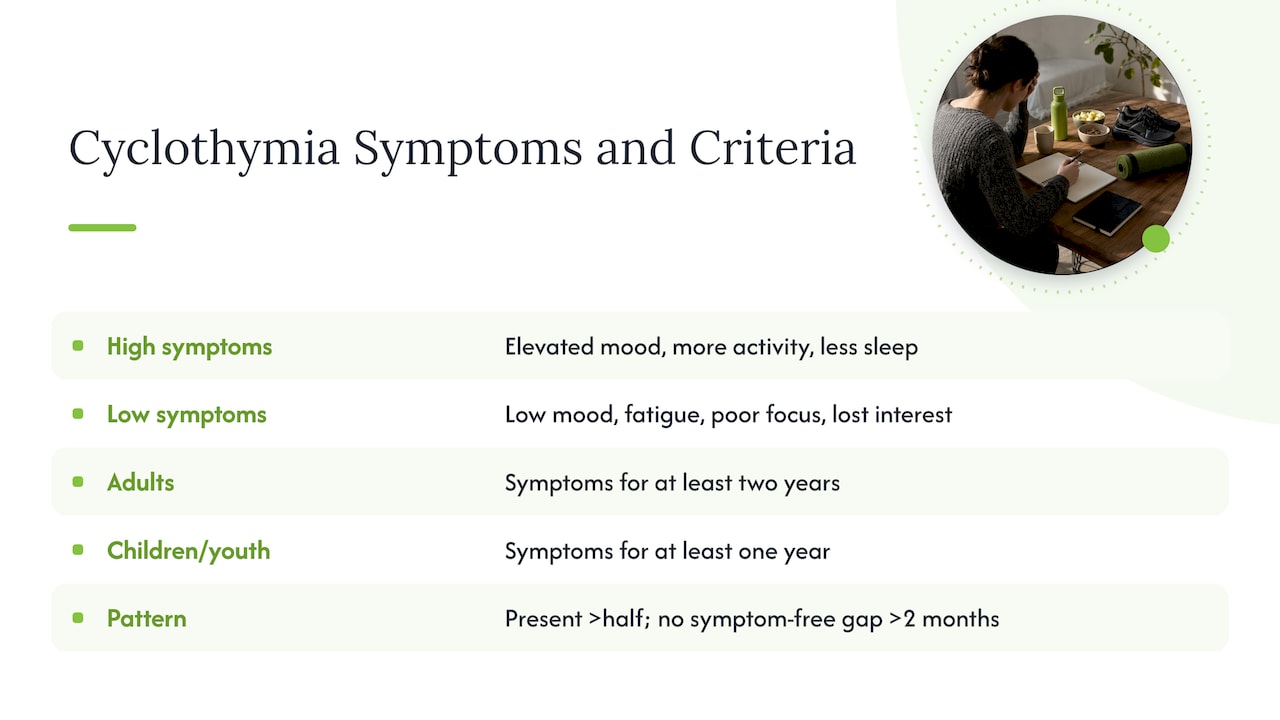
On the high side, the symptoms are hypomanic ones: lifted or irritable mood, more goal-directed activity, less need for sleep, talkativeness, racing thoughts, distractibility. On the low side: low mood, fatigue, trouble concentrating, loss of interest. Psychology Today’s clinical overview lays out the DSM-5 criteria: symptoms for at least two years (one year for children and adolescents), present more than half the time, and never absent for more than two months in a row.
The “not quite” problem
The defining feature of cyclothymia is that the symptoms are real but sub-threshold. They do not add up to a hypomanic episode, and they do not add up to a major depressive episode. That is why the label feels odd to patients. You may be told your symptoms are “not severe enough” for bipolar II, and then hear that you still have something that needs care. Both statements are true.
How bipolar I and bipolar II differ
The National Institute of Mental Health defines bipolar I by manic episodes lasting at least seven days, most of the day, nearly every day, or by manic symptoms so severe that hospital care is needed. Depressive episodes usually occur as well, but they are not required for the diagnosis. Bipolar II is defined by a pattern of depressive and hypomanic episodes, without the full manic episodes of bipolar I.
We have written separately about the clinical signals that separate bipolar I from II, including the antidepressant warning that applies to both. Here, the short version is enough.
| Cyclothymia | Bipolar II | Bipolar I | |
|---|---|---|---|
| Highs | Hypomanic symptoms that never reach a full episode | Full hypomanic episodes | Full manic episodes (7+ days, or hospitalization) |
| Lows | Depressive symptoms below the threshold for major depression | Major depressive episodes | Often major depressive episodes, though not required |
| Course | Chronic, frequent shifts, two years or more | Episodic, can be long depressions | Episodic, can be severe |
| Typical day-to-day feel | Unpredictable, hard to pin down | Depression often dominates | Mania can cause serious disruption |
This table simplifies. Real people cross the lines. Someone can have cyclothymia for years and then have a first full hypomanic or depressive episode, at which point the diagnosis changes. The peer-reviewed literature on cyclothymia describes this overlap and argues that cyclothymia is better understood as an exaggeration of a cyclothymic temperament than as a simple checklist of symptoms.
Is cyclothymia just “mild bipolar disorder”?
Many pages, including some at the top of Google, use the phrase “mild bipolar.” It is a fair shorthand for the episodes. It is a poor shorthand for the experience.
We have learned to be careful with the word mild. A person who has cycled between energy and exhaustion for eight years, who has changed jobs often, who has had relationship after relationship strained by irritability, does not feel mildly affected. The swings are smaller than in bipolar I, yes. But because they are constant, there is little stable ground to stand on. Some patients tell us the lack of a clear “episode” makes it harder, since nobody around them, including themselves, can point to a single moment and say something was wrong.
So the severity label tells you something about how a diagnosis is made. It tells you much less about how much support you need.
Why the diagnosis changes treatment
This is the part we most want you to take away. The difference between cyclothymia, bipolar II and plain depression is not academic. It decides which medications are safe to start with.
The antidepressant question
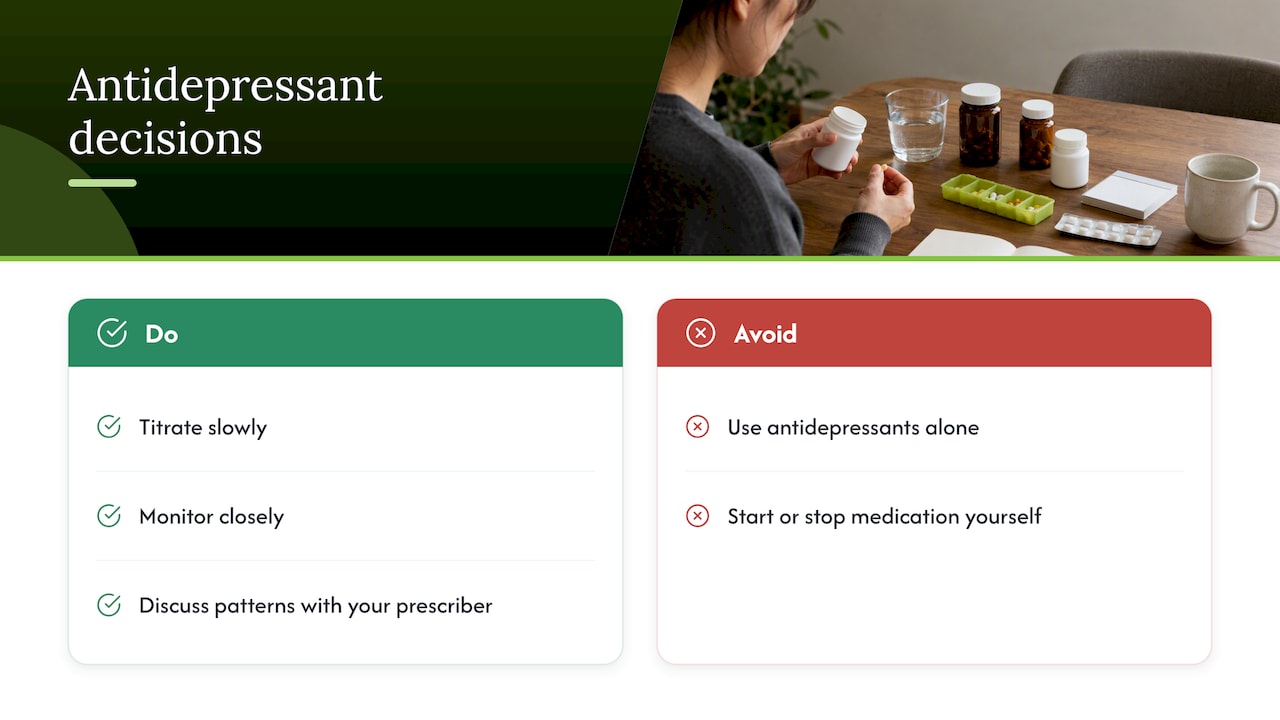
Many people reach a doctor during a low. The low looks like depression, and an antidepressant is the natural first step. In someone on the bipolar spectrum, that step can backfire. The literature on cyclothymia notes that antidepressant treatment alone can trigger mood switches, rapid cycling or worse instability, and that cyclothymic patients are often more sensitive to medication, which is why slow titration and close monitoring matter. The International Society for Bipolar Disorders task force also reviewed antidepressant use in bipolar disorders and described the risk-benefit picture as controversial, which is why expert consensus, rather than a simple rule, guides these decisions.
If you are wondering whether a drug like Lexapro can treat cyclothymia: it is an SSRI, and SSRIs are not a standard first-line treatment for cyclothymia on their own. Please do not stop or start any medication on your own because of something you read here. If you are taking an antidepressant now and see the pattern above, bring it up with your prescriber, who can adjust a plan safely.
If you want to understand how we think about this line more broadly, our piece on the diagnostic line between bipolar disorder and depression goes deeper.
What treatment usually includes
According to the APA, management is individualized and typically combines talk therapy, such as cognitive behavioral therapy, with mood-stabilizing medication to help control fluctuations over the long term. Some people start and stop treatment as symptoms rise and fall. That is common and not a failure.
Therapy is not a lesser option. It helps with regularity, sleep, early warning signs and the habit of taking medication when it is needed. If you want a primer on the medication side, we explain what mood stabilizers do and the roles they play. For the practical side, our guide to coping strategies for mood disorders may help between visits.
What a diagnostic visit looks like
There is no blood test for cyclothymia. Diagnosis rests on history, and history is hard, because memory flattens mood. A good day and a hypomanic day can feel similar in hindsight.
That is why we lean on the following:
- A timeline. When did the pattern start? Was there a year when it was worse? Was there ever a stretch of two months or more when you felt steady?
- A mood log. Even two to four weeks of daily notes on mood, sleep hours and energy helps. Practitioners find this a core clinical tool, not a nicety, because people struggle to see where a good day ends and a hypomanic one begins.
- Family history. Bipolar disorder, depression and substance use in relatives all matter.
- A medical and substance review. Thyroid problems, sleep disorders, stimulants, alcohol and cannabis can all mimic or amplify mood swings.
- Someone else’s view. A partner, parent or close friend often sees the pattern more clearly than you do.
We describe the steps in more detail in what adults should expect from a bipolar diagnosis process. If depression is the main thing bringing you in, the list of details to bring that help separate depression from bipolar disorder is a good place to start.
Signs it is time to see a psychiatrist
You do not need to be in crisis. These are reasons to book a visit:
- Your mood or energy shifts regularly and you cannot predict it.
- You sleep very little for days and feel fine, then crash.
- Relationships or work keep getting disrupted by irritability or impulsive decisions.
- An antidepressant helped briefly and then made you feel wired, agitated or worse.
- Parents: your teen’s moods run in cycles that last days, not hours, and seem out of proportion to what is happening. The NIMH has a guide to bipolar disorder in teens and young adults.
If you ever have thoughts of harming yourself, call or text 988, the Suicide & Crisis Lifeline, or go to the nearest emergency room. Do not wait for an appointment.
Living with it: the long game
Because cyclothymia is chronic, the aim of care is management, not cure. We say this early so that nobody walks away feeling they failed when it does not vanish. What we are working toward is steadier mood, steadier sleep, and the ability to function consistently at work and at home. Treatment is a journey, not a straight line, and there will be better and harder months.
Daily rhythm is a big part of it. Regular sleep and wake times, regular meals, limiting alcohol, and noticing early signs all help. Some patients also add stress-reduction practices alongside care. If that appeals to you, this overview of managing chronic stress is one reference to explore. It supports, and does not replace, a clinical plan.
Our perspective
We see a lot of people who arrive with a single word in mind: depression. Or anxiety. Or, increasingly, ADHD. Sometimes that is exactly right. Sometimes it is one piece of a bigger pattern, and we only see that after hearing the whole timeline.
What we have learned is to go slowly. We would rather take an extra visit to understand the pattern than start a medication that pushes someone into a harder place. With cyclothymia in particular, small changes can have large effects, so we start low, we check in often, and we ask patients to keep a log. It is not glamorous. It works better than guessing.
We also try not to oversell the diagnosis. Cyclothymia sits close to bipolar II and sometimes becomes it. That is not a reason to be frightened. It is a reason to keep watching and to keep the door open to adjusting the plan.
If you have been told your symptoms are not serious enough, and you still feel they are costing you, trust that. Come in and we will look at it together.
— Felix
Care at Nortex Psychiatry
Nortex Psychiatry is based in Allen, Texas, and sees adults and families across North Dallas, including Frisco, McKinney and Plano, in person and by telehealth. We offer psychiatric evaluation and medication management for mood disorders, anxiety and ADHD. For people whose depression has not responded to usual treatment, we also offer TMS therapy, Spravato and ketamine therapy. Whether any of these fits you depends on your diagnosis, which is why the evaluation comes first. You can start at our home page to request a visit, and our overview of mood disorder treatment explains how care is planned.
FAQ
What does it feel like to have cyclothymia?
Usually like living on shifting ground. You may have stretches of unusual energy, confidence and little need for sleep, followed by flat, tired, irritable periods. Neither feels dramatic enough to be an “episode,” so many people assume it is simply their temperament.
How often does the cyclothymia cycle occur?
There is no fixed rhythm. The DSM-5 criteria require symptoms to be present more than half the time over at least two years in adults, with no symptom-free gap longer than two months. Within that, cycles can last days or weeks and often do not follow a schedule.
Can cyclothymia turn into bipolar disorder?
It already is part of the bipolar spectrum. Some people with cyclothymia later have a full hypomanic or major depressive episode, and the diagnosis then becomes bipolar II. Antidepressants without a mood stabilizer may raise the risk of instability, which is one reason a careful evaluation matters.
How is cyclothymia managed?
Typically with a combination of talk therapy, such as CBT, and a mood stabilizer when symptoms warrant it, along with steady sleep and routine. Treatment is individualized, and the goal is steadiness rather than a cure. A psychiatrist can help decide what mix suits you.
Sources
- American Psychiatric Association: What Are Bipolar Disorders?
- Diagnosis and Treatment of Cyclothymia: The “Primacy” of Temperament (PMC)
- NIMH: Bipolar Disorder
- ISBD Task Force Report on Antidepressant Use in Bipolar Disorders (PMC)
- NIMH: Bipolar Disorder in Teens and Young Adults
- Psychology Today: Cyclothymic Disorder