


Quetiapine, lurasidone, cariprazine, and the olanzapine/fluoxetine combination carry the strongest evidence and formal approvals for acute bipolar depression, with lamotrigine and lithium supporting longer-term stability. Every choice trades efficacy against real risks, mainly sedation, weight gain, and the chance of triggering mania. If you’re in a depressive episode right now, the next step isn’t a supplement or a wait-and-see approach. It’s a call to your psychiatrist or care team, with your medication history in hand.
TL;DR:
- Quetiapine, lurasidone, and olanzapine/fluoxetine are FDA-approved or guideline-supported for acute bipolar depression, with lamotrigine and lithium focusing on long-term stability.
- Sedation and metabolic side effects are common early in treatment, especially with quetiapine, requiring regular lab monitoring and careful medication management.
- Response to medications should be assessed within two to four weeks, as adherence and close follow-up are critical to effective long-term management.
- Non-drug treatments like psychotherapy, ECT, TMS, and lifestyle modifications play an essential role alongside medication for better outcomes.
- Treatment plans are highly individual, depending on history, comorbidities, side effect tolerability, and patient preferences, emphasizing ongoing monitoring and adjustment.
Table of Contents
- Bipolar Depression Treatment Options With the Strongest Evidence
- Lithium, Lamotrigine, Valproate, and the Antidepressant Question
- Where Psychotherapy, ECT, rTMS, and Ketamine Fit In
- How You and Your Clinician Choose (And Monitor) Treatment
- After Remission: Maintenance and Staying Well
- How We Approach Bipolar Depression at Our Practice
- When Substance Use or Anxiety Complicates the Picture
- Living With Bipolar Depression: What Helps Day to Day
- Guidelines and Resources Worth Bringing to Your Appointment
- Our Take: What Gets Overcomplicated (And What Doesn’t)
- Getting Evidence-Based Care for Bipolar Depression
- Sources
- FAQ
Bipolar Depression Treatment Options With the Strongest Evidence
We tell patients this often, and it still surprises people: most antidepressants were never actually tested and approved for bipolar depression. Only several agents carry an FDA-specific label for acute bipolar I depression, and that gap between “commonly prescribed” and “actually approved for this” matters more than most patients realize when they’re comparing notes with friends who have unipolar depression.
Here’s the current list of medications with dedicated approval or strong guideline backing for bipolar depression:
- Quetiapine (immediate or extended release): One of the best-studied options and often the first one we reach for as monotherapy, particularly when a patient also has anxiety or sleep disruption alongside the depression.
- Lurasidone: Approved both as monotherapy and as an add-on to lithium or valproate, and it tends to carry a lighter metabolic footprint than some older antipsychotics.
- Olanzapine/fluoxetine combination: One of the original approved treatments for bipolar depression, though the metabolic tradeoffs are real and worth discussing before you start.
- Cariprazine: A newer addition with a more favorable weight profile for many patients, which is often why it comes up for people who’ve struggled with weight gain on prior medications.
- Lumateperone: The newest of the group, generally well tolerated with lower rates of sedation and metabolic disruption in trial data, though clinical experience with it is still accumulating.
The VA/DoD Clinical Practice Guideline for Bipolar Disorder lists quetiapine as a monotherapy option and names cariprazine, lumateperone, lurasidone, and olanzapine as alternatives, reflecting how the treatment landscape has broadened over the past decade. A systematic review of acute bipolar depression treatment reaches a similar conclusion: quetiapine, lurasidone, and olanzapine/fluoxetine show the most consistent efficacy signals across trials, while acknowledging that plenty of other agents get used off-label with far less direct evidence behind them.
Pro Tip: Bring a written list of every medication and dose you’ve tried for depression or mood symptoms, even ones from years ago. Response history is one of the biggest factors we use to narrow down options, and most people forget the details under stress.
None of these medications work the same way for every patient, and none of them is free of tradeoffs. A 2022 review of bipolar depression treatment options makes the point plainly: selection has to weigh symptom relief against long-term adverse effects and whether a patient will actually keep taking the medication. That last part, adherence, gets underweighted in a lot of conversations about “best” treatments. A drug with excellent trial data does nothing for you if the side effects make you stop after six weeks.
Roughly a dozen or so agents make up the entire list of FDA-approved options for acute bipolar depression, compared with dozens approved for unipolar depression. That gap explains a lot of the off-label prescribing you’ll see in real-world practice.
Sedation is the most common complaint we hear early in treatment, especially with quetiapine at higher doses. Weight and metabolic changes, elevated blood sugar, cholesterol shifts, and waist circumference gains, tend to show up over months rather than weeks, which is exactly why baseline and follow-up labs matter so much. Akathisia, a restless, can’t-sit-still sensation, shows up more with some antipsychotics than others and is worth reporting immediately rather than pushing through.
In practice, we use these agents in two different ways. Some patients do well on monotherapy, one medication carrying the full load. Others need an antipsychotic added on top of an existing mood stabilizer like lithium or valproate, particularly if they’ve had partial response to that mood stabilizer alone or have a history of more severe episodes. Neither approach is inherently better. It depends on your history, your current symptom severity, and what you’ve already tried. How psychiatrists approach depression treatment more broadly follows this same logic of starting where your history points and adjusting from there.
Clinicians have also been leaning toward agents with a lighter metabolic burden when the clinical picture allows it. Lumateperone, lurasidone, and cariprazine tend to get more consideration for patients who’ve already had trouble with weight gain or blood sugar changes on other medications, even though the older agents sometimes have a longer track record of efficacy data behind them. That’s a genuine tension in the field right now, not a settled question.
Lithium, Lamotrigine, Valproate, and the Antidepressant Question
Lithium remains one of the only mood stabilizers with genuine evidence for reducing suicide risk in bipolar disorder, and that alone keeps it in serious consideration even though it’s not FDA-labeled specifically for acute bipolar depression. We tend to think of lithium as doing its best work over the longer arc of the illness rather than in the acute depressive episode itself, though some patients do see real improvement in mood during an episode once levels stabilize.
Monitoring is non-negotiable with lithium. You’ll need periodic blood levels to stay in the therapeutic range, along with regular kidney function and thyroid panels, since lithium can affect both organs over time. This isn’t a medication you start and forget about. It’s one you and your psychiatrist track together, usually every few months once you’re stable, more frequently early on or after any dose change.
- Lamotrigine: Modest evidence for treating an active depressive episode, but notably stronger evidence for preventing the next one from happening. This is why it shows up so often in maintenance plans rather than acute crisis management.
- Valproate: Useful in specific clinical pictures, but it carries serious reproductive safety warnings, including risks to a developing fetus, that make it a poor fit for many women of childbearing age unless alternatives have failed.
- Antidepressants: Limited direct evidence for bipolar depression specifically, and a real risk of triggering a switch into mania or hypomania when used without a mood stabilizer alongside them.
Lamotrigine requires a slow, deliberate titration schedule, typically over five or six weeks, because ramping the dose too quickly raises the risk of a serious skin reaction. It’s one of the few psychiatric medications where patience with the dosing schedule is itself part of the safety plan. Once you’re at a therapeutic dose, though, it tends to be well tolerated, without the weight gain or sedation that makes some antipsychotics hard to stick with long term.
Valproate still gets prescribed in situations where other options haven’t worked or where a patient has a mixed episode pattern that responds particularly well to it. But the CANMAT/ISBD guidelines and most current practice steer away from it as a first choice for anyone who could become pregnant, given the documented risks to fetal development. This is a conversation worth having early, before a prescription starts, not after.
Antidepressant monotherapy is where we see the most confusion among patients coming from a unipolar depression background. If you’ve been treated for depression before without a bipolar diagnosis, you may have been on an SSRI or SNRI by itself. In bipolar I depression specifically, guidelines generally advise against using an antidepressant alone, without a mood stabilizer or antipsychotic on board, because of the mania-switch risk. Antidepressants can still play a supporting role for some patients with bipolar II, added cautiously and monitored closely, but that’s a narrower and more individualized decision than the blanket approach used for unipolar depression.
Where Psychotherapy, ECT, rTMS, and Ketamine Fit In
Medication carries most of the acute treatment burden in bipolar depression, but it isn’t the whole plan. The evidence for non-drug interventions has grown enough that several now belong in a standard conversation about options, not as a last resort.
- Psychotherapy (CBT, interpersonal and social rhythm therapy, family-focused therapy): These aren’t just “extra support.” Structured therapies like IPSRT specifically target sleep and daily routine disruption, which has a direct line to mood episode triggers in bipolar disorder, as discussed in Bipolar Support Online UK — MySafeTherapy. The CANMAT/ISBD guidelines place psychosocial treatment alongside medication as a core part of both acute and maintenance care, not an optional add-on.
- Electroconvulsive therapy (ECT): Still the highest-evidence option for severe or treatment-resistant bipolar depression, particularly when there’s significant suicide risk or a patient hasn’t responded to multiple medication trials. Response can come faster than with medication alone, sometimes within one to two weeks of starting a course.
- Repetitive transcranial magnetic stimulation (rTMS): Recommended by the VA/DoD guideline as an adjunct for patients with partial or no response to standard treatment. It’s noninvasive, doesn’t require anesthesia, and typically runs as a daily session course over several weeks. TMS for bipolar disorder has picked up more clinical interest as access to treatment centers has expanded, though it works best layered onto an existing medication plan rather than replacing it.
- Ketamine and esketamine: The evidence base here is still developing. Reviews of bipolar depression treatment note that trial data for ketamine and esketamine in bipolar depression specifically remains limited compared with the research behind them in unipolar treatment-resistant depression. Some patients report meaningful short-term relief, but the durability and long-term safety picture, particularly around mania risk, needs more study before it becomes a routine first option.
- Short-term light therapy: Named in the VA/DoD guideline as an adjunctive option for partial responders, generally used alongside medication rather than in place of it, and typically for a defined stretch of weeks rather than indefinitely.
One statistic worth sitting with: only a small fraction of the medications used broadly across depression treatment actually carry a bipolar-specific approval, which is part of why nondrug options have earned a bigger seat at the table over the last several guideline revisions.
Lifestyle factors don’t replace any of the above, but they shape how well the above actually works. Sleep disruption is one of the most reliable triggers for mood episodes in bipolar disorder, and substance use, alcohol especially, can blunt medication response and complicate the whole picture. We bring these up early, not as an afterthought once medication is settled.
How You and Your Clinician Choose (And Monitor) Treatment
Treatment selection isn’t a chart lookup. It’s a conversation shaped by your history, your body, and your priorities. What worked for a friend or family member with bipolar disorder tells you very little about what will work for you, and a good psychiatrist will ask about several factors before recommending anything.
- Previous medication response, including partial responses and specific side effects you couldn’t tolerate.
- Coexisting conditions like anxiety, ADHD, or substance use that might influence which medication makes the most sense.
- Pregnancy or fertility plans, which rule out or deprioritize certain options, valproate being the clearest example.
- Metabolic risk factors, including your current weight, blood sugar, and family history of diabetes or heart disease.
- Your own preferences. Some patients will accept more sedation for better mood control; others prioritize staying sharp for work over maximal symptom relief.
Once a plan starts, the timeline matters as much as the choice itself. Most guideline-based approaches call for an early check-in, often around two to four weeks in, to assess whether the medication is doing anything at all. This isn’t about expecting full remission that fast. It’s about catching a nonresponse early enough to adjust before months go by on something that isn’t working. The VA/DoD guideline supports this kind of measurement-based, iterative approach rather than a “wait and see for three months” model.
Pro Tip: Track your mood daily, even briefly, using a simple 1 to 10 scale or a mood-tracking app. Bringing two to four weeks of consistent data to a follow-up appointment gives your psychiatrist far more to work with than “I think I’ve been a little better.”
A basic monitoring checklist looks something like this for most patients starting a new medication:
- Baseline metabolic labs (glucose, lipid panel, weight) before starting an antipsychotic, repeated at follow-up intervals.
- Lithium levels, along with kidney and thyroid function tests, if lithium is part of the plan.
- An EKG when a medication or your personal history calls for cardiac monitoring.
- Regular mood and symptom check-ins, ideally using a structured scale rather than a general “how are you feeling” conversation.
Some symptoms mean don’t wait for the next scheduled appointment. New or worsening suicidal thoughts, a sudden shift into elevated mood, racing thoughts, or decreased need for sleep, and severe or dangerous side effects like a spreading rash on lamotrigine all warrant contacting your care team immediately, not at your next routine visit. Ongoing medication management support exists precisely because this kind of tracking works better as a partnership than a solo effort.
After Remission: Maintenance and Staying Well
Getting the depressive episode under control is the first goal. Staying well afterward is a separate, ongoing project, and it’s the part that gets neglected once people start feeling better.
Most patients who respond to treatment continue on their medication well past the point symptoms resolve. The general approach is to hold steady for a defined stretch, often discussed in terms of three to six months of continuation, before revisiting whether the current plan should continue as maintenance or shift. Lithium, quetiapine, and lamotrigine are among the more common maintenance choices, each with a different profile: lithium for its longer-term mood-stabilizing and anti-suicide evidence, quetiapine for patients who did well with it acutely and tolerate it long term, lamotrigine specifically for those whose main risk is future depressive rather than manic episodes.
- Maintenance decisions get individualized after that initial continuation window, based on episode history, side effects, and how stable you’ve been.
- Psychoeducation, understanding your own early warning signs and triggers, consistently shows up in guideline recommendations as a relapse-prevention tool, not a nice extra.
- Sleep and social rhythm stability matter here just as much as during acute treatment; irregular sleep is one of the most consistent predictors of relapse.
- Substance use treatment, when relevant, needs to run alongside mood treatment rather than after it, since untreated substance use undermines almost every other intervention.
A collaborative chronic-care model, built around ongoing measurement and adjustment rather than a fixed plan set once and left alone, tends to produce better long-term outcomes and can actually reduce unnecessary long-term medication exposure by catching when a lower dose or different combination will hold. That’s the model most well-run psychiatric practices are trying to build toward, even if it takes longer than either the patient or the clinician would like.
How We Approach Bipolar Depression at Our Practice
At Nortex Psychiatry, we start with a real conversation, not a checklist rushed through in ten minutes. At your first visit, we ask about your mood history in detail: past episodes, what medications you’ve tried and how you responded, family history, and any co-occurring conditions like anxiety or ADHD that might be part of the picture. We use structured mood scales alongside that conversation, because a number tracked over time tells us things a single appointment can’t.
From there, sequencing tends to follow a logical path. We usually start by optimizing whatever mood stabilizer or first-line antipsychotic makes the most sense for your history, giving it a real trial before judging it. If response is partial, we look at adjuncts, another medication added on, or in some cases neuromodulation options like TMS, depending on your history and how you’ve responded so far. Side effects get managed as they come up, not dismissed as something to just push through.
- We offer both in-person visits and telehealth appointments, so follow-up care fits around your actual schedule rather than the other way around.
- Medication management, psychiatric evaluation, and TMS therapy are part of what we offer for patients navigating bipolar depression specifically.
- Follow-up cadence is individualized. Some patients need weekly check-ins early on; others settle into a monthly rhythm once stable.
Pro Tip: If a past provider dismissed your concerns about side effects or rushed your appointments, that’s worth mentioning at intake. It changes what we watch for and how we pace adjustments.
When Substance Use or Anxiety Complicates the Picture
Bipolar depression rarely shows up alone. Anxiety disorders and substance use are common companions, and treating one while ignoring the other tends to stall progress on both.
Integrated care means your psychiatrist is actively factoring in these co-occurring conditions when choosing medications and therapy approaches, not treating them as a separate problem for someone else to handle. Certain antidepressants used cautiously for comorbid anxiety carry a higher mania-switch risk in bipolar patients, so that combination needs careful oversight rather than a standard anxiety protocol borrowed from unipolar treatment. Alcohol and substance use, meanwhile, don’t just complicate diagnosis. They actively interfere with how well mood stabilizers and antipsychotics work, and they raise relapse risk substantially on their own.
A coordinated approach usually means your psychiatrist is either treating the substance use directly or working closely with an addiction specialist, rather than leaving it as an unaddressed variable in the background. The same goes for anxiety: therapy modalities like CBT can address both bipolar depression and anxiety symptoms simultaneously when structured well, which is often more efficient than treating each in isolation. If you’re managing more than one diagnosis, say so clearly and early. It shapes the entire treatment plan, not just one corner of it.
Living With Bipolar Depression: What Helps Day to Day
Treatment plans work better when you understand the why behind them, not just the what. Bipolar depression isn’t a single bad mood stretch. It’s a pattern with early warning signs that are often specific to you, and learning to recognize yours is one of the most useful things you can do alongside medication.
Keep a simple log of sleep, mood, and any major stressors. Patterns that seem invisible day to day often become obvious after a few weeks of consistent tracking, and that data is genuinely useful at appointments. Protecting your sleep schedule matters more in bipolar disorder than in almost any other condition we treat; irregular sleep is one of the most reliable relapse triggers we see. Alcohol and recreational substance use deserve honest conversation with your provider, since both can interact with medications and destabilize mood regardless of how “in control” it feels day to day.
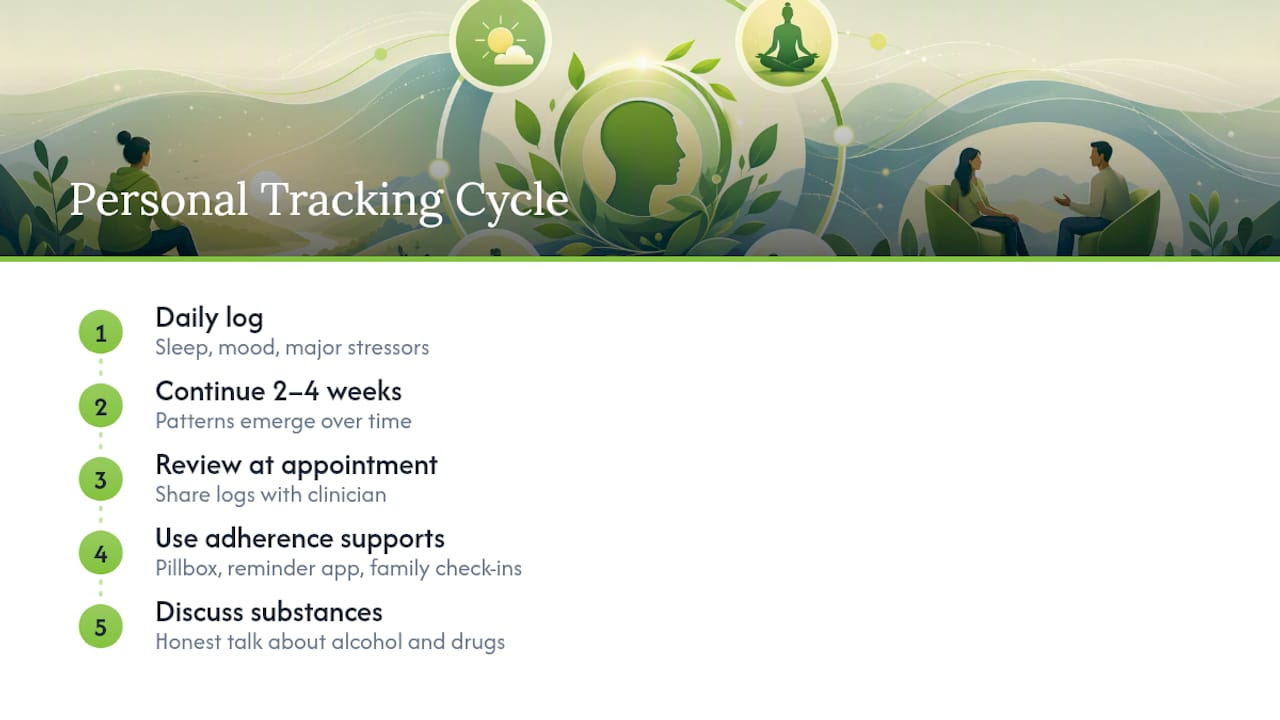
Medication adherence during a depressive episode is genuinely hard. Low motivation and low energy are symptoms of the illness itself, which makes taking medication consistently part of what you’re fighting against, not just a simple habit. Building small supports, a pillbox, a reminder app, a family member checking in, isn’t a sign of weakness. It’s a practical accommodation for a real symptom. Self-assessment tools can help you track patterns between appointments, though they work best as a supplement to professional care, not a replacement for it.
Guidelines and Resources Worth Bringing to Your Appointment
The recommendations in this article draw on established clinical guidelines rather than any single opinion, and it’s worth reading the primary sources yourself before your next appointment.
The VA/DoD Clinical Practice Guideline for Bipolar Disorder and the CANMAT/ISBD 2018 guidelines are the two most widely referenced treatment frameworks in North America. The NIMH bipolar disorder overview offers a clear, patient-facing summary of the condition and its depressive episodes specifically. For a deeper look at treatment tradeoffs, the PMC review of acute bipolar depression treatment is worth reading in full. Bringing even one of these to your visit, highlighted where you have questions, tends to make the conversation with your psychiatrist more productive.
Our Take: What Gets Overcomplicated (And What Doesn’t)
Here’s what we’d push back on: the idea that finding the “right” medication is the hard part. It isn’t, not really. The harder part is staying consistent with monitoring and follow-up long enough for any plan to prove itself, and that’s where most treatment attempts quietly fail.
We also think the conventional framing overstates antidepressants as a default and understates lamotrigine and structured psychotherapy as maintenance tools. Guidelines have shifted toward that view for good reason. If we could change one habit among patients starting treatment, it wouldn’t be about which drug to ask for. It would be about committing to the two-to-four-week check-in instead of quietly stopping a medication that just needed more time, or more patience with side effects that often fade.
Prioritize the follow-up schedule as much as the prescription itself. That’s the piece that actually determines whether a good treatment plan turns into a working one.
— Felix
Getting Evidence-Based Care for Bipolar Depression
Everything covered here, quetiapine, lurasidone, lamotrigine, TMS, careful monitoring, only works when it’s built into a real, ongoing relationship with a psychiatrist who tracks your response over time. That’s the gap between reading about treatment options and actually getting better.
A good psychiatric practice offers ongoing, measurement-based care for adults managing bipolar depression that fits their location and needs. Instead of a rushed medication check every few months, a provider adjusts your plan based on data from mood tracking and lab work, offering flexible appointment options to fit your schedule. If you’ve been managing bipolar depression on your own or feel like your current plan hasn’t been reassessed in a while, scheduling a psychiatric evaluation is the concrete next step, not another round of research.
This article is general information, not a substitute for advice from a qualified doctor. Consult a qualified healthcare professional about your own circumstances before acting on anything here.
Sources
- VA/DoD Clinical Practice Guideline for Bipolar Disorder (Provider summary)
- Treatment of acute bipolar depression (PMC review)
- CANMAT/ISBD 2018 bipolar treatment guidelines
- NIMH: Bipolar disorder information
FAQ
What Is the Best Treatment for Bipolar Depression?
Quetiapine, lurasidone, and the olanzapine/fluoxetine combination have the strongest trial evidence for acute bipolar depression, but the best option for you depends on your history, tolerability, and other health factors your psychiatrist will review with you.
Is Lamotrigine Good for Bipolar Depression?
Lamotrigine has modest evidence for treating an active depressive episode but stronger support for preventing future depressive episodes, which is why it’s used more often in maintenance planning than in acute crisis treatment.
Can Antidepressants Alone Treat Bipolar Depression?
Antidepressant monotherapy is generally advised against in bipolar I depression because of limited direct evidence and a real risk of triggering a manic or hypomanic switch without a mood stabilizer or antipsychotic on board.
How Long Does It Take to Know if a Bipolar Depression Medication Is Working?
Most guideline-based approaches call for an early review around two to four weeks after starting a new treatment to judge whether it’s helping enough to continue or whether an adjustment is needed.
Does TMS Help With Bipolar Depression?
Repetitive transcranial magnetic stimulation is recommended as an adjunct for patients with partial or no response to standard medication, and some practices include TMS as part of a broader treatment plan for appropriate patients.
What Natural Remedies Help With Bipolar Depression?
Sleep regulation, consistent daily routines, and limiting alcohol and substance use are the lifestyle factors with the most consistent support for reducing relapse risk, though they work as supports alongside medical treatment, not replacements for it.