

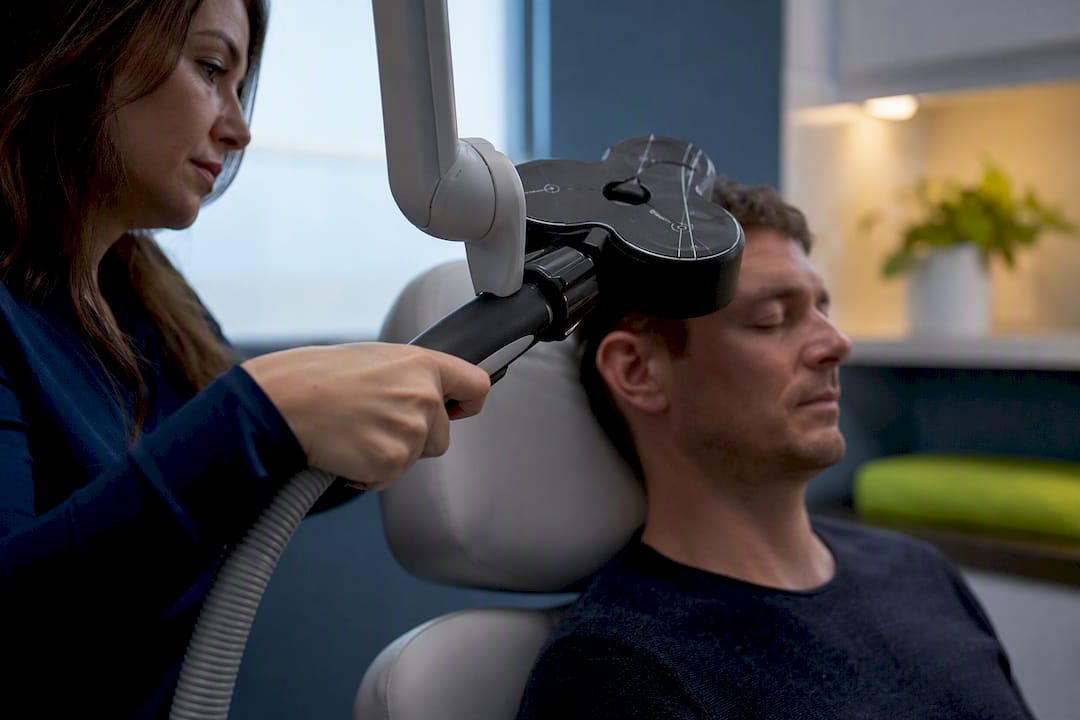
Maintenance TMS can meaningfully lower relapse risk for patients who responded to an acute course, particularly when the schedule is matched to individual relapse risk rather than applied uniformly. The strongest evidence, a recent randomized trial called MAINT-R found that maintenance rTMS worked about as well as lithium for preventing relapse, with fewer side effects. Guideline groups now treat it as a legitimate long-term option, not a fallback, and the best plans are the ones built around a specific patient, not a generic template.
TL;DR:
- Maintenance TMS can prevent relapse in higher-risk patients, especially if tailored to individual symptom trajectories and relapse history.
- Tapering protocols, fixed monthly sessions, clustered treatments, and as-needed retreatment are common scheduling options, each balancing effort and durability.
- The MAINT-R trial showed maintenance TMS is as effective as lithium for relapse prevention, with fewer side effects and less medical monitoring.
- Patients with multiple episodes, partial remission, or a history of relapse are more likely to benefit from ongoing maintenance treatment.
- Planning should start during the final acute treatment, with symptom score tracking and insurance logistics addressed early.
Table of Contents
- What Is Maintenance TMS, and How Does It Differ From an Acute Course?
- What Does the Research Actually Show About Relapse Prevention?
- Who Actually Needs Maintenance TMS?
- What Do Real Maintenance Schedules Look Like?
- How Does Maintenance TMS Compare With Other Relapse-Prevention Options?
- How Do You Actually Plan and Monitor a Maintenance TMS Schedule?
- How We Build Maintenance Plans at Nortex Psychiatry
- Ready to Talk About a Maintenance Plan?
- Sources
- FAQ
What Is Maintenance TMS, and How Does It Differ From an Acute Course?
In our work, we describe maintenance TMS as any ongoing rTMS treatment given after the initial acute course to protect gains rather than produce them. The acute phase is intensive and time-limited, often daily sessions for four to six weeks. Maintenance is the opposite: fewer sessions, spread out, aimed at holding the line rather than pushing further improvement.
There is no single accepted maintenance model. In practice, we see four general approaches:
- Tapering protocols, which step down from weekly to biweekly to monthly sessions over two to three months.
- Fixed-interval maintenance, a single session on a set schedule, often monthly, indefinitely.
- Clustered maintenance, several sessions condensed into a short window on a recurring basis, meant to mimic more of the acute course’s intensity.
- Retreatment, a short course reintroduced only if relapse signs appear, rather than continuous scheduled visits.
We have learned that the right choice depends less on a protocol chart and more on how a particular patient’s depression has behaved over time.
What Does the Research Actually Show About Relapse Prevention?
The evidence here is better than most people expect, and it is also more limited than marketing pages sometimes suggest. The MAINT-R randomized clinical trial compared low-frequency maintenance rTMS against lithium in 75 participants over 24 weeks.
Statistic: The trial found no significant difference in MADRS depression scores or relapse rates between the two groups, but the lithium group had more adverse events compared with the rTMS group.
That tolerability gap matters clinically. Lithium requires blood monitoring, carries thyroid and kidney risks, and is unforgiving of missed labs. Maintenance rTMS carries a much lighter medical burden for a comparable protective effect, at least across the trial’s 24-week window.
Guideline bodies had already been pointing this way. The CANMAT neurostimulation guidelines describe naturalistic cohorts where relapse without any maintenance plan arrived at a median of around 120 days, with reported relapse rates vary widely across studies over two to six months. Other cohort data, compiled in practical maintenance TMS protocol reviews, report sustained remission in many patients over 12 months when maintenance was part of the plan.
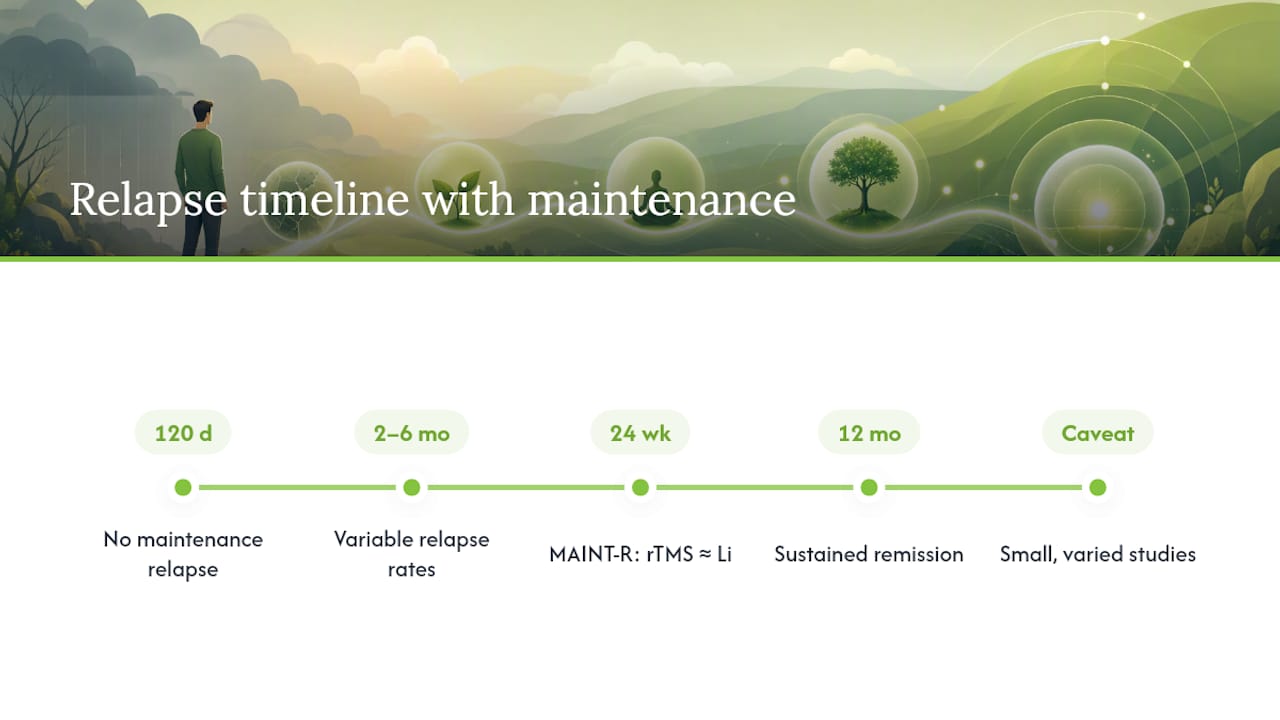
A few caveats keep us cautious about overselling this. Study protocols vary widely (different frequencies, different session counts, different patient populations), and most samples are small. We read this evidence as a strong directional signal, not a settled formula, which is exactly why individualized planning matters more here than in most areas of psychiatry.
Who Actually Needs Maintenance TMS?
Not every patient who finishes acute TMS needs a maintenance plan. In our experience, a handful of clinical features tend to raise relapse risk enough to warrant one:
- A history of multiple depressive episodes, not a single isolated one.
- A chronic or long-standing course of illness rather than a recent onset.
- Only partial remission at the end of the acute course, rather than full symptom resolution.
- A prior relapse after a previous round of TMS.
- Plans to taper or discontinue antidepressant medication around the same time.
Severity of the original episode and how quickly someone responded during the acute phase also shape the conversation. A patient who responded slowly and incompletely carries a different risk profile than one who remitted early and fully, and we treat those two people differently even if their diagnosis looks the same on paper.
Pro Tip: Ask your prescriber to document your symptom trajectory week by week during the acute course. That record becomes the single most useful tool for deciding whether maintenance is worth it.
None of this is a checklist that spits out a yes or no. It is a conversation, and the patient’s own preference for visit frequency, travel time, and tolerance for medication side effects belongs in that conversation as much as the clinical risk factors do.
What Do Real Maintenance Schedules Look Like?
Templates vary, but a few patterns show up repeatedly in practice and in the literature on maintenance frequency:
- Weekly to monthly taper. Sessions start weekly right after the acute course, step down to biweekly after a month, then to monthly for two to three more months. This is the most common template we see referenced in guideline material.
- Fixed monthly single sessions. One session per month, indefinitely, for patients whose relapse risk is moderate rather than high.
- Clustered monthly maintenance. Two to three sessions condensed into a single week each month, repeated on a monthly cycle. This more closely resembles the intensity of the acute course and appears to extend relapse-free intervals more reliably for higher-risk patients.
- As-needed retreatment. No fixed schedule at all. Instead, a short course (often one to two weeks) is reintroduced only when early relapse signs appear, guided by symptom scores rather than the calendar.
Session length and pulse counts generally mirror the acute protocol used originally, adjusted by the treating clinician. The trade-off is straightforward: tapering and fixed monthly sessions ask less of your schedule but may offer less durable protection for higher-risk patients, while clustered maintenance asks more of your calendar in exchange for a stronger buffer.
How Does Maintenance TMS Compare With Other Relapse-Prevention Options?
Patients often ask us how this stacks up against staying on medication, continuing therapy, or considering ECT or ketamine. Each has a different risk and burden profile:
- Medication (like lithium or antipsychotics) carries known systemic risks, including thyroid, kidney, or metabolic effects that require ongoing labs, an issue borne out directly in the MAINT-R trial’s adverse event data.
- Maintenance rTMS asks for regular clinic visits but has a comparatively light physical side effect profile.
- ECT tends to be reserved for more severe or treatment-resistant presentations and carries cognitive side effects that TMS does not share.
- Ketamine or Spravato can work faster for some patients but usually requires closer in-office monitoring per session.
Insurance coverage for maintenance sessions varies by payer, and that logistical reality shapes real-world decisions as much as the clinical evidence does. We often recommend combination approaches, TMS alongside a lower medication dose, for example, rather than treating these as an either-or choice. A closer look at how TMS stacks up against medication on tolerability and monitoring burden can help frame that decision.
How Do You Actually Plan and Monitor a Maintenance TMS Schedule?
We tell patients to start this conversation before the acute course ends, not after.
- Raise maintenance during your final acute-phase visits. Ask directly whether your relapse risk profile supports it.
- Get a baseline symptom score recorded, using PHQ-9 or MADRS, at the point acute treatment ends. This becomes your reference point.
- Set a monitoring cadence and a clear threshold. Decide in advance what score change should trigger a booster session or an earlier check-in, and know who to contact when it happens.
- Handle logistics early. Confirm insurance preauthorization requirements, and pencil in recurring appointments around work and travel before they become a scheduling scramble.
Pro Tip: Keep a simple running log of your PHQ-9 or MADRS scores on your phone. A two-point rise over a few weeks is often the earliest sign that a booster session is worth discussing, well before symptoms feel unmanageable again.
If relapse does occur despite a maintenance plan, retreatment with a short acute-style course tends to work well for patients who responded the first time. That is worth knowing going in. It takes some of the fear out of the phrase “if this stops working.”
How We Build Maintenance Plans at Nortex Psychiatry
In our practice, maintenance planning starts with a straightforward risk conversation, not a preset protocol. We look at episode history, how complete the response to acute TMS was, and what a patient’s life actually allows in terms of visit frequency. From there, we build a schedule together and track it with the same symptom scales we used during the acute course, so decisions are based on numbers, not guesswork.
Telehealth check-ins handle much of the follow-up between in-person sessions, which keeps monitoring consistent without adding unnecessary trips to the office. If early warning signs show up, we adjust the schedule rather than waiting for a full relapse. That flexibility, more than any single protocol, is what individualized maintenance care is supposed to mean.
— Felix
Ready to Talk About a Maintenance Plan?
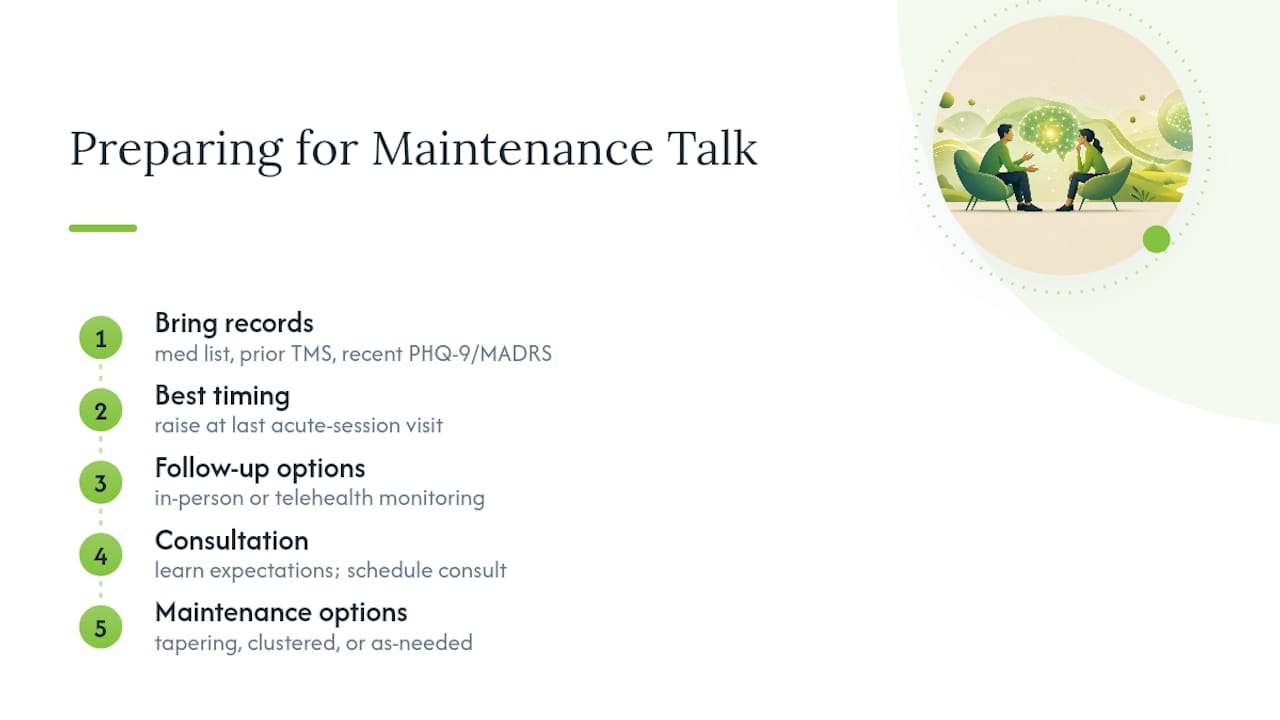
If you are finishing an acute TMS course or thinking ahead about relapse prevention, the conversation goes better when you come prepared. Bring your current medication list, any prior TMS treatment records, and your most recent PHQ-9 or MADRS scores if you have them. That gives us a real starting point instead of a guess.
A practical next step for adults seeking relapse-prevention planning built around their own history rather than a one-size-fits-all schedule includes options with both in-person and telehealth follow-up so monitoring does not add unnecessary trips to the office. The best time to raise maintenance is during your last acute-session visit, while your treatment team still has the full picture of how you responded. From there, you can learn what to expect from psychiatric care and schedule a consultation to talk through whether a tapering, clustered, or as-needed maintenance approach fits your situation.
Sources
Key references include the MAINT-R randomized trial, the CANMAT neurostimulation guidelines, and our own guide on whether TMS prevents relapse.
This article is general information, not a substitute for advice from a qualified doctor. Consult a qualified healthcare professional about your own circumstances before acting on anything here.
- Repetitive Transcranial Magnetic Stimulation as Maintenance Treatment of Depression: The MAINT-R Randomized Clinical Trial (JAMA Network Open)
- Observational/consensus discussions on maintenance rTMS frequency and clustered approaches (PMC)
- TMS List — Maintenance TMS
FAQ
What Is the Controversy With TMS?
The debate mostly centers on inconsistent protocols across studies and clinics, small trial sizes, and insurance coverage that varies widely, not on whether TMS works for depression at all.
What Does TMS Stand For?
TMS stands for Transcranial Magnetic Stimulation, a treatment that uses magnetic pulses to stimulate specific brain regions involved in mood regulation.
Do You Have to Do TMS Forever?
No. Many patients complete an acute course and either need no further sessions or move to a tapering or as-needed maintenance schedule rather than indefinite treatment.
Does TMS Have to Be Every Day?
Only during the acute phase, which typically runs daily on weekdays for four to six weeks; maintenance sessions afterward are spaced out to weekly, monthly, or as-needed depending on relapse risk.
How Long Do TMS Results Typically Last Without Maintenance?
Naturalistic data cited in CANMAT’s guidelines show a median relapse time of around 120 days without any maintenance plan in place, which is why many higher-risk patients choose to continue some form of ongoing treatment.