


Mood stabilizers are medications used to treat acute mania, manage bipolar depression, and prevent future mood episodes from recurring. The best-known examples are lithium, the anticonvulsants valproate (divalproex) and lamotrigine, plus a handful of atypical antipsychotics used for the same purpose. If you or someone you love is dealing with a mood disorder, the right next step is a full evaluation with a psychiatrist who can order baseline labs and match a medication to your specific history.
TL;DR:
- Lithium offers the most comprehensive evidence for treating mania, depression, and preventing relapse, but requires strict monitoring due to its narrow safety margin.
- Anticonvulsants and atypical antipsychotics are grouped into specific roles, with lamotrigine mainly preventing depressive episodes and some antipsychotics acting faster during manic crises.
- Treatment selection depends on individual response, medical conditions, pregnancy plans, and tolerability, not on a simplified medication hierarchy.
- Regular labs to monitor kidney, liver, blood, and metabolic health are essential and should be integrated into ongoing treatment, not seen as optional.
- Full effect of mood stabilizers typically takes 4 to 6 weeks, making early adjunctive therapy and close follow-up crucial during initial treatment phases.
Table of Contents
- Mood Stabilizers Explained: What the Term Actually Covers
- What Are the Main Types of Mood Stabilizers?
- How Do Mood Stabilizers Work in the Brain?
- How Long Does It Take for Mood Stabilizers to Work?
- How Do Clinicians Choose the Right Mood Stabilizer?
- What Side Effects and Monitoring Should You Expect?
- A Closer Look at Lithium, Valproate, Carbamazepine, Lamotrigine, and Antipsychotics
- Special Considerations for Pregnancy, Older Adults, and Teens
- What Happens When You Start, Continue, or Stop Treatment
- Nortex Psychiatry’s Approach to Medication Selection and Monitoring
- The Real Gap Between Textbook Mood Stabilizers and Clinical Practice
- Sources
- FAQ
Mood Stabilizers Explained: What the Term Actually Covers
Here’s something we tell nearly every new patient: there is no official drug category called “mood stabilizer.” The FDA doesn’t approve a class by that name. It’s a term clinicians adopted because it’s useful shorthand, not because it describes one pharmacological mechanism shared by every drug we put under that umbrella, according to a widely cited evidence-based analysis of the term. Lithium works differently than lamotrigine, and lamotrigine works differently than an atypical antipsychotic. We lump them together because of what they accomplish clinically, not how they get there.
That matters more than it sounds like it should. When a patient asks “why does my medication work differently than my cousin’s,” the honest answer is that they may not be treating the same problem at all. A mood stabilizer’s job breaks down into four separate clinical roles, and not every drug covers all four.
- Treating acute mania. Lithium, valproate, and several atypical antipsychotics have strong evidence here.
- Treating acute bipolar depression. Lithium and lamotrigine (plus a smaller set of antipsychotics like quetiapine) do the heavy lifting; valproate’s evidence for the depressive pole is weaker.
- Preventing manic relapse. Lithium and valproate lead this category.
- Preventing depressive relapse. Lamotrigine tends to outperform the others for this specific role, while lithium also has solid maintenance data.
Lithium is the outlier because it has meaningful evidence across all four roles, according to a well-regarded systematic review on the definition of mood stabilizers. That’s why we still reach for it first in many cases, even though it demands more monitoring than newer options. Nobody expects a mood stabilizer to be interchangeable with another one, and once you see it broken into these four jobs, it becomes obvious why your prescriber picked one drug over another. This is also the framework we lean on when discussing mood disorder treatment plans with patients and families.
What Are the Main Types of Mood Stabilizers?
If you’re trying to make sense of a mood stabilizer medications list, it helps to sort them into four groups rather than memorizing individual names. Each group has a distinct chemical origin and a distinct role in treatment. All of them are prescription-only, and none of them should be started, stopped, or adjusted without a clinician tracking your response.
- Lithium. The oldest and, by most evidence syntheses, the broadest-acting mood stabilizer we have, according to StatPearls’ clinical review. It covers mania, depression, and long-term prevention, though it needs regular blood monitoring.
- Anticonvulsants. Valproate/divalproex and carbamazepine were both developed for epilepsy before doctors noticed they calmed mania. Lamotrigine, also an anticonvulsant, is used more for preventing depressive relapse than for acute mania.
- Atypical antipsychotics. Drugs like quetiapine, olanzapine, aripiprazole, and lurasidone are FDA-approved for various phases of bipolar disorder, often working faster than lithium or the anticonvulsants during a manic episode.
- Adjunctive anticonvulsants. Some clinicians add other anticonvulsants off label in specific, harder-to-treat cases, though the evidence for these is thinner than for the four above.
We know it’s tempting to research this list and try to guess which category fits your situation. Resist that urge. A broader overview of psychiatric medication classes can help you understand the landscape, but matching an actual drug to an actual diagnosis requires a clinician who has seen your history, your labs, and your prior response to treatment.
How Do Mood Stabilizers Work in the Brain?
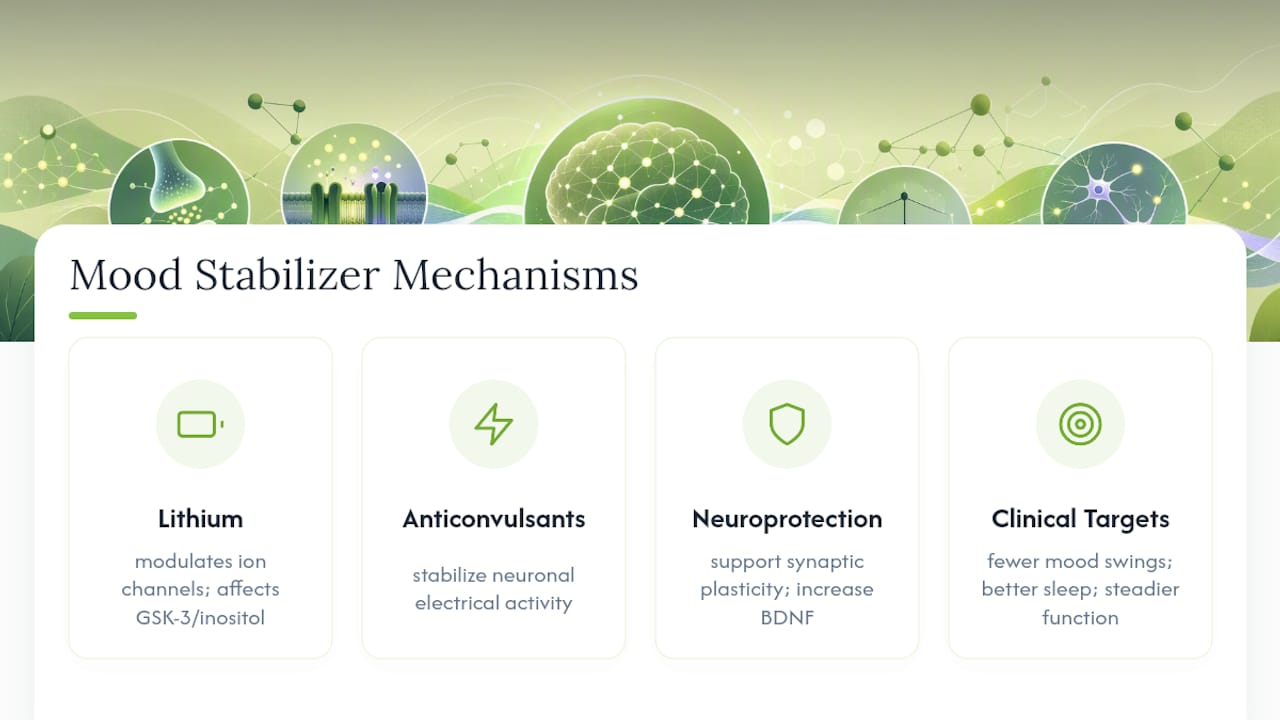
Honestly, we don’t have one clean mechanism to hand you. Different mood stabilizers appear to work through different biological pathways, and researchers are still filling in the gaps. Lithium seems to modulate ion channels and interfere with intracellular signaling cascades, including the GSK-3 and inositol pathways, both of which influence how neurons communicate and adapt over time. Anticonvulsants like valproate and lamotrigine stabilize electrical activity across neuron membranes, which is the same property that makes them useful for seizure disorders.
There’s also a neuroprotective angle worth knowing about. Some research points to mood stabilizers supporting synaptic plasticity and boosting neurotrophic factors like BDNF, a mechanism proposed as one reason long-term maintenance treatment may protect against the cumulative brain changes associated with repeated mood episodes, according to a review on mood stabilizer mechanisms.
We’ll be straight with you: this mechanistic uncertainty doesn’t stop us from prescribing these medications. It does shape what we monitor and what we tell you to expect. We’re not looking for a lab value to normalize. We’re watching for fewer mood swings, better sleep, steadier function at work or school, and side effects staying manageable. That’s the real target, even when the underlying biology stays a little fuzzy.
How Long Does It Take for Mood Stabilizers to Work?
Patience is the hardest part of starting a mood stabilizer, and we say that with real sympathy. Most of these medications show an initial effect within 4 to 10 days, but reaching full effect commonly takes 4 to 6 weeks, with some variation depending on the specific drug, according to the Merck Manual’s clinical guidance.
That gap between “starting to help” and “fully working” is exactly why clinicians often add a faster-acting antipsychotic during acute mania or severe distress. We’re bridging the time it takes lithium or valproate to build up while keeping symptoms from spiraling in the meantime.
In those early weeks, keep a simple daily log: mood, sleep hours, and anything unusual. Watch closely for confusion, severe tremor, vomiting, or worsening suicidal thoughts. Any of those warrant a same-day call to your prescriber, not a wait-and-see approach.
How Do Clinicians Choose the Right Mood Stabilizer?
There’s no algorithm that spits out the “correct” answer here. Selecting a medication is genuinely iterative, and it depends on a set of factors specific to you.
- Prior response. If a family member responded well to lithium, that’s a meaningful data point, since treatment response can run in families.
- Episode type. Someone whose main problem is depressive episodes may do better on lamotrigine than on valproate, which leans more toward the manic pole.
- Comorbid conditions. Kidney issues steer us away from lithium; liver concerns affect how comfortable we feel with valproate.
- Pregnancy plans. This one carries enough weight that it can override other preferences entirely.
- Tolerability and lifestyle. Weight gain, sedation, tremor, and cognitive fog all affect whether someone actually keeps taking a medication long term.
Choosing a mood stabilizer is rarely a one-visit decision. We often start with an educated first guess, watch how you respond over several weeks, and adjust from there. That’s not failure. It’s how individualized psychiatric care is supposed to work, and it’s a theme we return to often in our guide to personalized mood disorder treatment.
Pro Tip: Bring a written timeline of your mood episodes to your appointment, including rough dates, what triggered them if you know, and any medications you tried before. It saves time and gives your prescriber real data instead of a general impression.
Good questions to bring to that visit: What role is this drug meant to play for me? What side effects should worry me versus what’s just an adjustment period? What labs will you check, and how often? How will we know if this is working? What’s the plan if it isn’t?
What Side Effects and Monitoring Should You Expect?
This is where mood stabilizers ask more of you than a typical prescription. Regular labs aren’t optional extras. They’re part of how these medications are used safely.
- Lithium requires monitoring of serum lithium levels, kidney function, and thyroid function, both at baseline and on an ongoing basis, per its official prescribing information.
- Valproate needs liver function tests (LFTs) and a complete blood count (CBC), since it can affect liver enzymes and platelet counts.
- Carbamazepine carries hematologic risks and a long list of drug interactions, so CBC monitoring and a careful medication review matter here too.
- Lamotrigine requires a slow titration schedule specifically to lower the risk of a rare but serious skin reaction, Stevens-Johnson syndrome.
- Atypical antipsychotics call for metabolic monitoring: weight, blood glucose, and lipid panels, since these drugs can affect metabolic health over time.
A practical monitoring rhythm looks something like this: baseline labs before you start, a follow-up check within the first couple of weeks, then a steady cadence after that. For lithium specifically, expect level checks roughly weekly until your dose is stable, then every 3 to 6 months once things settle, according to StatPearls’ clinical guidelines. This isn’t your prescriber being overly cautious. Lithium has a narrow therapeutic window, meaning the gap between an effective dose and a toxic one is smaller than with most medications.
Toxicity signs are worth memorizing if you or a family member is on lithium: persistent vomiting, severe tremor, confusion, slurred speech, or unsteady walking. Dehydration, certain blood pressure medications, and NSAIDs like ibuprofen can all push lithium levels higher without you changing your dose, so staying hydrated and telling every provider you see that you’re on lithium isn’t optional. If any of these toxicity signs show up, that’s an urgent care or emergency room visit, not a “call tomorrow” situation. For everyday adherence support between appointments, our medication management guide for chronic conditions covers practical habits worth building early.
A Closer Look at Lithium, Valproate, Carbamazepine, Lamotrigine, and Antipsychotics
Lithium remains the medication with the broadest evidence base, covering acute mania, acute depression, and long-term prevention of both poles, according to a key evidence synthesis. Its main tradeoff is a narrow safety margin that demands consistent blood monitoring and steady hydration.
Valproate/divalproex works well and fast for acute mania, often within days. Its standout risk is teratogenicity: it’s linked to neural tube defects and developmental concerns including ADHD and autism spectrum presentations when taken during pregnancy, which is why it’s typically not the first choice for women of childbearing age, according to Merck Manual’s professional guidance. LFTs and CBC checks are standard here.
Carbamazepine is used less often than it once was, largely because of its hematologic risks and a dense web of drug interactions that complicate combining it with other medications. It still has a role for patients who haven’t responded to first-line options.
Lamotrigine shines for preventing depressive relapse rather than treating acute mania, where its evidence is weak. The tradeoff is a mandatory slow titration schedule over several weeks to reduce the risk of Stevens-Johnson syndrome, a rare but serious skin reaction, according to MSD Manual’s consumer guidance.
Atypical antipsychotics, as a category, often act faster than the other groups during acute mania and several (quetiapine, lurasidone) also have solid depression evidence. Their standout concern is metabolic: weight gain, elevated blood sugar, and lipid changes over time, which is why routine metabolic labs matter as much as psychiatric follow-up.
Special Considerations for Pregnancy, Older Adults, and Teens
We treat prescribing decisions differently depending on who’s in front of us, and this is one area where a one-size answer genuinely doesn’t apply.
Women of childbearing potential deserve a direct conversation about pregnancy plans before starting valproate, given its teratogenic profile, and contraception should come up explicitly as part of that discussion. Lithium and lamotrigine carry their own considerations in pregnancy too, so this conversation belongs with a psychiatrist rather than guesswork.
Older adults typically need lower starting doses and closer kidney function monitoring, since reduced renal clearance raises the risk of lithium accumulating to toxic levels. For teens, some mood stabilizers carry specific pediatric approval and dosing guidance that differs meaningfully from adult protocols, which our parent’s guide to teen medication management walks through in more depth. If breastfeeding is part of the picture, that’s a conversation for a specialist who can weigh the specific medication against infant exposure risk.
What Happens When You Start, Continue, or Stop Treatment
Starting a mood stabilizer usually begins with baseline labs (kidney and thyroid panels for lithium, liver function and CBC for anticonvulsants), sometimes an ECG, and a full review of your current medications for interactions. Early follow-up visits are more frequent, often within the first two weeks, to check levels and tolerability before spacing out to monthly, then quarterly.
How long you stay on treatment depends on your history. After a single manic episode, many clinicians recommend at least 12 to 24 months of maintenance treatment; a history of multiple episodes usually points toward longer-term, sometimes indefinite, prophylaxis. If stopping ever becomes appropriate, it happens gradually, under supervision. Stopping a mood stabilizer abruptly meaningfully raises the risk of relapse, sometimes within weeks, which is a risk worth avoiding through a proper taper.
Nortex Psychiatry’s Approach to Medication Selection and Monitoring
In our practice, we start with a full evaluation and baseline testing before recommending anything, then build the plan around your history and preferences through genuine shared decision-making. We offer both telehealth and in-person visits so follow-up labs and check-ins fit your actual schedule. When medication alone isn’t getting you where you need to be, we also discuss adjunctive options like TMS therapy or ketamine treatment alongside ongoing medication management. Coming to your first visit with a list of current medications, a rough symptom timeline, and notes on what has or hasn’t worked before helps us move faster toward the right plan.
The Real Gap Between Textbook Mood Stabilizers and Clinical Practice
Here’s what we think gets lost in most explainers on this topic: people want a clean hierarchy, a “best” mood stabilizer, and the evidence simply doesn’t hand us one. Lithium has the broadest support, but broadest doesn’t mean best for every person sitting across from us. Conventional advice tends to oversell mechanism and undersell monitoring. Patients read about GSK-3 pathways and BDNF and think the science is settled; meanwhile the thing that actually protects them week to week is a lithium level drawn on schedule and a prescriber who answers the phone when tremor shows up.
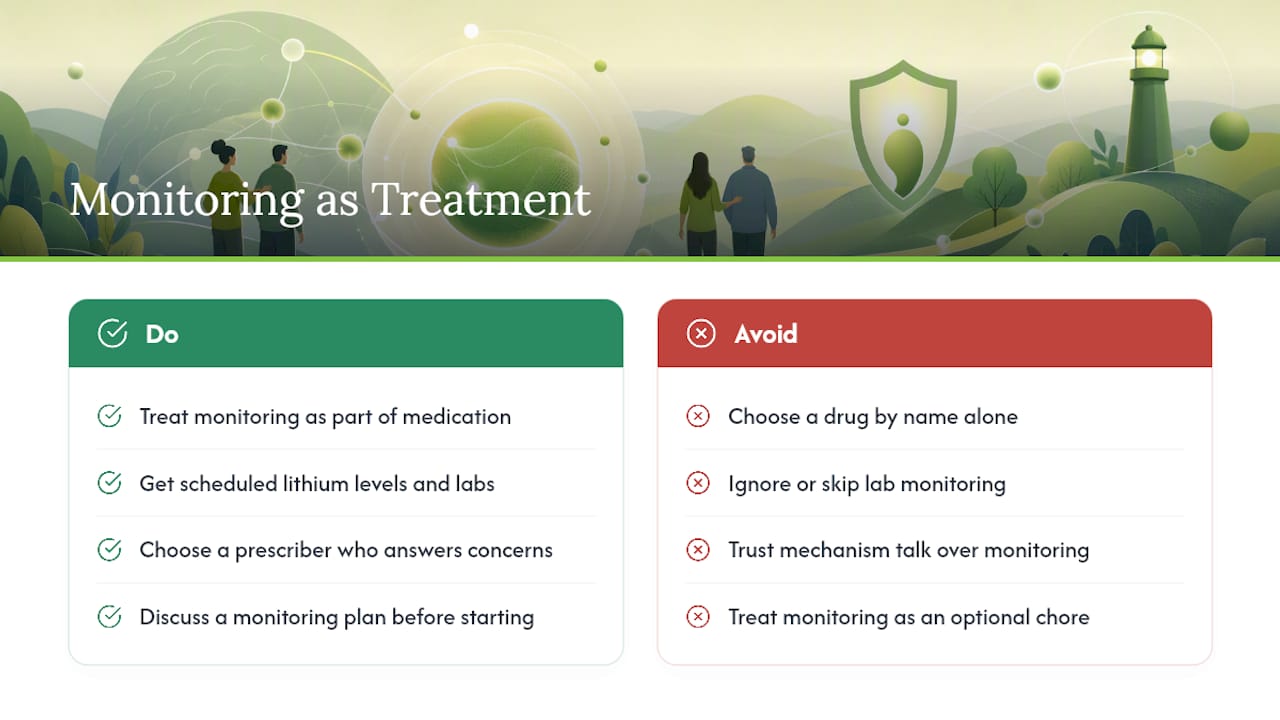
If we had to name one priority for readers, it’s this: treat monitoring as part of the medication, not a separate chore. A mood stabilizer without labs is an incomplete treatment. That’s not overcaution. It’s the entire reason these drugs remain safe enough to use for decades at a time, for millions of people, despite narrow safety margins and real risks. Choose your prescriber with that in mind, not just the drug name.
If you’re ready to talk through your options with someone who will actually track the details, our guide on when to seek psychiatric care is a reasonable place to start, and for readers looking into broader treatment context beyond medication alone, this overview of depression treatment options covers additional ground worth knowing.
— Felix
This article is general information, not a substitute for advice from a qualified doctor. Consult a qualified healthcare professional about your own circumstances before acting on anything here.
Sources
- Mood Stabilizers – StatPearls – NCBI Bookshelf
- Medications for Treatment of Bipolar Disorders – Merck Manual Professional
- What is a “mood stabilizer”? An evidence-based response
- Lithium carbonate capsules – DailyMed
- Medications for treatment of bipolar disorders – MSD Manual (consumer)
FAQ
What Are the Top Mood Stabilizers Used for Bipolar Disorder?
The most commonly used mood stabilizers are lithium, valproate/divalproex, carbamazepine, lamotrigine, and several atypical antipsychotics such as quetiapine and aripiprazole, according to StatPearls’ clinical review.
Can You Still Feel Happy While Taking a Mood Stabilizer?
Yes. Mood stabilizers are designed to reduce the frequency and intensity of extreme highs and lows, not to blunt normal positive emotion, and most people report feeling more like themselves once symptoms are controlled, according to CAMH’s overview of mood stabilizing medication.
Which Mood Stabilizer Is Considered the Least Risky?
There’s no single “safest” option since each drug’s risk profile depends on your medical history; lamotrigine is often well tolerated for depression prevention with fewer metabolic effects, while lithium and valproate require more intensive monitoring, per MSD Manual’s consumer guidance.
Do Mood Stabilizers Reduce Anger and Irritability?
Yes, many patients notice reduced irritability and anger outbursts as mood episodes come under control, since irritability is often part of both the manic and depressive presentations these medications target.
Is Lithium Still the First-Choice Mood Stabilizer?
Lithium remains a common first choice because it has evidence across acute mania, acute depression, and long-term prevention, though the actual first choice depends on your specific history, prior response, and other health factors, according to a key evidence review.