


BLUF: SPRAVATO is available only through the SPRAVATO REMS — a restricted distribution program that limits dosing to certified outpatient settings and certified pharmacies. If you’re a clinic administrator building a program, or a patient trying to understand why esketamine treatment looks so different from a typical prescription refill, here’s what actually has to happen at every visit:
- Your clinic and pharmacy must both be REMS certified before a single dose is dispensed
- Patients must be enrolled in the REMS before their first outpatient session, confirming understanding of monitoring requirements
- Every dose is administered under direct observation, never taken home
- Monitoring runs for at least 2 hours with pulse oximetry after each dose
- The clinic must submit a Patient Monitoring Form within a week of every session
We’ve built our own Spravato program around these rules, and we can tell you they’re not bureaucratic decoration. Each requirement traces back to a real safety concern: sedation, dissociation, and elevated blood pressure that needs a trained clinician nearby, not a patient driving home alone.
TL;DR:
- Both the clinic and pharmacy must be REMS certified; without this dual certification, dispensing or administering Spravato is illegal.
- Every dose requires direct supervision, with monitoring that includes blood pressure checks at baseline and during peak effects, extending beyond two hours if needed.
- Patient monitoring forms are due within seven days of each session, and failure to submit complete, timely documentation risks compliance violations.
- Certification involves designated staff, proper equipment, and ongoing training, with regular review of enrollment and documentation to prepare for audits.
- Nortex Psychiatry operates a fully certified Spravato program in North Dallas, emphasizing safety, staff training, and efficient documentation to ensure continuous compliance.
Table of Contents
- Spravato REMS Requirements: What Certification Actually Involves
- Who Qualifies to Prescribe and Administer Spravato?
- How to Get Your Outpatient Clinic Certified
- What Does the 2-Hour Monitoring Requirement Actually Mean?
- Which Forms Are Required and When Are They Due?
- What Equipment and Staffing Does a Spravato Program Need?
- Why Do Clinics Fail REMS Audits, and How Do You Avoid It?
- How Nortex Psychiatry Runs a REMS-Compliant Spravato Program
- Nortex Psychiatry’s Spravato Service: How We Can Help
- Key Takeaways
- Sources
- FAQ
Spravato REMS Requirements: What Certification Actually Involves
The REMS program exists because SPRAVATO carries genuine risks. It’s a Schedule III controlled substance, and the FDA built this REMS specifically around sedation, dissociation, respiratory depression, and misuse potential. That’s not marketing language from Janssen. It’s the reason a psychiatrist can’t just write a script and send a patient to a retail pharmacy.
Certification has two separate tracks that both have to close before treatment starts. The healthcare setting (your clinic) certifies to administer and monitor. The pharmacy or distributor certifies to dispense the drug to that setting. Miss either one and you can’t legally treat a patient, no matter how ready your staff is.
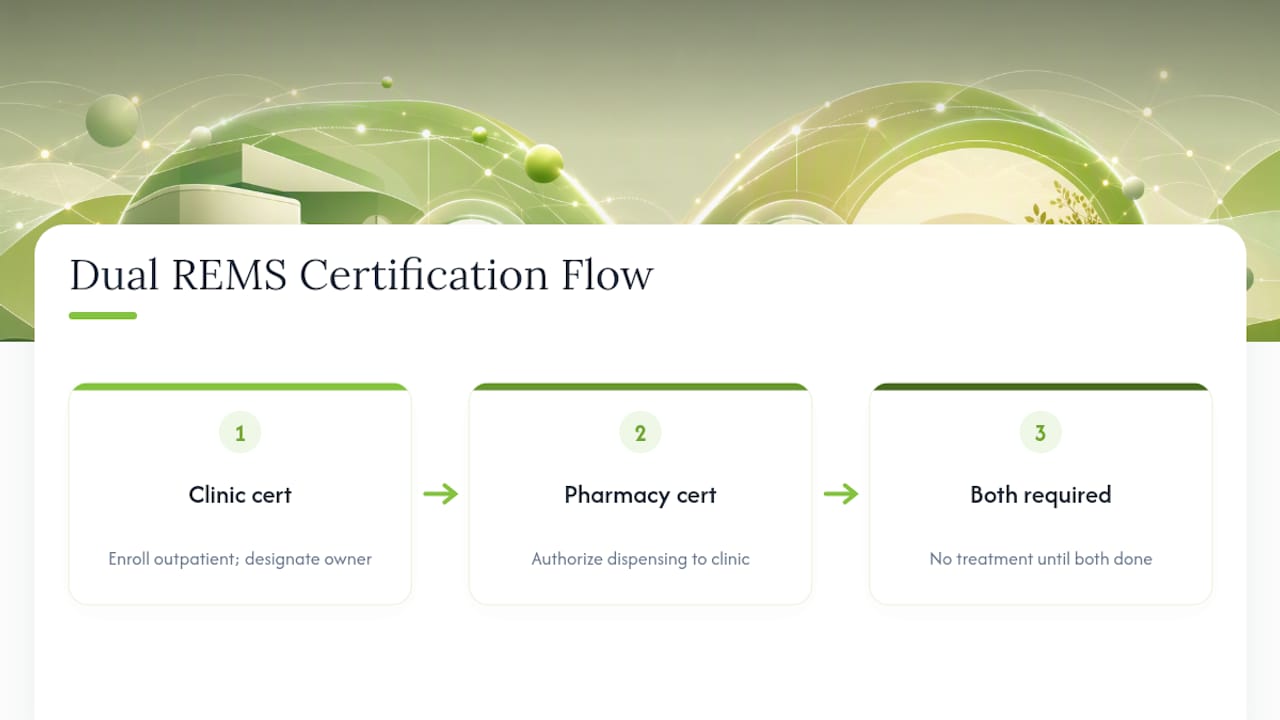
For clinics specifically, certification means enrolling as an outpatient healthcare setting, which requires designating someone to own the process from start to finish.
Who Qualifies to Prescribe and Administer Spravato?
Not every psychiatric provider can offer this treatment. Spravato eligibility on the clinical side starts with prescriber credentials and clinic infrastructure, not just an interest in offering the therapy. A few realities we’ve learned running our own program:
- The prescriber must be affiliated with a REMS-certified outpatient setting; a DEA number alone doesn’t clear you to dispense
- The setting needs monitoring equipment, trained staff, and emergency plans to gain approval for pharmacy shipments
- Someone at the practice must serve as Authorized Representative, responsible for REMS materials and enrollment attestations
Pro Tip: Pick your Authorized Representative based on who’s actually going to stay in that role for years, not whoever’s available to sign paperwork this week. Every AR change triggers a re-enrollment step, and we’ve seen practices lose weeks of continuity because nobody updated the record after a role change.
How to Get Your Outpatient Clinic Certified
Getting certified isn’t complicated, but it has a specific order. Skip a step and you’ll be stuck waiting on a resubmission instead of treating patients.
- Designate your Authorized Representative. This person becomes the clinic’s point of contact with the REMS program and is responsible for keeping enrollment information current.
- Review the mandatory REMS materials. That includes the Fact Sheet, the full prescribing information, and the Instructions for Use. Your AR and prescribers should read these together, not separately.
- Choose your acquisition pathway. Clinics generally pick between buy-and-bill, where the practice purchases the drug directly and bills insurance, or ordering through a REMS-certified specialty pharmacy that ships to your setting.
- Complete know-your-customer (KYC) verification if you’re buying and billing. Distributors run this check to confirm your practice is a legitimate, certified setting before releasing product.
We’d add a sixth step that isn’t officially part of the checklist: build a recurring calendar reminder to review your enrollment status. Contact information changes, staff turn over, and re-enrollment obligations creep up faster than most practices expect.
Maintaining certification is really about staying current, not passing a one-time test. Update your AR information any time it changes. Keep training logs current for every staff member involved in administration or monitoring. And treat the possibility of an audit as a permanent condition of doing this work, not a rare event.
If you’re weighing whether to add esketamine to your practice at all, it helps to understand how esketamine differs from off-label ketamine, since that distinction is exactly why one requires REMS certification and the other doesn’t.
What Does the 2-Hour Monitoring Requirement Actually Mean?
Here’s where a lot of the confusion comes in, because “2 hours” sounds like a stopwatch requirement. It isn’t. The prescribing information sets a minimum of 2 hours of observation with pulse oximetry after every dose, but that’s a floor, not a discharge trigger.
Physiologically, here’s what you’re watching for during that window:
- Blood pressure typically rises after dosing, peaking around 40 minutes and sometimes lasting up to 4 hours; a meaningful share of patients see systolic increases over 40 mmHg or diastolic increases over 25 mmHg during trials
- Dissociation usually emerges within the first 40 minutes and tends to resolve within the observation window, though timing varies by patient
- Sedation can persist quietly even after dissociative symptoms fade, which is why we check alertness, not just orientation, before signing off
We’ve learned to build BP checks into a rhythm: baseline before dosing, again around the 40-minute mark when pressure typically peaks, and once more before discharge. That schedule catches most of the physiologic action without turning monitoring into constant interruption for the patient.
Pro Tip: Document specific behavioral signs, not vague labels. “Patient oriented to person, place, and time; ambulates steadily; BP 128/82 at 120 minutes” holds up in a chart review far better than “patient stable.”
Patients on other CNS depressants, or with a history of substance use, deserve extra caution here. Combined sedation risk is real, and we’ve extended monitoring past 2 hours more than once for patients on benzodiazepines or with a documented substance-use history, simply because the clinical picture wasn’t clean enough to release them on schedule. Clinical stability, in practice, means the patient can walk, talk, and think clearly without another adult steadying them, not just that a timer went off. If sedation or dissociation lingers, the standard here is that monitoring extends until the clinician is satisfied, not until the form says you can stop.
Which Forms Are Required and When Are They Due?
Two forms carry the REMS program’s compliance weight, and both have hard deadlines attached.
Patient Enrollment Form. This is completed once, before the patient’s first outpatient treatment session. It confirms the patient understands the risks and agrees to the monitoring requirements.
Patient Monitoring Form. This one repeats after every single outpatient session. It captures vital signs, pulse oximetry readings, any adverse events, and concomitant medications, and it must be submitted within 7 calendar days of the visit through SPRAVATOrems.com or an approved fax line.
A few workflow details matter more than they might seem to at first glance:
- Keep a copy of every submitted form in your own records, don’t rely solely on the portal’s history
- Serious adverse events need to be identified and reported according to REMS definitions, separate from routine monitoring data
- Decide upfront who’s authorized to submit forms versus who has to sign attestations; those are different levels of responsibility
- Complete the monitoring form immediately after the observation period ends, while details are fresh
- Route it for any required clinician sign-off same day if possible
- Submit it well before the 7-day deadline, not on day 6
Waiting until the deadline is where most practices get into trouble, which we’ll get into shortly.
What Equipment and Staffing Does a Spravato Program Need?
Certification on paper is one thing. Running the program day to day is another, and it comes down to a fairly specific list of operational essentials.
- A prescriber physically onsite for every administration and throughout monitoring, no exceptions
- A pulse oximeter and blood pressure cuff at each monitoring station, checked regularly for accuracy
- Emergency oxygen and a documented response plan in case of respiratory depression
- Monitoring logs and documentation templates that match REMS form fields, so staff aren’t transcribing data twice
- A clear acquisition plan, whether that’s buy-and-bill with completed KYC verification or scheduled deliveries from a REMS-certified pharmacy
Pro Tip: Build your monitoring log template to mirror the Patient Monitoring Form field for field. When your nurse’s notes already match the form’s structure, submission becomes a five-minute copy job instead of a reconstruction project.
Training logs deserve their own attention. Every staff member touching administration or monitoring needs documented training, refreshed periodically, with dates and signatures on file. If you’re navigating insurance alongside acquisition decisions, our step-by-step guide to Spravato insurance coverage covers how billing choices intersect with your operational setup.
Why Do Clinics Fail REMS Audits, and How Do You Avoid It?
The 7-day reporting window is where we’ve seen the most operational strain, and it’s rarely because staff don’t understand the requirement. It’s because busy clinics let monitoring forms pile up, and a backlog can eventually disrupt ordering and continuity of care for patients already mid-treatment.
Common failure points we’ve either seen directly or heard about from colleagues:
- Monitoring forms submitted late or with incomplete vital sign fields
- Training logs that exist somewhere but can’t be produced quickly when asked
- Inventory records that don’t reconcile with dispensing logs, a red flag in any KYC audit
- No backup person designated when the Authorized Representative is out sick or on leave
REMS-certified settings can be selected for a REMS audit or a KYC audit at any time, and communication typically comes through dedicated REMS or KYC mailboxes rather than a phone call. Practices that respond quickly tend to have one thing in common: a maintained audit folder with logs, SOPs, and copies of every submitted form ready to go.
Pro Tip: Set a recurring internal review, quarterly works well, where someone checks that every monitoring form from the past quarter was actually submitted, not just started.
How Nortex Psychiatry Runs a REMS-Compliant Spravato Program
In our own practice, we’ve built the Authorized Representative role around continuity rather than convenience. The same person owns our REMS relationship, tracks re-enrollment triggers, and keeps our training logs current for every clinician and nurse involved in administration.
Our post-dose monitoring routine follows the physiologic timeline we described above: baseline vitals, a check near the 40-minute blood pressure peak, and a final assessment before any patient leaves the building. We’ve found that patients tolerate the process far better when we walk them through what to expect at intake, rather than explaining it dose by dose. That includes helping patients manage side effects like dissociation and blood pressure changes between visits, and helping them navigate insurance before treatment starts, not after the first bill arrives.

A short clinician note: balancing throughput and patient safety
We understand the pressure to move efficiently between patients, especially on a full monitoring day. But clinical stability has to outrank the clock every time. If a patient needs 20 extra minutes, document why and extend the observation. A note explaining a judgment call protects the patient and holds up far better under review than a form that simply says two hours passed.
— Felix
Nortex Psychiatry’s Spravato Service: How We Can Help
If you’ve been reading this as a patient rather than an administrator, here’s the practical version: Nortex Psychiatry runs a fully REMS-compliant Spravato program in Allen, Texas, serving patients across Frisco, McKinney, Plano, and the surrounding North Dallas area, with trained staff and documented monitoring at every session. Unlike a practice still building its certification from scratch, our workflows for enrollment, monitoring, and form submission are already in place, which means fewer delays getting your first dose scheduled.
Booking starts with an intake evaluation to confirm Spravato is appropriate for your history and current medications. From there, we walk you through what to expect on treatment days, including the 2-hour monitoring window, and help you sort out insurance questions before your first visit rather than after. If you’re comparing clinics, ask directly about their Authorized Representative, their monitoring equipment, and their average form-submission turnaround, questions our Spravato Therapy program is built to answer clearly. For a broader look at what treatment costs and how coverage typically works, our guide on Spravato Therapy costs and financial options is a good next stop. Reach out to schedule an evaluation, and we’ll walk you through the rest.
Key Takeaways
SPRAVATO requires REMS certification, patient enrollment, onsite monitored administration, and a 7-day monitoring form deadline to stay compliant and keep patients safe.
| Point | Details |
|---|---|
| Certification is two-sided | Both the clinic and the pharmacy must be REMS certified before any dose is dispensed. |
| Monitoring is judgment-based | The 2-hour rule is a floor; extend observation when sedation or dissociation persists. |
| Forms have hard deadlines | Patient Monitoring Forms are due within 7 calendar days of every outpatient session. |
| Audits happen without warning | Keep training logs, SOPs, and submitted forms in one folder ready for review anytime. |
| Nortex runs a compliant program | Nortex Psychiatry offers REMS-certified Spravato Therapy with trained staff across North Dallas. |
This article is general information, not a substitute for advice from a qualified doctor. Consult a qualified healthcare professional about your own circumstances before acting on anything here.
Sources
FAQ
Does Esketamine Require REMS Certification?
Yes. SPRAVATO (esketamine) is available only through the SPRAVATO REMS because of sedation, dissociation, respiratory depression, and misuse risk associated with the drug.
What Are the Requirements for the REMS Program?
Certified outpatient settings must enroll, designate an Authorized Representative, administer doses under direct observation, monitor patients for at least 2 hours with pulse oximetry, and submit monitoring forms within 7 calendar days.
What Disqualifies a Patient From Spravato?
Disqualifying factors typically include uncontrolled hypertension, a history of aneurysmal vascular disease, intracerebral hemorrhage, or clinical instability that a prescriber determines makes monitoring unsafe; a full risk review happens during your psychiatric evaluation.
What Are the Requirements for Using Spravato as a Patient?
Patients must be enrolled in the REMS before their first dose, agree to onsite administration under supervision, and remain for at least 2 hours of monitored observation after each session, since take-home dosing is never permitted.
Can Nortex Psychiatry Help With Spravato REMS Compliance Questions?
Yes. Nortex Psychiatry operates a REMS-certified outpatient Spravato program with trained staff, documented monitoring routines, and support navigating insurance and acquisition questions for patients across North Dallas.
Recommended
- Finding the Right Spravato Therapy Clinic: Top Factors to Consider – Nortex Psychiatry
- Navigating Insurance Coverage for Spravato Therapy: A Step-by-Step Approach – Nortex Psychiatry
- The Cost of Spravato Therapy: Understanding Your Financial Options – Nortex Psychiatry
- Managing Side Effects: A Practical Guide for Spravato Therapy Patients – Nortex Psychiatry