


A psychiatric assessment is a structured clinical evaluation that establishes your mental health diagnosis and guides personalized care. The formal term used in clinical settings is psychiatric evaluation, and both phrases describe the same process. Using the DSM-5-TR framework, which organizes more than 300 diagnostic categories for mental disorders, a psychiatrist gathers your mental, emotional, social, and medical history to form a complete picture of your functioning. The goal is not just to name a condition. It is to build a clinical formulation that connects your symptoms to a treatment plan made specifically for you.
What is a psychiatric assessment and who conducts it?
A psychiatric assessment is led by a psychiatrist, who is a medical doctor with specialized training in diagnosing and treating mental health conditions. Psychiatrists focus on diagnosis, medication management, and overall treatment planning. They are the only mental health professionals who can prescribe medication, which makes their role central to the evaluation.

That said, a multidisciplinary team often enriches the process. Psychologists contribute standardized cognitive and personality testing. Nurses assess physical health and daily functioning. Social workers evaluate your home environment, relationships, and social supports. Occupational therapists look at how symptoms affect your ability to manage work and daily tasks. Each professional adds a layer of understanding that a single clinician cannot provide alone.
This team approach matters because mental health conditions rarely exist in isolation. Anxiety can look like a thyroid problem. Depression can overlap with grief, chronic pain, or ADHD. A broader clinical team catches what a single interview might miss.
- Psychiatrist: Medical diagnosis, medication decisions, and overall treatment direction
- Psychologist: Standardized testing for cognitive function, learning, and personality
- Psychiatric nurse: Physical health screening, medication history, and daily functioning
- Social worker: Family dynamics, housing, trauma history, and community resources
- Occupational therapist: Impact of symptoms on work, self-care, and daily routines
Pro Tip: If you are referred to a multidisciplinary team, ask each clinician what their specific role is. Knowing who does what reduces confusion and helps you prepare the right information for each appointment.
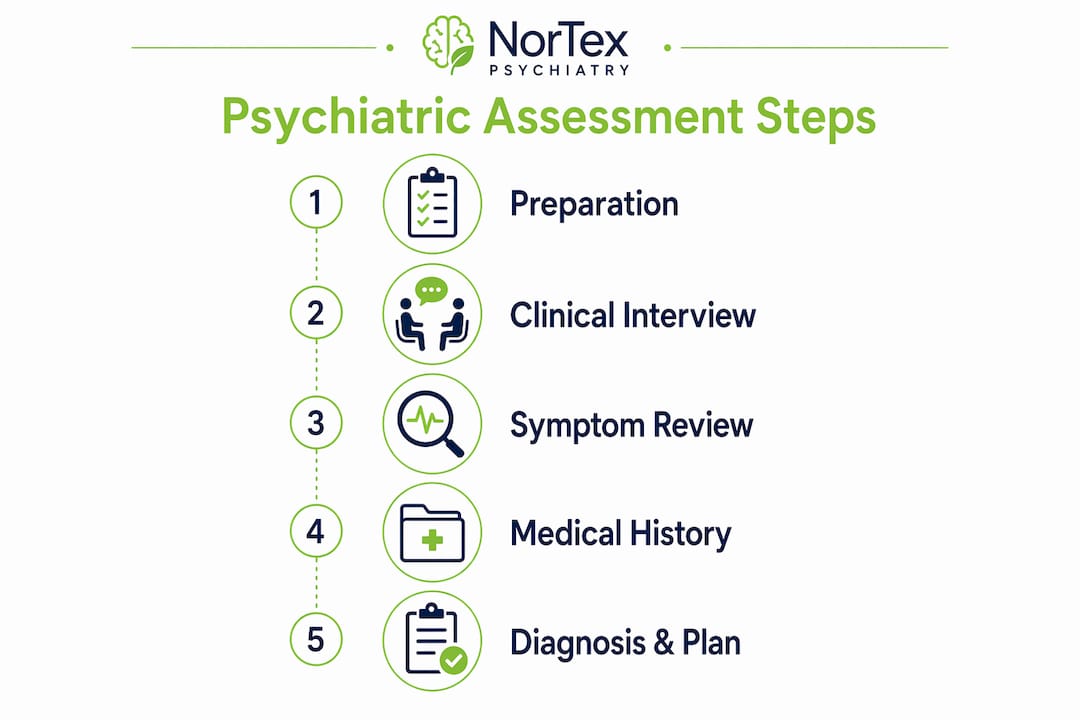
How is a psychiatric assessment done? Step-by-step overview
A typical psychiatric assessment lasts between 60 and 90 minutes, with more time allocated for complex cases. That time commitment reflects the depth of information a clinician needs to form an accurate diagnosis. Rushing this process compromises the quality of the clinical formulation and, by extension, the treatment that follows.
Here is what you can generally expect:
- Clinical interview. The psychiatrist asks about your current symptoms, when they started, and how they affect your daily life. This is the core of the evaluation.
- Mental status examination. The clinician observes and documents your appearance, speech, mood, thought patterns, memory, and insight. This is a structured clinical observation, not a test you pass or fail.
- Developmental and social history. You will be asked about your childhood, family relationships, education, work history, and significant life events. These details provide context that symptoms alone cannot.
- Medical and psychiatric history. Past diagnoses, hospitalizations, medications, and any previous mental health treatment are reviewed. Physical health conditions that affect mood or cognition are noted here.
- Family history. Mental health conditions have genetic components. A family history of depression, bipolar disorder, or schizophrenia informs the diagnostic picture.
- Screening tools and lab tests. When needed, validated screening tools such as the PHQ-9 for depression or the GAD-7 for anxiety are used. Blood tests may rule out thyroid dysfunction, vitamin deficiencies, or other medical causes.
- Clinical formulation and treatment discussion. The psychiatrist synthesizes everything into a working diagnosis and presents a treatment plan. This is the point where you ask questions and participate in decisions about your care.
Pro Tip: Write down your three most disruptive symptoms before your appointment and note when each one started. Clinicians work faster and more accurately when you arrive with a clear, chronological account rather than reconstructing it from memory in the room.
Learning more about starting psychiatric treatment before your first appointment can also reduce first-visit anxiety considerably.
How is a psychiatric assessment different from psychological testing?
Patients often arrive expecting one thing and receive another. Understanding the distinction between a psychiatric assessment and psychological testing prevents that confusion and helps you prepare appropriately.
A psychiatric assessment is a medical clinical interview. A psychiatrist conducts it, and the output is a diagnosis and treatment plan. Psychological testing, by contrast, involves standardized test batteries administered by a psychologist. These tests measure cognitive ability, memory, attention, learning differences, and personality structure. They take longer, sometimes spanning multiple sessions, and they produce detailed written reports with scores and percentiles.
| Feature | Psychiatric assessment | Psychological testing |
|---|---|---|
| Conducted by | Psychiatrist (medical doctor) | Psychologist (doctoral-level) |
| Primary method | Clinical interview and observation | Standardized tests and questionnaires |
| Output | Diagnosis and treatment plan | Detailed written report with scores |
| Typical duration | 60–90 minutes | Multiple sessions over several hours |
| Prescribes medication | Yes | No |
| Common uses | Anxiety, depression, ADHD, mood disorders | Learning disabilities, cognitive concerns, personality assessment |
Both approaches complement each other. A psychiatrist may refer you for psychological testing when a diagnosis is unclear, when cognitive concerns need precise measurement, or when a detailed report is required for school or workplace accommodations. The two processes work together rather than competing. You can read more about common mental health conditions to understand which type of evaluation fits your situation.
Why patient participation matters and how to prepare
Active patient participation directly improves the accuracy of the clinical formulation and the quality of your treatment outcomes. You are not a passive subject in this process. You are a collaborator.
The most useful thing you can bring to your assessment is honesty. Clinicians are not there to judge you. They are there to understand you. Minimizing symptoms, or framing them in a way you think sounds more acceptable, leads to a less accurate diagnosis. The NHS is clear that patients retain the right to ask about their diagnosis, understand the causes, and know how any proposed treatment may affect their daily life. That right only works if you engage fully.
Practical steps to prepare:
- Write a symptom timeline. Note when each symptom started, what makes it worse, and what has helped.
- List all current medications, including supplements and over-the-counter drugs.
- Bring a summary of past mental health treatment, including therapists, medications tried, and outcomes.
- Note any significant recent life changes, such as job loss, relationship changes, or bereavement.
- Write down two or three questions you want answered before you leave.
Knowing how to communicate your mental health needs to your provider is a skill worth developing before your first appointment. Patients who arrive prepared get more from their evaluation time.
Key Takeaways
A psychiatric assessment is a structured clinical interview that produces a clinical formulation connecting your symptoms to a personalized treatment plan.
| Point | Details |
|---|---|
| DSM-5-TR guides diagnosis | The framework covers more than 300 conditions, giving clinicians a shared standard for accurate diagnosis. |
| Multidisciplinary teams improve accuracy | Psychiatrists, psychologists, nurses, and social workers each contribute distinct clinical information. |
| Assessment differs from psychological testing | Psychiatric evaluations are medical interviews; psychological testing uses standardized test batteries. |
| Patient preparation improves outcomes | A symptom timeline and honest history lead to a more accurate clinical formulation. |
| Clinical formulation drives treatment | The assessment output is a working diagnosis and care plan, not just a diagnostic label. |
What I have learned from years of conducting psychiatric evaluations
The most common fear I hear from patients before their first evaluation is that they will be judged, or that the psychiatrist will decide something about them that they cannot change. That fear is understandable. It is also worth setting aside.
A psychiatric assessment is a collaborative check-up, not a test to be passed or failed. The clinical formulation that comes out of a thorough evaluation is the essential roadmap for everything that follows. Without it, treatment is guesswork. With it, every decision about medication, therapy, or lifestyle adjustment has a clear rationale behind it.
What I have also noticed is that patients who rush through their evaluation, or who see it as a box to check before getting a prescription, tend to have more difficult treatment courses. The evaluation is not a formality. It is the foundation. Skipping depth at this stage means rebuilding that foundation later, usually after a treatment that did not work as expected.
The patients who do best are the ones who come in willing to talk, willing to be honest about what is not working, and willing to ask questions. They treat the psychiatrist as a partner in care rather than an authority handing down a verdict. That shift in perspective changes everything about the experience. If you are preparing for your first evaluation, read about personalized psychiatric treatment plans so you understand what the process is building toward.
— Felix
Psychiatric evaluation and ongoing care at Nortexpsychiatry
Nortexpsychiatry conducts thorough psychiatric evaluations for adults and families across Allen, Frisco, McKinney, Plano, and the broader North Dallas area, with telehealth options available for those who prefer remote care. The evaluation process at Nortexpsychiatry follows the same structured clinical approach described here, producing a clear clinical formulation and a treatment plan tailored to your specific history and needs. For patients whose assessment leads to a medication recommendation, the medication management guide covers what to expect at each stage. If you want to take a first step before booking, the self-assessment tool at Nortexpsychiatry gives you a structured starting point.
FAQ
What is a psychiatric assessment used for?
A psychiatric assessment is used to diagnose mental health conditions and create a personalized treatment plan. It covers your symptoms, history, and functioning using the DSM-5-TR framework.
How long does a psychiatric evaluation take?
A standard psychiatric evaluation typically lasts 60–90 minutes. Complex cases may require additional sessions to complete the clinical formulation.
What questions are asked in a psychiatric assessment?
Clinicians ask about your current symptoms, when they started, your medical and family history, past treatments, and how your symptoms affect daily life. You will also have the opportunity to ask your own questions.
Is a psychiatric assessment the same as psychological testing?
No. A psychiatric assessment is a medical clinical interview conducted by a psychiatrist. Psychological testing involves standardized test batteries administered by a psychologist and produces a detailed written report with scores.
Do I need to prepare anything before my psychiatric evaluation?
Preparing a chronological symptom timeline, a list of current medications, and a summary of past mental health treatment significantly improves the accuracy of your evaluation. Writing down two or three questions you want answered is also helpful.