


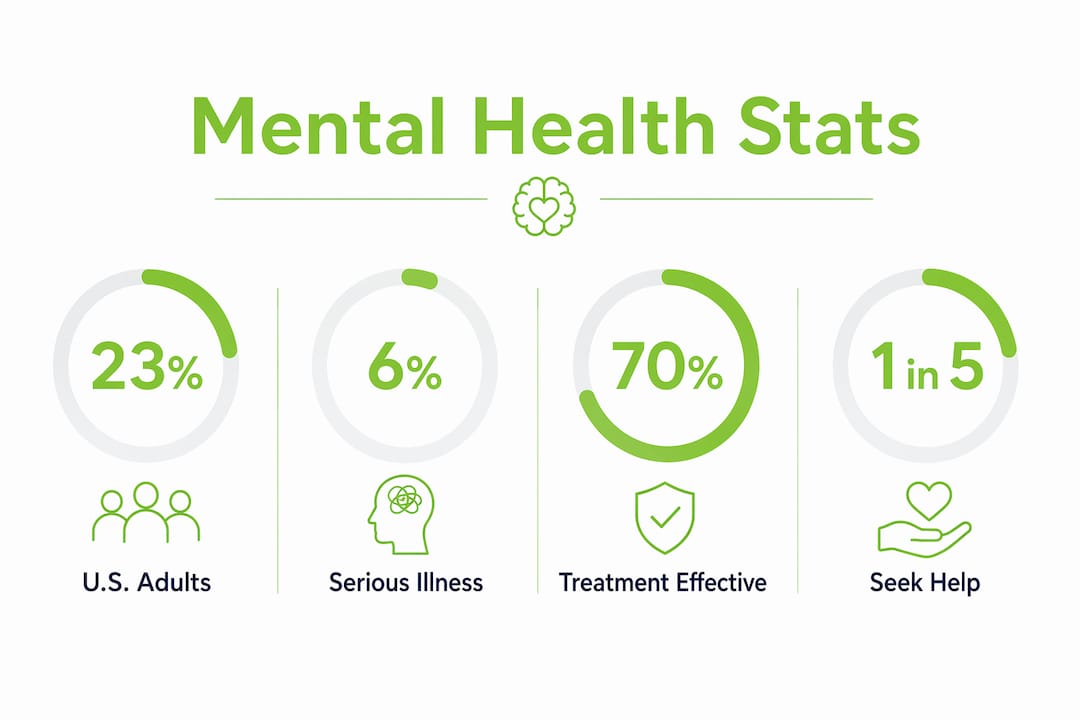
Common mental health conditions are diagnosable illnesses that change how you think, feel, and behave, and they affect nearly 1 in 5 U.S. adults. The clinical term for this group is “mental disorders,” as defined by the DSM-5-TR, the diagnostic manual used by psychiatrists and psychologists across the country. What are common mental health conditions, exactly? They include anxiety disorders, depression, bipolar disorder, PTSD, and several others. Understanding what these conditions look like, what causes them, and how they are treated is the first step toward getting real help, for yourself or someone you care about.
What are the most common types of mental health conditions?
Mental health conditions fall into several broad categories, each with distinct features and treatment needs. Anxiety disorders affect 19.11% of people in the U.S., making them the single most diagnosed group of mental disorders. That prevalence means anxiety is not a personality quirk. It is a medical condition that responds to treatment.
The most frequently diagnosed conditions include:
- Anxiety disorders: Generalized anxiety disorder (GAD), panic disorder, social anxiety disorder, and specific phobias. Characterized by excessive fear or worry that interferes with daily life.
- Depressive disorders: Major depressive disorder (MDD) and persistent depressive disorder (dysthymia). Depression affects 8.3% of U.S. adults and is a leading cause of disability worldwide.
- Bipolar disorder: Affects roughly 2.8% of adults and involves cycling between manic or hypomanic episodes and depressive episodes.
- Post-traumatic stress disorder (PTSD): Affects 3.6% of U.S. adults and develops after exposure to traumatic events. Symptoms can persist for years without treatment.
- Eating disorders: Conditions like anorexia nervosa, bulimia nervosa, and binge eating disorder. These frequently co-occur with anxiety or OCD, which complicates treatment.
- Personality disorders: Patterns of inner experience and behavior that deviate significantly from cultural expectations, causing long-term distress.
- Psychotic disorders: Including schizophrenia, which involves breaks from reality such as hallucinations or delusions.
Of the 23% of U.S. adults living with a mental health condition, 6% experience serious mental illness that significantly limits daily activities. That distinction matters because it shapes the level of care a person needs.
How do symptoms of mental health conditions manifest and differ?

Symptoms vary widely across conditions, but they share one defining feature. The DSM-5-TR requires that symptoms cause significant distress or impairment in work, relationships, or daily functioning before a clinical diagnosis applies. Feeling sad for a week after a loss is not depression. Feeling persistently hopeless for months, losing interest in things you used to enjoy, and struggling to get out of bed, that meets the threshold.
Core symptoms by condition:
- Anxiety disorders: Excessive worry, restlessness, muscle tension, fatigue, difficulty concentrating, and sleep disruption. Panic disorder adds sudden episodes of intense physical fear.
- Depression: Persistent sadness or emptiness, irritability, changes in appetite or weight, cognitive slowing, and in severe cases, thoughts of death or suicide.
- Bipolar disorder: Manic phases bring elevated mood, reduced need for sleep, impulsivity, and racing thoughts. Depressive phases mirror major depression.
- PTSD: Flashbacks, nightmares, emotional numbness, hypervigilance, and avoidance of reminders of the trauma.
Comorbidity is common across all of these. A person with depression often also meets criteria for an anxiety disorder. Comorbid conditions require more personalized treatment plans because addressing one condition alone rarely resolves the full picture.
Pro Tip: If you notice irritability, sleep changes, or withdrawal from activities you used to enjoy, do not wait for symptoms to become severe. Early recognition of subtle changes significantly improves long-term outcomes.
What causes mental health conditions and what factors influence risk?
Mental health conditions result from a complex interaction of genetics, environment, trauma, and societal stressors. No single cause explains any condition fully. Exposure to poverty, violence, and discrimination increases risk in measurable ways. That means mental illness is not simply a chemical imbalance or a personal weakness. It is shaped by the life a person has lived.
Genetics create vulnerability, not destiny. A family history of depression raises your risk, but it does not guarantee you will develop it. Protective factors like strong social support, access to care, and stable housing reduce that risk significantly. Adverse childhood experiences, chronic stress, and social isolation push risk in the other direction.
“Mental health conditions are not fixed labels. They are diagnostic frameworks that evolve as our understanding of the brain and human experience improves.” — Change Direction
Stigma remains one of the most damaging forces in mental health. It delays diagnosis, discourages treatment, and isolates people who are already struggling. Reducing stigma is not just a cultural goal. It is a clinical priority because it directly affects whether people seek care in time.
What are the effective treatment options and how can you seek help?
Effective treatments for common mental illnesses exist and work well when matched to the right person. The three main approaches are psychotherapy, medication, and a combination of both. Combined treatment consistently outperforms either approach alone for moderate to severe depression and anxiety.
Here is a practical sequence for seeking help:
- Recognize the signs. Persistent symptoms lasting two weeks or more, especially those affecting work or relationships, warrant professional evaluation.
- Start with a consultation. A psychiatrist or licensed therapist can conduct a full evaluation and rule out medical causes for your symptoms.
- Discuss treatment options. For anxiety, cognitive behavioral therapy (CBT) is the most evidence-supported psychotherapy. For depression, CBT and interpersonal therapy (IPT) both show strong results. Medication options include SSRIs and SNRIs, which are first-line for both conditions.
- Consider medication management. A psychiatrist can prescribe and adjust medications based on your specific symptoms, history, and response. Read more about anxiety medication options to understand what that process looks like.
- Stay consistent. Most treatments take four to eight weeks to show full effect. Stopping early is one of the most common reasons people do not improve.
Effective treatments exist, but global healthcare systems remain under-resourced. Stigma and limited access delay care even when treatments are available. If cost or access is a barrier, telehealth has significantly expanded options for adults in many areas.
Pro Tip: You do not need a crisis to see a psychiatrist. Mild symptoms that persist are a valid reason to seek an evaluation. The benefits of psychiatric care extend well beyond severe illness.
How do mental health conditions impact daily functioning and quality of life?
Mental disorders are among the leading causes of disability worldwide. Globally, they account for 1 in 6 years lived with disability. That figure reflects the real weight these conditions place on people’s ability to work, maintain relationships, and participate in daily life.
The impact shows up in concrete ways:
| Area of Life | How mental health conditions affect it |
|---|---|
| Work and productivity | Depression and anxiety reduce concentration, increase absenteeism, and raise the risk of job loss |
| Relationships | Mood disorders and PTSD strain communication, trust, and emotional availability |
| Physical health | Serious mental illness is associated with higher rates of cardiovascular disease and reduced life expectancy |
| Social connection | Withdrawal and isolation are both symptoms and consequences of untreated conditions |
| Quality of life | Untreated conditions often worsen over time, while treated conditions frequently improve significantly |
Comorbidity compounds these effects. A person managing both depression and an anxiety disorder faces a heavier burden than someone with either condition alone. Treatment that addresses both simultaneously produces better outcomes than treating each in isolation.
The hopeful reality is that most people with mental health conditions improve meaningfully with appropriate care. Recovery is not always linear, but it is achievable for the large majority of people who engage with treatment.
Key takeaways
Mental health conditions are diagnosable, treatable illnesses that affect thinking, mood, and behavior, and early recognition combined with evidence-based care produces the best outcomes.
| Point | Details |
|---|---|
| Prevalence is high | Nearly 1 in 5 U.S. adults lives with a mental health condition, with 6% experiencing serious illness. |
| Anxiety leads in diagnosis | Anxiety disorders affect 19.11% of U.S. adults, making them the most common mental health condition. |
| Symptoms must impair functioning | The DSM-5-TR requires significant distress or impairment for a clinical diagnosis, not just symptom presence. |
| Causes are complex | Genetics, trauma, environment, and societal stressors all contribute, and no single factor explains any condition. |
| Treatment works | Combined therapy and medication outperforms either alone, and early intervention improves long-term prognosis. |
What we have learned from working with patients on this
The thing I notice most in clinical practice is how long people wait before asking for help. Not because they do not know something is wrong. They usually do. They wait because they are not sure their symptoms are “bad enough” to deserve attention, or because they worry about what a diagnosis might mean for how others see them.
That hesitation is understandable. But it costs people months, sometimes years, of unnecessary suffering. In our work at Nortexpsychiatry, we see patients who have been managing anxiety or depression quietly for a long time before they walk through the door. The relief they feel when they realize their experience has a name, and a treatment, is real and immediate.
One thing I want to push back on is the idea that a diagnosis is a life sentence. Mental health conditions are not fixed labels. They are working frameworks that help clinicians and patients make sense of symptoms and choose a direction. A diagnosis can change. Symptoms can remit. People get better.
What actually predicts success in treatment is not the severity of the condition at the start. It is consistency, honesty with your provider, and willingness to adjust the plan when something is not working. Those are things you have control over.
If you are reading this for a loved one, the most useful thing you can do is reduce the pressure around seeking help. Normalize the conversation. Offer to help them find a provider. Dealing with stigma around mental health treatment is a real barrier, and your support matters more than you might think.
— Felix
Mental health care that fits your life
Nortexpsychiatry serves adults and families across Allen, Frisco, McKinney, Plano, and the broader North Dallas area with personalized, evidence-based psychiatric care. Whether you are managing anxiety, depression, ADHD, or a mood disorder, the team offers medication management, evaluations, and ongoing support through both in-person and telehealth appointments. If you are not sure where to start, a self-assessment can help clarify what you are experiencing. For adults weighing treatment decisions, the medication vs. therapy comparison is a practical place to begin. Nortexpsychiatry makes it straightforward to get the right care at the right time.
FAQ
What are common mental health conditions in adults?
The most common mental health conditions in adults are anxiety disorders, major depressive disorder, bipolar disorder, and PTSD. Anxiety disorders are the most frequently diagnosed, affecting 19.11% of U.S. adults.
How do I know if my symptoms qualify as a mental health condition?
The DSM-5-TR requires that symptoms cause significant distress or impairment in daily functioning, such as at work or in relationships, before a diagnosis applies. Persistent symptoms lasting two weeks or more are a reliable signal to seek a professional evaluation.
What causes mental health problems in otherwise healthy people?
Mental health conditions result from a combination of genetics, life experiences, trauma, and environmental stressors like poverty or discrimination. No single cause explains any condition, and having risk factors does not mean a condition is inevitable.
How do I recognize signs of a mental health condition in a loved one?
Watch for changes in sleep, appetite, mood, or social withdrawal that persist for more than two weeks. Irritability, loss of interest in usual activities, and difficulty concentrating are early signs that often precede a formal diagnosis.
Can mental health conditions be treated effectively?
Yes. Psychotherapy, medication, and combined approaches all produce meaningful improvement for most people. Early intervention improves outcomes significantly, and most people who engage consistently with treatment see real progress.