


Most people wait too long. The decision to seek psychiatric care often comes after months or years of struggling through anxiety, depression, or other mental health challenges, hoping things will improve on their own. Why seek psychiatric care before it feels like a crisis? Because early intervention changes outcomes in ways that waiting simply cannot. This guide breaks down the real reasons to seek help, what psychiatric care actually involves, and how to take your first step without feeling overwhelmed.
Table of Contents
- Key takeaways
- Signs that suggest you should seek help
- What psychiatric care actually involves
- Why getting help early matters
- Common barriers and how to get past them
- How to take your first step
- My honest take on waiting too long
- Getting the right support at Nortex Psychiatry
- FAQ
Key takeaways
| Point | Details |
|---|---|
| Early care prevents worsening | Untreated mental health conditions can deepen over time and become harder to treat. |
| Psychiatric care is not just for crises | Anxiety, depression, and mood shifts all warrant professional evaluation well before a breaking point. |
| Treatment is personalized | A psychiatrist tailors your care based on your symptoms, history, and preferences, not a one-size-fits-all formula. |
| Barriers are real but solvable | Stigma, cost, and uncertainty delay care, but practical tools and resources exist to help you start. |
| Asking for help is a clinical decision | Seeking psychiatric help is a medical decision, the same as seeing a doctor for chest pain. |
Signs that suggest you should seek help
Understanding when to see a psychiatrist starts with paying attention to changes that affect your daily life. Many people dismiss these signs as stress or a rough patch. Sometimes that’s true. But when the changes persist or deepen, they often signal something that warrants a professional assessment.
Common signs that suggest a psychiatric evaluation is worth considering include:
- Persistent sadness, hopelessness, or emotional flatness lasting more than two weeks
- Anxiety that interferes with work, sleep, or relationships
- Significant shifts in eating or sleeping patterns that have no obvious physical cause
- Withdrawing from people, activities, or routines you used to value
- Difficulty concentrating, making decisions, or completing tasks you managed easily before
- Irritability or anger that feels disproportionate to the situation
- Thoughts of self-harm or feeling like life is not worth living
These are not signs of weakness. They are signs that your brain, like any other organ, may need support. Mental disorders account for 1 in 6 years lived with disability globally, and many of the people living with that burden never received care. Recognizing the signs early is the most direct path to changing that.
The impact on daily functioning matters too. When anxiety stops you from showing up at work, or when depression makes it hard to care for your family, the cost is real. Relationships suffer. Performance drops. The longer you wait, the wider that gap tends to grow.
What psychiatric care actually involves
One of the most common reasons people avoid seeking help is a misunderstanding of what psychiatric care looks like. It is not just medication. It is not a place you go only when things are severely wrong. It is a medical process that looks at your full picture.
The evaluation process
A psychiatric evaluation integrates your symptoms with your medical history, current medications, lifestyle, and any physical conditions that might be contributing to what you’re experiencing. Thyroid disorders, vitamin deficiencies, and neurological conditions can all mimic psychiatric symptoms. Ruling these out is part of good psychiatric care, and it improves the precision of any treatment that follows.

Treatment options available to you
Once a clear picture is established, treatment is tailored to your needs. The most commonly used approaches include:
- Cognitive behavioral therapy (CBT): The first-line behavioral treatment for anxiety and depression, focused on identifying and shifting unhelpful thought and behavior patterns
- Medications like SSRIs and SNRIs: First-line pharmacological options that are well-studied and generally well-tolerated, prescribed when medication is clinically appropriate
- Combined care: Collaborative care models that integrate psychiatrist consultation with primary care improve outcomes compared to standard care alone
- Advanced options: For cases that do not respond to first-line treatments, options like TMS (Transcranial Magnetic Stimulation) may be considered
Choosing between therapy vs. medication is not something you need to figure out before your first visit. That decision should be made with your provider, based on your specific presentation, preferences, and any concerns about side effects. Shared decision-making leads to better outcomes than having treatment decided for you without your input.
Pro Tip: Before your first psychiatric appointment, write down your symptoms, when they started, and how they affect your daily life. This helps your provider build an accurate picture faster and spend more time on your care plan.
Why getting help early matters
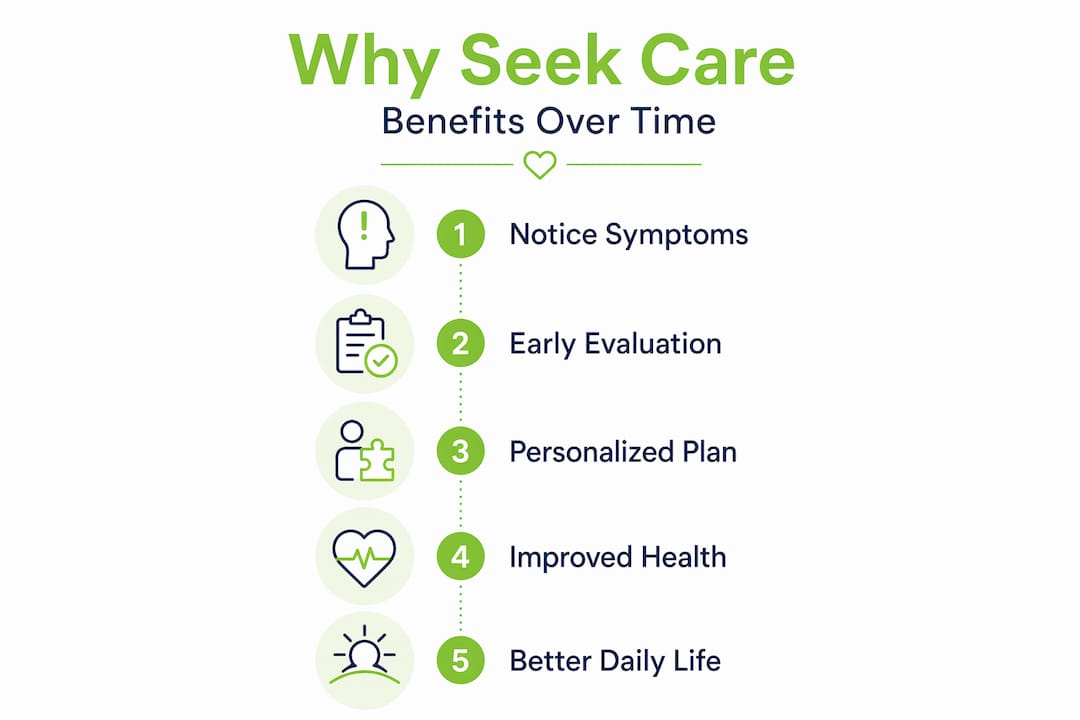
The benefits of psychiatric help go well beyond symptom relief. The practical, everyday improvements that follow treatment are what most people do not anticipate until they experience them.
“Untreated mental health conditions do not simply stay the same. They tend to grow. The earlier someone receives appropriate care, the better the prognosis, the lower the risk of disability, and the stronger the foundation for sustained recovery.”
People with severe untreated mental health conditions die 10 to 20 years earlier than the general population. That is a striking fact, and it is worth sitting with. It is not meant to frighten you. It is meant to make clear that the importance of mental health care is not separate from your physical health. They are the same thing.
Early care also reduces the risk of crisis. Suicide risk, hospitalization, and severe functional decline are all outcomes that timely psychiatric intervention can reduce. On the other side of treatment, people commonly report improved focus at work, stronger relationships, better sleep, and a greater sense of control over their own lives. These are not minor improvements. For many people, they represent a fundamental shift in how life feels from day to day.
The benefits of psychiatric care for anxiety and depression extend into nearly every area of functioning. Getting ahead of the problem, rather than waiting until it is severe, makes the path back far shorter.
Common barriers and how to get past them
Knowing why you should seek psychiatric help is not always enough to make the first call. Several real barriers get in the way, and acknowledging them honestly is more useful than pretending they don’t exist.
Stigma remains one of the most significant. Stigma and system under-resourcing contribute directly to the treatment gap worldwide. People worry about being judged, labeled, or seen differently at work or in their families. That fear is understandable. It is also, increasingly, at odds with how most people actually view mental health today.
Misinformation about medications leads many to refuse treatment that could genuinely help. Fears about dependence or permanent change are common. A good psychiatrist addresses these directly, explains exactly what a medication does and does not do, and monitors your response carefully.
Other barriers include:
- Not knowing where to start or who to call
- Concerns about cost and insurance coverage
- Uncertainty about whether symptoms are “bad enough” to warrant professional help
- Previous negative experiences with mental health treatment
Practical tools exist to reduce these blocks. FindTreatment.gov provides a confidential, searchable directory of treatment providers across all U.S. territories, including Spanish-language resources. Using it takes minutes and removes one of the most common reasons people delay care, not knowing where to look.
Pro Tip: If cost is a concern, ask about sliding-scale fees, telehealth options, or whether your primary care provider can manage your initial care while you find a specialist. Many psychiatric practices, including those with telehealth availability, offer more flexibility than people expect.
How to take your first step
Starting is often the hardest part. Here is a straightforward path forward that does not require you to have everything figured out first.
- Talk to your primary care provider. Starting with a health provider is the recommended first step. They can assess your symptoms, rule out physical contributors, and refer you to a psychiatrist or therapist based on what they find. Many also manage depression and anxiety directly.
- Use a treatment locator. If you do not have a primary care provider or want to go directly to a mental health specialist, FindTreatment.gov and SAMHSA’s locator tools can connect you with providers in your area quickly and confidentially.
- Know what to expect at your first visit. A psychiatric evaluation typically takes 45 to 90 minutes. Your provider will ask about your symptoms, medical history, current medications, family history, and daily functioning. There is no right or wrong answer. Honesty gives your provider the clearest picture.
- Ask questions. You have every right to ask about your diagnosis, the reasoning behind a treatment recommendation, and what the alternatives are. Shared decision-making in treatment is not just encouraged. It is good medicine.
- Give it time. Psychiatric treatment is not instantaneous. Medications often take two to four weeks to show their full effect. Therapy requires practice and repetition. Commit to the process, and check in regularly with your provider about how you’re responding.
My honest take on waiting too long
I have seen many patients who came in after years of managing on their own. They pushed through. They told themselves it wasn’t that bad. And some of them did fine for a while. But in my experience, waiting rarely makes things easier.
What I’ve learned over years of clinical work is that people who come in earlier tend to respond to treatment more readily. The symptoms are less entrenched. The habits formed around managing pain, like avoidance, withdrawal, and overwork, have not had time to become automatic. There is more flexibility to work with.
What I’ve also seen is that the fear of what psychiatric care means is almost always worse than what actually happens. People expect judgment. They get a conversation. They expect to lose control of their treatment. They find they have more say than they anticipated. The first step is genuinely the hardest, and it gets easier from there.
I want to be clear: seeking care is not an admission that you cannot handle life. It is recognizing that some things require expertise, the same way you would not set a broken bone yourself. Getting a psychiatric evaluation is a rational, medical decision. And in my view, it is one of the most worthwhile ones a person can make.
— Felix
Getting the right support at Nortex Psychiatry
At Nortex Psychiatry, we work with adults across Allen, Frisco, McKinney, Plano, and the greater North Dallas area who are ready to take that first step toward feeling like themselves again. Whether you are dealing with anxiety, depression, ADHD, or a mood disorder, we build a treatment plan around you, not a template. Our services include psychiatric evaluations, medication management, therapy coordination, and advanced options like TMS. Both in-person and telehealth appointments are available to fit your schedule. If you want to understand your options and start with a clear plan, explore our personalized mood disorder treatment or learn how we transform anxiety care for adults just like you.
FAQ
Why seek psychiatric care instead of just therapy?
Psychiatrists can evaluate both the psychological and medical dimensions of your symptoms, prescribe medications when needed, and coordinate care across providers. Therapy addresses thought and behavior patterns, while psychiatric care can manage the full clinical picture, including cases where medication is part of the treatment.
When should you see a psychiatrist versus a primary care provider?
A primary care provider is a good starting point, and many manage anxiety and depression effectively. A psychiatrist is appropriate when symptoms are more complex, when initial treatments have not worked, or when a detailed diagnostic evaluation is needed to clarify what is driving your symptoms.
What can you expect from your first psychiatric evaluation?
Your first visit typically involves a thorough conversation about your symptoms, history, and daily functioning. A psychiatric evaluation also reviews medical history to rule out physical causes, so expect questions that go beyond your mental health alone.
Does seeking psychiatric help mean you will be on medication forever?
Not at all. Many people use medication short-term while building coping skills through therapy, then taper off with medical guidance. Treatment plans are designed around your needs and adjusted over time based on how you respond.
How do you find a psychiatric care provider near you?
SAMHSA’s treatment locator at FindTreatment.gov is a confidential, easy-to-use tool that searches providers by location and specialty. You can also ask your primary care provider for a referral or contact a practice like Nortex Psychiatry directly for an intake appointment.