


Daily anxiety can overwhelm every aspect of life, from your morning routine to your ability to focus at work or be present with your family. The good news is that effective management is absolutely possible. CDC recommendations point to a range of science-backed strategies, from deep breathing and physical activity to connecting with others and practicing gratitude. This guide walks you through everything: how to prepare, what steps to take, how to troubleshoot setbacks, and how to recognize when personalized psychiatric support can make all the difference.
Table of Contents
- Get ready to manage anxiety: tools and mindsets
- Step-by-step strategies to reduce anxiety
- Common pitfalls and how to troubleshoot setbacks
- Comparing approaches: Self-help, CBT, and advanced psychiatric care
- What most anxiety advice misses and what actually helps
- Take the next step with personalized support
- Frequently asked questions
Key Takeaways
| Point | Details |
|---|---|
| Preparation is key | Having the right tools, mindset, and support ready makes managing anxiety much more achievable. |
| Daily actions matter | Simple steps—deep breaths, exercise, and healthy connections—lead to steady anxiety relief over time. |
| Know when to get help | If anxiety persists or worsens despite your efforts, professional psychiatric care can offer effective solutions. |
| Compare your options | Choosing between self-care, CBT, and advanced therapies depends on your needs and how you respond. |
Get ready to manage anxiety: tools and mindsets
With the goal of taking control, let’s begin by organizing the tools and attitude you’ll need for steady progress.
Before you can reduce anxiety, you need to remove the friction that stops most people before they start. Common obstacles include not knowing where to begin, setting goals that are too ambitious, and feeling discouraged when progress seems slow. The right preparation addresses all of these upfront.
Here are the most frequent barriers people face, and how to get ahead of them:
- Not knowing which strategy to start with. Pick one, not five. Overwhelming yourself with a full lifestyle overhaul on day one almost always leads to burnout within a week.
- Expecting instant results. Anxiety builds over time, and so does relief. Managing expectations from the start protects your motivation.
- Skipping support systems. Going it completely alone is harder than it needs to be. Friends, family, or a professional can all play a role.
- Ignoring physical factors. Healthy eating, exercise, and relaxing activities meaningfully reduce anxiety symptoms, yet many people overlook these basics while searching for more complex solutions.
- Avoiding clinical support. Many people wait too long to consult a professional. Being open to both self-care and clinical guidance from the start gives you more options.
The table below summarizes the core mindsets and tools that set a strong foundation:
| Category | What you need | Why it helps |
|---|---|---|
| Mindset | Patience | Progress is gradual, not overnight |
| Mindset | Self-compassion | Reduces shame, increases follow-through |
| Mindset | Openness | Allows you to accept clinical support if needed |
| Tools | Journal or notebook | Tracks patterns and progress |
| Tools | Wellness or mood app | Provides reminders and structure |
| Tools | Support network | Friends, family, or a therapist |
| Tools | Appointment scheduler | Makes booking professional help frictionless |
| Tools | Outdoor access | Nature exposure combined with movement is powerful |
Research consistently supports that building habits around connecting with others and gratitude creates lasting improvement in mood and anxiety levels. These are not just feel-good suggestions. They have measurable effects on the nervous system.
If you want to explore options beyond standard self-care, learning about TMS therapy for anxiety early can help you make informed decisions later, especially if symptoms are persistent or severe.
Pro Tip: Set one small, achievable goal for the first two weeks. Something like “walk 15 minutes after dinner three times this week” is far more effective than “exercise every day.” Small wins build the confidence and momentum needed for bigger changes.
Step-by-step strategies to reduce anxiety
Now that you’re equipped with the right mindset and tools, here’s how to put anxiety management directly into action.
These steps are designed to build on each other. You don’t need to implement all of them at once. Start with two or three, and add more as they become habit.
-
Practice deep breathing daily. Slow, controlled breathing activates your parasympathetic nervous system, which is the part of your body responsible for calming you down. Try a simple 4-7-8 pattern: inhale for four counts, hold for seven, exhale for eight. Do this for five minutes each morning before checking your phone.
-
Try meditation or mindfulness. Even ten minutes a day of focused attention on your breath can reduce anxious thought spirals over time. Apps like Headspace or Insight Timer offer guided sessions that are beginner-friendly. CDC-recommended practices like meditation and journaling are accessible starting points for most adults.
-
Schedule physical activity at 2.5 hours per week. That breaks down to about 30 minutes, five days a week of moderate movement. Walking, swimming, cycling, and yoga all count. This is not about fitness performance. It is about giving your nervous system a healthy outlet for built-up tension.
-
Start a gratitude journal. Each evening, write down three specific things that went well or that you appreciated that day. This trains your brain to notice positive information, which naturally competes with anxious, threat-focused thinking over time.
-
Limit distressing news and social media. Studies show that reducing news consumption, even modestly, can decrease anxiety symptoms with a measurable effect size of d=0.22. That is a small but consistent and reproducible benefit. If you check the news four times a day, try cutting to once. The world will not fall apart, and your nervous system will thank you.
-
Reduce alcohol and nicotine. Both are commonly used to manage anxiety in the short term but worsen it over time. Research on nicotine and anxiety shows that while nicotine may feel calming momentarily, it increases baseline anxiety levels with regular use.
-
Spend time outdoors. Even 20 minutes in a park or natural setting lowers cortisol, your body’s primary stress hormone. Combining outdoor time with walking is one of the highest-leverage moves you can make.
Pro Tip: Pair each new habit with something you already do. For example, meditate right after brushing your teeth, or journal right before bed. Habit pairing dramatically increases follow-through because you do not have to remember to do it. It becomes automatic faster.
Common pitfalls and how to troubleshoot setbacks
Even with great planning and steps, most people hit snags. Here is what you should know to navigate them.

Understanding where things tend to go wrong is just as important as knowing what to do right. Recovery from anxiety is a journey, not a straight line, and anticipating bumps in the road keeps you from interpreting them as failure.
Common mistakes that slow progress include:
- Overloading on new habits at once. Adding six new behaviors in week one almost guarantees you’ll drop all six by week three. Prioritize ruthlessly.
- Using setbacks as evidence that “nothing works.” A hard week or a spike in anxiety does not undo prior progress. It is part of the process, not proof the process is broken.
- Avoiding professional support out of stigma or cost concerns. Delaying clinical evaluation when symptoms are persistent often makes recovery longer, not shorter.
- Relying solely on self-care for a clinical disorder. This is perhaps the most important point for people to understand.
“Self-care is foundational but insufficient alone for clinical anxiety disorders. Clinician-guided therapies produce stronger outcomes and should be considered when self-care strategies plateau or symptoms remain significant.”
Warning signs that you need professional evaluation include experiencing anxiety most days for more than four weeks, struggling to meet work or family responsibilities, avoiding situations or places due to fear, using substances to cope, or having physical symptoms like heart racing, chest tightness, or chronic insomnia.
If you recognize any of these in yourself, learning more about what psychiatrists do for anxiety care is a practical next step. A qualified psychiatrist can assess whether your anxiety rises to the level of a diagnosable disorder and recommend options you may not have considered.
Comparing approaches: Self-help, CBT, and advanced psychiatric care
When you’re ready for the next step, compare the core paths available and see how to make an informed choice.
There is no single right answer for everyone. The best approach depends on your symptom severity, how long you have been struggling, your preferences, and what has already been tried. Here is how the main options compare:
| Approach | Best for | Evidence strength | Access |
|---|---|---|---|
| Self-help strategies | Mild to moderate anxiety, prevention | Moderate | Immediately available |
| Individual CBT | Moderate to severe anxiety | Strongest | Therapist or psychiatrist |
| Group CBT | Moderate anxiety, cost-conscious | Strong | Mental health clinics |
| Medication management | Moderate to severe, fast relief needed | Strong | Psychiatrist evaluation |
| TMS therapy | Treatment-resistant cases | Growing | Specialty clinics |
| Ketamine therapy | Severe, rapid relief needed | Emerging | Specialty clinics |
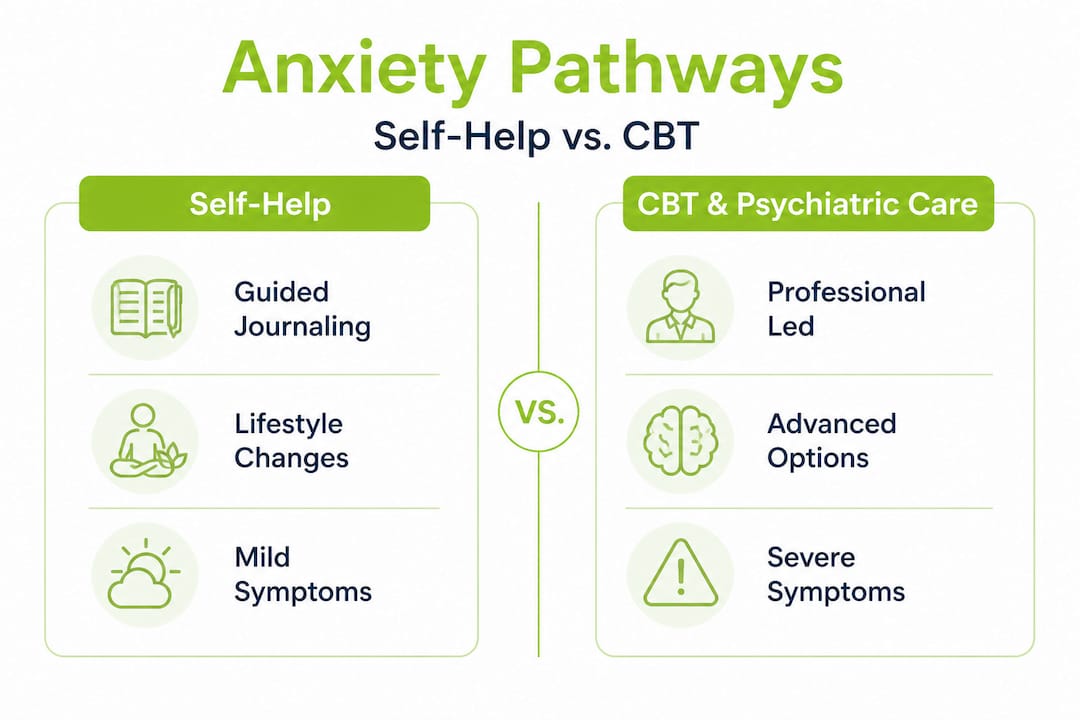
Research confirms that individual CBT outperforms remote CBT with a standardized mean difference (SMD) of 0.96, making it one of the most robustly supported treatments available. Group CBT is a strong alternative, especially when access or cost is a barrier.
For adults in North Dallas, local specialists offer access to the full spectrum of these interventions. Local psychiatrists provide expertise in advanced therapies including CBT, TMS, and ketamine, meaning you do not have to travel far to access the most effective options.
Understanding the effects of TMS for anxiety can help you decide whether a non-medication approach fits your situation. And if you are weighing your options, a comparison of TMS vs medication gives you a side-by-side look at what each offers.
Pro Tip: If self-care strategies have not produced noticeable improvement after 8 to 12 weeks of consistent effort, seek a psychiatric evaluation. You do not need to reach a crisis point to deserve professional support. Earlier intervention typically leads to faster, more lasting results.
What most anxiety advice misses and what actually helps
Having seen the main options, here is the hard-won reality our clinical experience and research reveal.
Most anxiety guides fall into one of two traps. They either hand you a list of lifestyle tips and imply that willpower is all you need, or they jump straight to medication as if other options do not exist. Both approaches miss something important.
The truth is that anxiety looks different in every person. What works powerfully for one adult may do almost nothing for another. This is not a failure of the person. It reflects the genuine complexity of how anxiety develops, how it is maintained, and how the nervous system responds to different interventions.
We have seen this repeatedly in our practice: a patient follows all the “right” steps for months with limited progress, then finds significant relief through a combination of targeted therapy and medication adjustment. Another patient does the opposite: medication alone feels incomplete, but adding a specific behavioral strategy produces breakthrough improvement. There is no single formula.
Third-wave therapies, including Acceptance and Commitment Therapy (ACT) and mindfulness-based cognitive therapy, show real promise for long-term anxiety management, especially for people who have not fully responded to traditional CBT. These approaches do not just try to change anxious thoughts. They change your relationship to those thoughts entirely, which often produces more durable results.
The other thing most advice skips is that your needs change over time. What works at 35 may not work at 50. A strategy that helped you through a stressful career transition may not address anxiety that has shifted into a more chronic pattern. Staying open to revisiting professional care as your life changes is not a sign of weakness. As we often tell our patients: “Layering self-care with clinical support is not weakness. It is wisdom.”
Explore what psychiatrists’ anxiety approaches look like in practice, because personalized evaluation changes the picture significantly.
Take the next step with personalized support
If you’re ready to move from reading to real change, options are available nearby for clinical evaluation and care.
At Nortex Psychiatry, we work with adults across Allen, Frisco, McKinney, Plano, and the surrounding North Dallas area to create personalized anxiety treatment plans that actually fit your life. Whether you are dealing with everyday stress that has become unmanageable, or a more persistent anxiety disorder that self-care has not resolved, our team is ready to help you figure out what comes next.
We offer psychiatric evaluations, medication management, and access to advanced therapies including TMS and ketamine, all in a supportive, judgment-free environment. Both in-person and telehealth appointments are available, so getting started is easier than you might think. Learn more about psychiatric care for anxiety or explore whether TMS therapy for anxiety is the right fit for your situation. You deserve to feel better.
Frequently asked questions
How quickly can I expect anxiety relief using self-care methods?
Some self-care strategies, like deep breathing, can ease anxiety within days, but GAD-7 scores improve by 0.4 to 1 point with consistent healthy habits over several weeks, so measurable progress typically takes a few weeks of sustained effort.
What types of therapy are most effective for managing anxiety?
Individual CBT has the strongest research backing, with individual CBT outperforming remote CBT by an SMD of 0.96, while group CBT remains a strong and accessible alternative for many adults.
When should I seek professional help for anxiety?
If self-care has not reduced your symptoms after several weeks of consistent effort, or if anxiety is affecting your work, relationships, or daily function, a psychiatric evaluation is the right next step, since self-care alone is often insufficient for clinical anxiety disorders.
Can diet and exercise really help with anxiety?
Yes. Research shows that a healthy diet and regular exercise can reduce anxiety symptoms in a clinically meaningful way, lowering GAD-7 scores by 0.4 to 1 point when practiced consistently alongside other healthy habits.
Recommended
- How psychiatrists transform anxiety care for adults
- TMS Therapy for Anxiety: Can It Really Help? – Nortex Psychiatry
- TMS Therapy for Anxiety: A Closer Look at Its Impact – Nortex Psychiatry
- Ketamine Therapy for Anxiety: Does It Really Help? – Nortex Psychiatry
- Emotional relief workflow for families: A step-by-step guide
- Nicotine Pouches and Anxiety – Does Nicotine Help or Make It Worse? – HitSnus