


Perimenopausal mood swings are common, biological, and treatable. Antidepressants plus psychotherapy remain first-line for depressive episodes, hormone therapy often eases mood when hot flashes and sleep disruption drive the problem, and lifestyle changes support every treatment path. The next step is straightforward: talk to a clinician who can screen for major depression and help you match treatment to what your body is actually doing.
TL;DR:
- Estrogen therapy can reduce hot flashes by up to 95 percent when started within ten years of menopause, especially if vasomotor symptoms are prominent.
- Antidepressants like SSRIs and SNRIs, particularly venlafaxine, are recommended first-line treatments for depression during perimenopause and may also alleviate hot flashes.
- Cognitive behavioral therapy and mindfulness-based interventions can significantly reduce anxiety and depression, with CBT generally providing quicker symptom relief.
- Lifestyle habits such as consistent sleep routines, regular exercise, blood sugar stabilization, and stress management support mood stability alongside medical treatments.
- Proper evaluation by a clinician is essential to identify the specific causes of mood swings, as hormonal fluctuations, thyroid issues, sleep disruption, and Circumstantial stress all contribute.
Table of Contents
- Medical Treatments for Perimenopause Mood Swings
- How Effective Is Therapy for Perimenopause Anxiety Relief?
- Lifestyle Steps That Support Emotional Health in Perimenopause
- What Should You Ask Your Doctor About Mood Treatment?
- How We Approach Perimenopausal Mood Care at Our Clinic
- Why Do Mood Swings Happen During Perimenopause?
- Do Supplements Help With Perimenopause Mood Symptoms?
- Can Yoga or Acupuncture Ease Perimenopause Mood Symptoms?
- How Do Thyroid and Other Conditions Affect Perimenopause Mood?
- How Should You Track Mood and Hormone Changes?
- What’s New in Perimenopause Mood Research?
- Our Take: Stop Treating This as One Problem With One Fix
- How Nortex Psychiatry Supports You Through This
- Sources
- FAQ
Medical Treatments for Perimenopause Mood Swings
We see a lot of confusion about where to start, and honestly, the answer depends on what’s driving the mood symptoms. If hot flashes and night sweats are wrecking your sleep, hormone therapy often makes more sense than an antidepressant. If you’re dealing with a clear depressive episode, medication and therapy usually come first.
Transdermal estradiol is our go-to when vasomotor symptoms and sleep disruption are prominent. It improves mood for many perimenopausal women largely by reducing hot flashes and improving sleep quality, which in turn stabilizes mood. If you still have a uterus, you’ll need a progestogen alongside it to protect the uterine lining. Estrogen therapy isn’t right for everyone. Women with a history of certain cancers, unexplained vaginal bleeding, active liver disease, or clotting disorders usually need a different approach, and that conversation belongs with your prescriber.
For major depressive episodes, antidepressants and psychotherapy are the recommended first-line treatments during perimenopause. SSRIs like escitalopram and SNRIs like venlafaxine both have solid track records here, and venlafaxine in particular can reduce hot flashes while treating depression, which makes it a practical dual-purpose option for some patients.
A few other tools round out the picture:
- Gabapentin and fezolinetant target vasomotor symptoms directly, and better sleep often brings mood improvements along with it.
- rTMS (repetitive transcranial magnetic stimulation) is worth considering for depression that hasn’t responded to standard antidepressants.
- Ketamine or esketamine (Spravato) enters the conversation for treatment-resistant depression, usually after other options have been tried.
Estrogen therapy can reduce hot flash frequency by 70 to 95 percent in women who respond to it, and for many patients started within 10 years of menopause, the benefit to risk profile favors treatment. That timing window matters more than most people realize.
How Effective Is Therapy for Perimenopause Anxiety Relief?
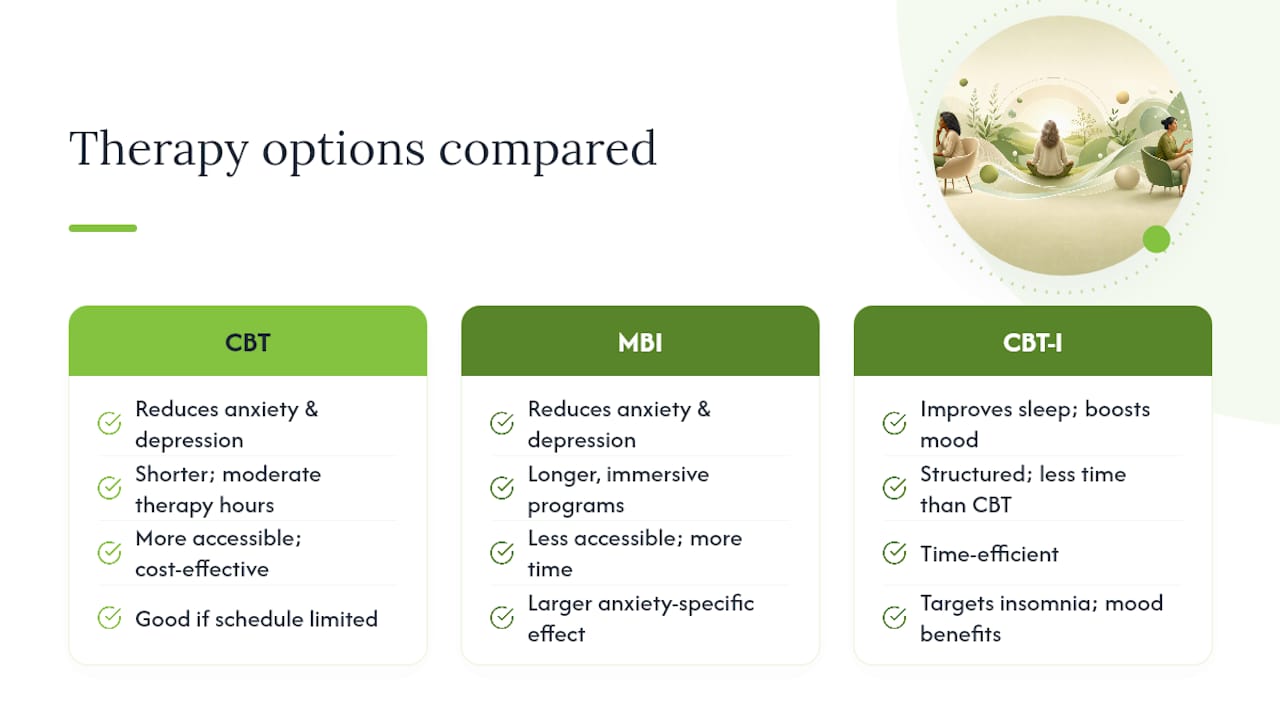
Therapy works, and the data on this is more specific than most people expect. Cognitive behavioral therapy (CBT) and mindfulness-based interventions (MBI) both significantly reduce anxiety and depression scores during the menopausal transition, but they get there differently.
CBT tends to work in a shorter time frame, averaging a moderate number of therapy hours. MBI programs run longer and show a larger effect on anxiety specifically, though neither approach is definitively better outright. CBT is often more accessible and cost-effective because it asks less of your schedule, while MBI may suit someone who wants a slower, more immersive practice.
CBT adapted for insomnia (CBT-I) deserves its own mention. Trials show it improves sleep during menopause, and better sleep tends to pull mood up with it, even without directly treating depression.
Group programs and psychoeducation classes can work as adjuncts rather than replacements. Partners and family members who understand what’s happening physiologically tend to respond with more patience, which matters more than people give it credit for.
Pro Tip: If your schedule can’t accommodate weekly therapy right now, ask about a structured CBT-I program specifically for sleep. It requires less time than full CBT and often produces a mood benefit almost as a side effect.
Lifestyle Steps That Support Emotional Health in Perimenopause
Medication and therapy do the heavy lifting for clinical depression, but daily habits shape how stable you feel between appointments. None of this replaces treatment. It supports it.
- Protect your sleep window. Keep a consistent bedtime, avoid heavy meals and alcohol within a few hours of sleep, and if insomnia persists past a few weeks, ask about CBT-I rather than relying on medication alone.
- Move your body most days. Regular moderate exercise, something like brisk walking or cycling most days of the week, supports mood and helps offset the sleep disruption that perimenopause causes.
- Stabilize your blood sugar. Irregular eating and sugar spikes can mimic or worsen mood swings; a Mediterranean-style pattern with steady protein intake tends to smooth things out.
- Limit alcohol and caffeine. Both interfere with sleep architecture, and alcohol in particular can worsen hot flashes and next-day irritability.
- Build stress reduction into your week. Structured mindfulness practice, breathing exercises, or simply protecting time for people who support you all reduce the baseline stress load that amplifies hormonal mood shifts.
None of these five steps requires a prescription, which is exactly why we recommend starting them the same week you schedule a clinical evaluation, not instead of it.
What Should You Ask Your Doctor About Mood Treatment?
Before your appointment, it helps to think through a few things so the visit actually moves you forward instead of just restating what you already know.
Your clinician should screen for a major depressive episode and rule out look-alikes: thyroid dysfunction, sleep apnea, or substance use can all present with mood symptoms that mimic perimenopause. Treatment choice hinges on several factors:
- How severe are your mood symptoms, and are they interfering with work or relationships?
- How prominent are hot flashes and night sweats?
- Do you have a personal or family history of depression?
- Are there contraindications to hormone therapy (certain cancers, clotting disorders, active liver disease)?
- Are you still trying to conceive, which changes medication options?
Bring specific questions: which medication and why, what a referral to therapy would look like, how long before you should expect improvement, and what side effects to watch for.
One thing we say plainly, every time: if you’re having thoughts of suicide or self-harm, or you can barely function day to day, that’s urgent. Call your clinician immediately or go to an emergency room. Everything else on this list can wait for a scheduled visit.
How We Approach Perimenopausal Mood Care at Our Clinic
In our work, we start with a full history, validated screening tools, a medication review, and lab work to rule out thyroid issues or other medical contributors before we settle on a diagnosis. From there, treatment paths split: therapy-first for milder symptoms, medication-first for a clear depressive episode, or combined care when both are warranted. We consider TMS or ketamine only after standard approaches haven’t done enough. We also coordinate with primary care and gynecology, because mood and hormones rarely stay in separate lanes.
We have learned that mood symptoms respond best when we treat sleep disruption and hot flashes at the same time as depression, not one after the other. Waiting for the vasomotor symptoms to resolve before addressing mood, or vice versa, tends to slow everyone down.
Telehealth visits work well for initial evaluations and follow-ups, which matters if getting to an office during business hours isn’t realistic for you.
Why Do Mood Swings Happen During Perimenopause?
Three forces converge here, and understanding which one is dominant for you actually changes what helps.
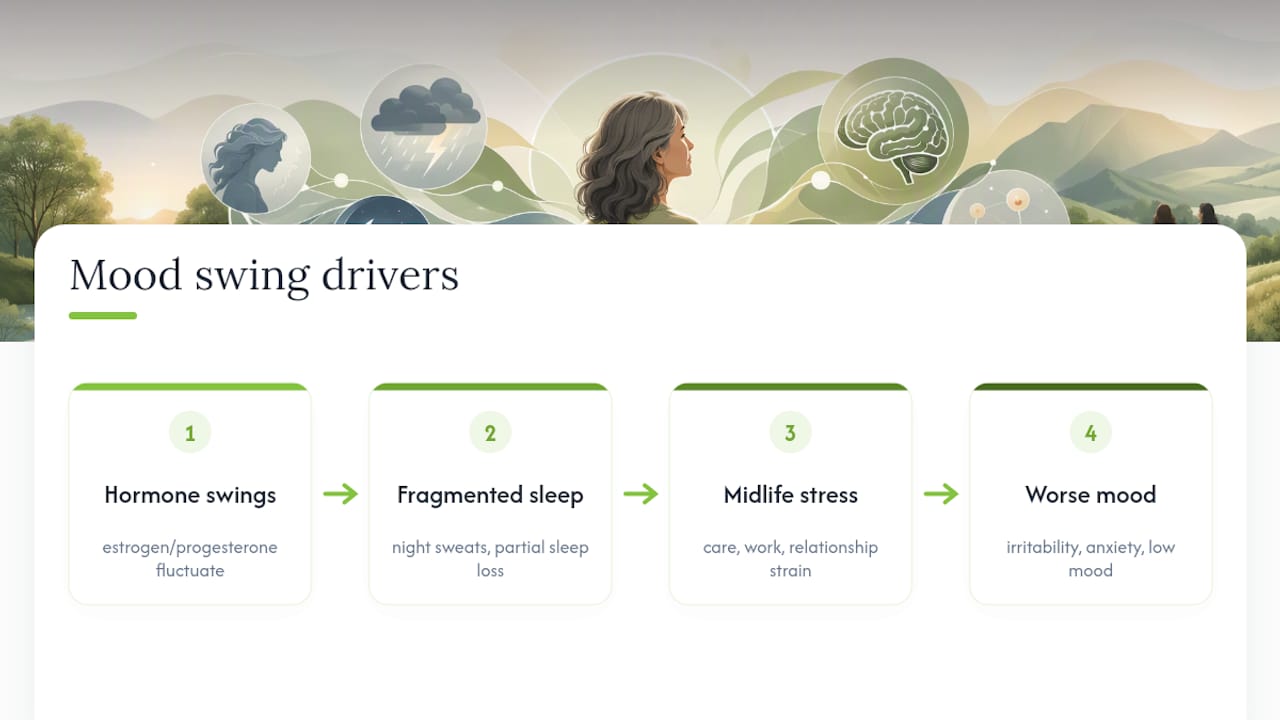
Estrogen and progesterone don’t decline smoothly during perimenopause. They fluctuate, sometimes wildly, from cycle to cycle. Those swings affect serotonin and other neurotransmitters directly, which is why mood can shift within days, not just months.
Sleep disruption compounds it. Night sweats fragment sleep even when you don’t fully wake up, and chronic partial sleep loss is one of the most reliable ways to worsen irritability, anxiety, and low mood in anyone, hormones aside.
Then there’s timing. Perimenopause tends to land in the same years as teenagers, aging parents, career pressure, and marriages under strain. The hormonal shift doesn’t cause all of that stress, but it lowers your capacity to absorb it. That combination, biology plus circumstance, is why treatment that only addresses one piece often falls short.
Do Supplements Help With Perimenopause Mood Symptoms?
The evidence here is genuinely mixed, and it’s worth being honest about that instead of overselling any one supplement.
Omega-3 fatty acids have reasonable support for mood benefits generally, and some women report improvement in irritability and low mood when supplementing consistently, though the perimenopause-specific evidence is thinner than for major depression overall. Vitamin D deficiency is common and correlates with worse mood in many populations, so checking a level and correcting a deficiency is a low-risk, sensible step, even if it isn’t a stand-alone treatment for clinical depression.
Phytoestrogens, found in soy, flaxseed, and certain legumes, get a lot of attention for vasomotor symptoms, but their effect on mood specifically is inconsistent across studies. Some women notice a modest benefit; others notice nothing.
None of these should replace antidepressants or hormone therapy when those are clinically indicated. Think of supplements as a supporting layer, not a substitute. If you’re already on medication, mention any supplements to your prescriber. Some, particularly high-dose omega-3s, can interact with blood thinners, and St. John’s Wort (sometimes used informally for mood) interacts with a long list of psychiatric medications.
Can Yoga or Acupuncture Ease Perimenopause Mood Symptoms?
Yes, for some women, though the evidence strength varies by technique. Yoga and structured mind-body practices show consistent, if modest, benefits for stress and mood regulation during the menopausal transition, largely through improved stress response and better sleep quality.
Acupuncture’s evidence is more mixed. Some trials show benefit for insomnia and hot flashes, which can indirectly help mood, while others show effects close to placebo. We don’t discourage patients from trying it, particularly for sleep, but we’re careful not to oversell it as a primary mood treatment.
The common thread across these approaches is the nervous system. Chronic stress keeps cortisol elevated, and elevated cortisol worsens both sleep and mood. Yoga, breathing practices, and even regular time outdoors lower that baseline stress response over weeks, not overnight. If you already do CBT or an MBI program, adding a movement-based practice like yoga tends to reinforce rather than duplicate that work. If you’re not doing formal therapy right now, a mind-body practice like mindfulness for anxiety can be a reasonable starting point while you arrange an evaluation.
How Do Thyroid and Other Conditions Affect Perimenopause Mood?
Thyroid dysfunction is one of the most commonly missed contributors to perimenopausal mood symptoms, and it’s a big reason we insist on lab work before finalizing a diagnosis. Hypothyroidism can produce fatigue, low mood, brain fog, and weight changes that overlap heavily with both depression and perimenopause itself. Hyperthyroidism can cause anxiety, irritability, and sleep disruption that looks a lot like a hormonal mood swing.
Other conditions worth ruling out include anemia, vitamin B12 deficiency, and sleep apnea, which becomes more common around midlife and independently worsens mood and cognitive symptoms.
Treating the underlying condition often resolves a meaningful portion of the mood symptoms on its own, but it rarely resolves all of it when perimenopause is also in play. A woman with both hypothyroidism and significant vasomotor symptoms usually needs thyroid hormone correction and a separate conversation about estrogen or antidepressant treatment. Treating one without addressing the other tends to leave patients frustrated, wondering why they still feel off despite “normal” labs. This is exactly why an evaluation that looks at the whole picture, not just a single hormone panel, matters more than people expect going into it.
How Should You Track Mood and Hormone Changes?
A simple daily log changes how productive your appointments are. Note your mood on a basic 1 to 10 scale, sleep quality, hot flash frequency, and where you are in your cycle if you’re still having periods, even irregular ones.
Patterns emerge faster than most women expect. Some notice mood dips reliably in the days before a period even as cycles become unpredictable. Others notice mood tracks more closely with sleep quality than with the calendar at all. Either pattern is useful information for your clinician, because it points toward hormone-driven versus insomnia-driven symptoms, which changes the treatment conversation.
A basic notes app or a printed weekly chart works fine. Apps built specifically for cycle and symptom tracking add convenience but aren’t required. What matters is consistency, ideally at least four to six weeks of data before a follow-up visit, so you’re not relying on memory when a clinician asks how things have been.
Bring that log to appointments. It turns a vague “I’ve been more irritable lately” into something concrete a clinician can act on, whether that means adjusting a medication dose, timing hormone therapy differently, or confirming that a current treatment plan is actually working better than it feels.
What’s New in Perimenopause Mood Research?
Fezolinetant, a nonhormonal medication targeting vasomotor symptoms through a different mechanism than estrogen, has expanded options for women who can’t or don’t want to use hormone therapy but still need relief from hot flashes that are disrupting sleep and mood. It doesn’t treat depression directly, but by improving sleep, it can ease mood symptoms as a secondary effect.
Research into esketamine and ketamine for treatment-resistant depression continues to expand beyond general psychiatric populations, and some of that data is beginning to inform how clinicians think about midlife depression that hasn’t responded to standard antidepressants. It’s not a first-line option, but it’s increasingly available when other treatments have failed.
There’s also growing interest in earlier detection. FIGO’s best practice recommendations call for training primary care providers to recognize perimenopausal mood changes sooner, rather than waiting for symptoms to become severe before treatment starts. That shift toward earlier, individualized, multimodal care, combining lifestyle change, therapy, and hormone therapy where appropriate, reflects where the field seems to be heading rather than a single breakthrough drug or device.
Our Take: Stop Treating This as One Problem With One Fix
The biggest mistake we see isn’t choosing the wrong treatment. It’s choosing only one. Conventional advice tends to frame this as a fork in the road: hormones or antidepressants, medication or therapy, medical or lifestyle. That framing doesn’t match how mood symptoms actually behave in perimenopause.
We’d rather see a patient start an antidepressant and a sleep routine in the same month than wait three months to see if one alone is enough. Waiting rarely gives you clean information. It just delays relief.
If we had to prioritize one thing for a reader unsure where to start, it’s this: get evaluated before assuming which category you fall into. A depressive episode, a vasomotor-driven sleep problem, and an undiagnosed thyroid issue can look nearly identical from the inside. The treatment path that works depends entirely on which one, or which combination, is actually driving your symptoms.
— Felix
How Nortex Psychiatry Supports You Through This
Nortex Psychiatry gives you a coordinated alternative to piecing together care from multiple specialists on your own. We offer psychiatric evaluation, medication management, and, when standard treatments haven’t worked, advanced options for treatment-resistant depression, all in one practice serving a broad local area. Every plan is individualized and guideline-informed, and we coordinate directly with your primary care provider or gynecologist so hormone therapy and psychiatric treatment don’t happen in silos. Telehealth visits are available if getting into an office isn’t realistic for your schedule. If perimenopausal mood symptoms are affecting your daily life, the next step is a psychiatric evaluation to identify what’s actually driving them and build a treatment plan around your specific situation.
Sources
- Guidelines for the evaluation and treatment of perimenopausal depression: summary and recommendations
- The effectiveness of psychosocial interventions on non-physiological symptoms of menopause: A systematic review and meta-analysis
- Hormone replacement therapy for menopausal mood swings and sleep quality: The current evidence
FAQ
What Can I Take to Help My Mood During Perimenopause?
Antidepressants (SSRIs or SNRIs) and psychotherapy are first-line for depressive episodes, while transdermal estradiol often helps when hot flashes and sleep disruption are driving the mood changes. Omega-3s and vitamin D correction can support treatment but shouldn’t replace it.
How Do I Stop Being Moody During Perimenopause?
Mood swings often improve with a combination of medical treatment (antidepressants or hormone therapy, depending on your symptoms) and consistent sleep, exercise, and stress reduction habits. A psychiatric evaluation can pinpoint which combination fits your specific pattern.
How Do I Reduce Cortisol During Perimenopause?
Regular sleep, moderate exercise, mindfulness or breathing practices, and limiting alcohol and caffeine all help lower baseline stress hormone levels over time. Yoga and structured relaxation practices show consistent, modest benefits here.
Is Lack of Motivation a Common Symptom of Perimenopause?
Yes, low motivation and reduced drive are common during perimenopause and can reflect either hormonal fluctuation, sleep disruption, or an emerging depressive episode. If it persists for more than two weeks or interferes with daily functioning, it warrants a clinical evaluation rather than being dismissed as normal aging.