


Inattentive ADHD in adults is the form of ADHD where the main trouble is attention, organization and follow-through, not hyperactivity. It is easy to miss because nobody is bouncing off the walls. The person is usually the one who loses the thread, forgets the appointment, or stares at a task for an hour without starting. If that sounds familiar, a careful evaluation with a psychiatrist can tell you whether ADHD explains it, and in North Dallas that can be done in person or by telehealth with us at Nortex Psychiatry in Allen.
TL;DR
- Inattentive ADHD (often called primarily inattentive ADHD) shows up as forgetfulness, disorganization, trouble finishing tasks and difficulty sustaining focus, with little outward hyperactivity.
- For an adult diagnosis, at least five inattentive symptoms must persist for six months or more, have been present in childhood, and affect more than one area of life.
- Many adults are diagnosed late: over half of U.S. adults with a current ADHD diagnosis in 2023 were diagnosed at 18 or older.
- Anxiety, depression and poor sleep can look like ADHD, or sit alongside it, so the evaluation has to sort them out.
- Treatment is tailored to the person. It often combines medication with therapy or practical strategies, and it is adjusted over time.
Table of Contents
- What inattentive ADHD means in adults
- Symptoms of inattentive ADHD in adults
- How an adult diagnosis is defined
- Telling inattentive ADHD from anxiety, depression and poor sleep
- What an ADHD evaluation involves
- Treatment: medication, therapy and daily strategies
- ADHD at work
- Our perspective
- Talking with us in North Dallas
- FAQ
- Sources
What inattentive ADHD means in adults
ADHD is a developmental condition. The National Institute of Mental Health describes it as a pattern of inattention, hyperactivity and impulsivity that begins in childhood and can interfere with daily life. Clinicians describe it in presentations. The inattentive presentation means that most of your symptoms fall on the attention side, and the hyperactive and impulsive side is quiet or absent.
The CDC notes that ADHD often lasts into adulthood, that some adults have it without ever having been diagnosed, and that hyperactivity may fade or turn into a sense of inner restlessness. That last point matters. Many adults with inattentive ADHD do not feel hyperactive, but they do feel an internal hum that makes it hard to settle into one thing.
How common is it? The CDC reported that in 2023 an estimated 15.5 million U.S. adults, about 6.0%, had a current ADHD diagnosis. The same report found that more than half of them were first diagnosed as adults. In our work, that matches what we hear in the first conversation: “I always thought I was just disorganized.”
Symptoms of inattentive ADHD in adults
The NIMH lists procrastination, poor time management, forgetfulness, and trouble focusing on large tasks or finishing projects among the ways adult ADHD can show up, and notes that these can interfere with work, relationships, appointments and daily tasks.
In plain terms, adults tell us things like this:
- I start the email, get pulled away, and find it half-written three days later.
- I read the same page four times and nothing sticks.
- I miss deadlines even when I care about the work, and then I work all night to catch up.
- I lose keys, my phone, my wallet, again.
- People say I seem to be somewhere else when they talk to me.
- Bills, forms and scheduling pile up, not because I do not know how, but because I cannot get them started.
- Tasks that interest me hold my attention for hours. Tasks that do not feel almost physically impossible.
Notice that none of this is about intelligence or effort. Many of the adults we meet are capable, well liked at work, and worn out from the extra energy it costs them to look organized. Some have built elaborate systems of alarms, sticky notes and last-minute sprints that kept things working until a promotion, a new baby, a move or remote work removed the scaffolding.
Why it gets missed
Inattentive ADHD tends to be overlooked for a few reasons. Children with it are often quiet, so teachers do not flag them. Girls and women are more likely to be seen as dreamy or anxious than as having ADHD. Bright people compensate for years. And the adult version often arrives at a clinic labeled as something else: stress, burnout, low mood, or worry.
If you are a parent noticing the same pattern in a teen or young adult, our guide on how teen ADHD is diagnosed walks through what to expect.
How an adult diagnosis is defined
There is no blood test or brain scan that confirms ADHD. The diagnosis rests on history and on how symptoms affect your life. The Attention Deficit Disorder Association summarizes the adult criteria this way: at least five inattentive symptoms, lasting six months or longer, present in childhood, interfering with functioning, and occurring in at least two areas of life, such as work and home.
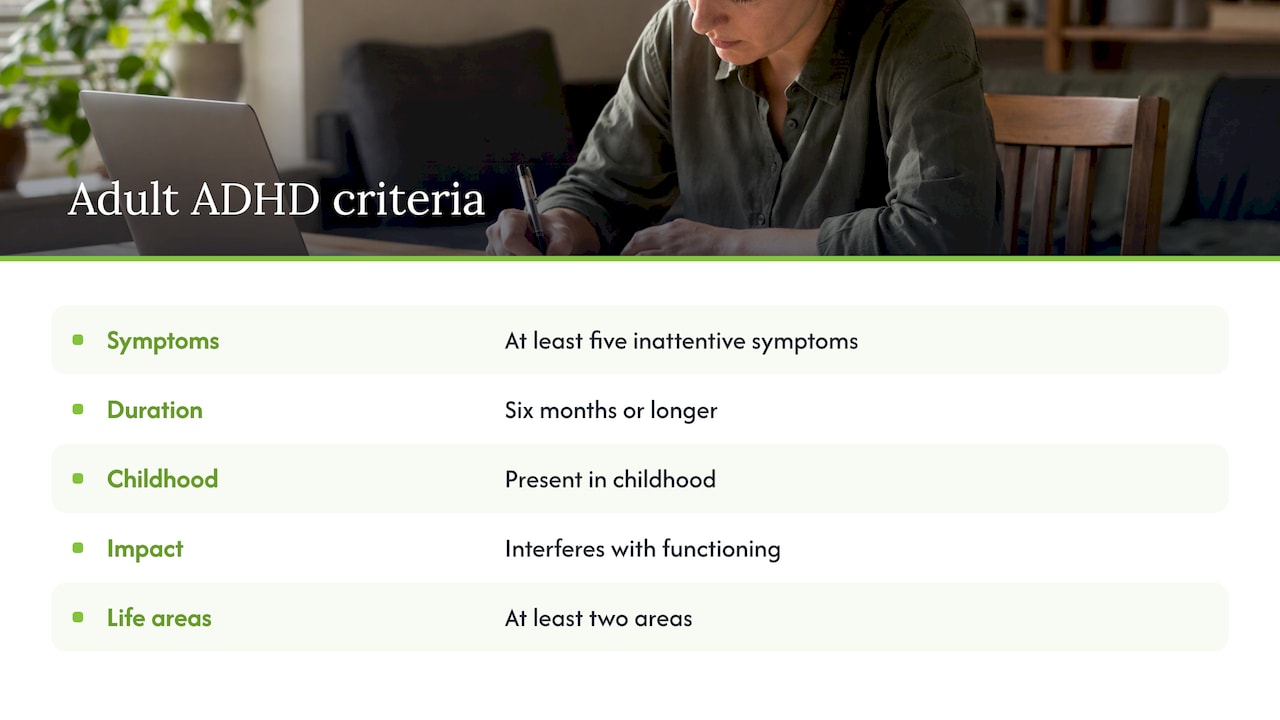
That “present in childhood” piece surprises people who feel their trouble began at 35. Often the signs were there earlier but were covered by structure, good grades, or a supportive environment. We ask about school, old report cards if they exist, and what a parent or sibling remembers.
The “two areas of life” piece is just as important. Someone who cannot focus only at one particular job may be dealing with a bad fit, a bad boss or burnout. Someone who struggles at work, at home and in friendships is a different picture.
Telling inattentive ADHD from anxiety, depression and poor sleep
This is where an experienced clinician earns their keep. Trouble concentrating is a feature of many conditions. Anxiety fills the mind with worry and leaves little room for the task. Depression slows thinking and drains motivation. Sleep problems, especially untreated sleep apnea or chronic short sleep, produce fog and forgetfulness that can mimic ADHD almost exactly.
CHADD, a professional organization for ADHD, notes that clinicians assess behavioral history and impairment across several life areas and distinguish ADHD from co-occurring conditions such as anxiety, depression, learning disorders and sleep problems. The word co-occurring is worth holding onto. ADHD and anxiety, or ADHD and depression, often travel together. Finding one does not rule out the other.
A few questions we find useful, and that you can think about before an appointment:
- Did the attention trouble exist before the anxiety or low mood began, or only since?
- Does it improve when you are well rested and calm, or does it stay about the same?
- Is it present in everything, or mostly when you are worried or hopeless?
- Do people who knew you as a child remember similar patterns?
There is no scoring system in those questions. They simply help us understand the order of events. If anxiety is part of your picture, our page on what to bring to an anxiety versus ADHD evaluation can help you prepare, and our article on anxiety and ADHD management steps covers what comes after.
What an ADHD evaluation involves
According to the NIMH, diagnosis involves reviewing symptoms and behavior history, often with input from family or friends. Providers may use standardized rating scales or checklists, and sometimes psychological testing, to look at cognitive strengths and challenges and to check for learning disabilities.
In practice, you can expect a real conversation, not a five-minute screen. Expect questions about school, work, relationships, sleep, caffeine, alcohol and other substances, mood, family history, and any medications you already take. Bringing records helps. So does asking a spouse, partner or old friend to describe what they notice. Our guides on the adult ADHD evaluation timeline and adult ADHD diagnosis in North Dallas explain how to get ready.
Telehealth is a normal part of this now. The CDC reported that about 46.0% of U.S. adults with ADHD had ever received telehealth services for ADHD. We offer both in-person and telehealth visits, which helps busy professionals in Allen, Frisco, McKinney and Plano who cannot easily leave a workday, and people elsewhere in Texas.
Treatment: medication, therapy and daily strategies
Good ADHD treatment is built around you. There is no single plan that fits everyone, and it is rarely set once and forgotten.
Medication
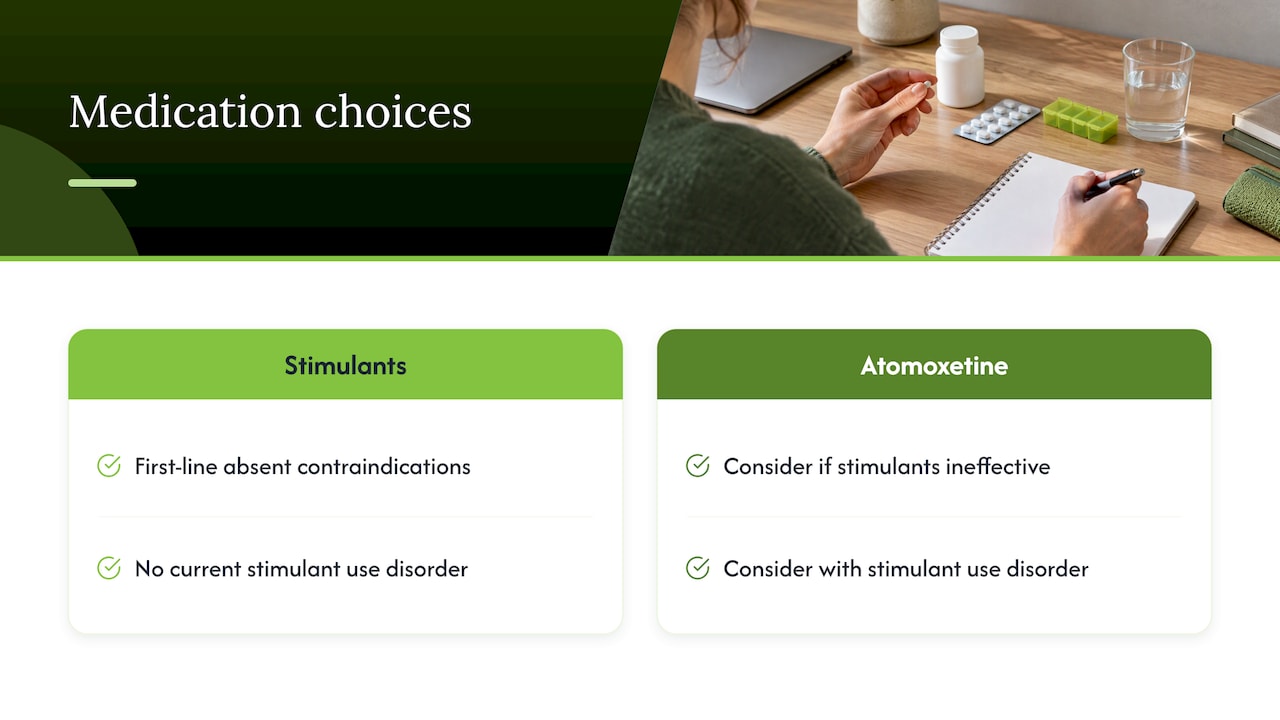
Federal guidance from the Indian Health Service formulary brief states that treatment should be patient-tailored and that stimulants are first-line for adults without contraindications or a current stimulant use disorder, with atomoxetine considered when stimulants are ineffective or when there is a current stimulant use disorder. The CDC reported that about half (50.4%) of U.S. adults with ADHD were prescribed medication in the prior 12 months, roughly one-third on a stimulant and 5.9% on a nonstimulant.
Safe use matters. Stimulant labels carry a boxed warning about abuse, misuse and addiction, and the FDA prescribing information for one methylphenidate product advises providers to assess and monitor those risks throughout treatment. That is part of why medication management is ongoing. Tell your psychiatrist about any history of substance use, heart conditions, anxiety, sleep trouble or other medicines before starting, and report side effects early. Dose changes should be made together with your prescriber, not on your own.
If you want a closer look at what dose adjustment looks like, see our ADHD medication titration guide. For a broader overview, ADHD treatment options for adults lays out the choices.
Therapy and behavioral strategies
The CDC describes comprehensive treatment plans as often combining medication with therapy or behavioral strategies, with ongoing monitoring and adjustment. Medication can make it easier to start and hold your attention. Therapy and coaching-style skills help with the habits: planning, breaking projects down, handling emotions when things go sideways. Our article on medication versus therapy for ADHD covers how the two fit together.
Everyday habits that tend to help
These are small and unglamorous. We have learned that small and repeatable beats ambitious and short-lived.
- Put the next step on a visible list, written so small you cannot argue with it (“open the document” rather than “write the report”).
- Use external reminders. Phone alarms, calendar alerts and a single place for keys and wallet take memory out of the equation.
- Work in short blocks with a defined stop. Twenty-five minutes, then a break, is a common pattern.
- Do the dull task alongside another person, on a call or in the same room, if that helps you stay with it.
- Protect sleep. It is one of the cheapest ways to improve focus.
We go through more of these in coping strategies for ADHD.
One more pattern worth naming: adults with ADHD sometimes lean on nicotine or on constant oral habits to manage restlessness and focus. If that is part of your picture, this piece on ADHD and oral fixation with smoking looks at why it happens. Tell your psychiatrist about nicotine use too, since it belongs in the full treatment plan.
ADHD at work
If your symptoms cause real impairment on the job, you may qualify for reasonable accommodations. The American Psychiatric Association notes that people with ADHD whose symptoms impair them at work may be eligible under the Americans with Disabilities Act. A diagnosis and documentation from your clinician are usually the starting point. Accommodations are often modest: written instructions after meetings, a quieter workspace, or flexible deadlines for big projects.
Our perspective
We have learned that the hardest part for most adults is not the diagnosis. It is the years of believing the problem was character. People arrive having read every productivity book, and they are tired.
In our work, the useful first step is a careful history. We want to know when the trouble started, where it shows up, and what else is going on, because anxiety, low mood and sleep can all be tangled with attention. We do not rush that part.
We practice personalized, evidence-based psychiatric care, and for ADHD that means medication management alongside a plan that suits your life. We offer in-person and telehealth visits so care fits a working week. Sometimes things go smoothly, sometimes the first dose is not right and we adjust. That is normal, and we expect to adjust together.
Mental health care is a journey, not a straight line. You do not need to have everything figured out before you call.
Felix
Talking with us in North Dallas
If you recognize yourself in this article, the next step is a conversation. Nortex Psychiatry is in Allen, Texas, and we see adults across Frisco, McKinney, Plano and nearby, with in-person and telehealth options. You can reach us through the Nortex Psychiatry website to ask about an ADHD evaluation and medication management.
FAQ
Is inattentive ADHD the same as ADD?
“ADD” is the older name many people still use. Today the diagnosis is ADHD, with a presentation specified, and what people call ADD usually corresponds to the primarily inattentive presentation. The symptoms and the evaluation are the same either way.
Can you develop inattentive ADHD as an adult?
ADHD begins in childhood, per the NIMH, but it can go unrecognized for years. That is why more than half of adults with a current diagnosis were first diagnosed at 18 or older. If attention trouble truly started only recently, we would look closely at stress, mood, sleep and medical causes.
What does an adult ADHD evaluation include?
It usually includes a detailed history of symptoms and behavior, sometimes input from family or friends, and standardized rating scales or checklists. Psychological testing may be added to look at cognitive strengths and possible learning disabilities. The goal is to understand your whole picture, not just to give a label.
Do I need medication for inattentive ADHD?
Not everyone does, and the choice is yours after a full discussion. Plans are tailored, and many combine medication with therapy or practical strategies. If you do start medication, your prescriber monitors how it works and any side effects, and adjusts over time.
Can I be evaluated for ADHD by telehealth in Texas?
Yes. Telehealth is widely used for ADHD care, and we offer both in-person and telehealth psychiatry. Contact us to learn which visit format suits your situation.
Sources
- Exploring ADHD-PI: When Inattention Is the Issue (ADDA)
- Attention-Deficit/Hyperactivity Disorder: What You Need to Know (NIMH)
- ADHD in Adults: 4 Things to Know (NIMH)
- ADHD in Adults: An Overview (CDC)
- MMWR, Volume 73, Issue 40, October 10, 2024 (CDC)
- Diagnosis and Treatment of Adult ADHD (CHADD)
- Formulary Brief: Treatment of Adult ADHD, April 2025 (Indian Health Service)
- Prescribing information, October 2023 (FDA)
- El TDAH en los adultos: resumen (CDC)
- What Is ADHD? (American Psychiatric Association)