


Switching ADHD medications is common, and it is usually a planned, stepwise process rather than a sign that treatment has failed. Most switches happen because the first medication did not help enough, caused side effects you could not live with, or stopped fitting your life. The safest way to do it depends on what you are leaving and what you are starting, and it should happen with your prescriber, not on your own.
TL;DR
- A first medication that does not work is not the end of the road. CHADD reports that about 80% of people who do not respond to their first medication respond promisingly to a different one.
- Stimulants generally do not need a taper. Nonstimulants such as atomoxetine, guanfacine and clonidine often do, so the type of drug matters.
- Track symptoms with a rating scale and your own written goals, not with how a single day felt.
- If you have tried both stimulants and nonstimulants without success, ask for a psychiatric re-evaluation instead of continuing to adjust on your own.
Table of Contents
- When a switch makes sense
- Decide what “working” means for you
- Stimulant to stimulant
- Stimulant to nonstimulant, and back
- Do you need to taper?
- Giving the new medication a fair trial
- How many switches is reasonable?
- When it is time for a psychiatrist
- Our perspective
- Getting help in North Dallas
- FAQ
- Sources
When a switch makes sense
In our work, people usually arrive at this question after one of three experiences. The medicine never quite helped. It helped, but the side effects came along with it. Or it worked for a while and then seemed to fade.
Before anyone changes a drug, we like to ask a plainer question: was the first one given a fair trial? That means a dose that was adjusted properly, taken consistently, for long enough. One Scottish NHS prescribing guideline, for example, suggests considering a switch when benefit is still inadequate after a six-week trial at an optimal dose. That is guidance from another country and one health system, but it matches the rhythm we see: a few weeks of careful adjustment, then a decision. If you want the detail on how dosing steps work, we wrote about it in our titration playbook.
Common reasons to switch:
- Not enough symptom relief at the highest dose that is reasonable for you
- Side effects such as appetite loss, trouble sleeping, irritability, a racing heart or anxiety
- Rebound, where focus drops sharply as the dose wears off
- A schedule that does not match your day, for instance a short-acting drug when you need coverage through the evening
- Insurance or formulary changes that make the current drug hard to get
Some of these have a simpler fix than a new drug. A different time of day, a different formulation, or a dose change may be enough. We try those first when they make sense. Sleep trouble deserves its own look, and our piece on insomnia in adults with ADHD covers what tends to help.
Decide what “working” means for you
This part gets skipped, and it causes a lot of discouragement. If you do not know what you are measuring, every new medication feels like a coin flip.
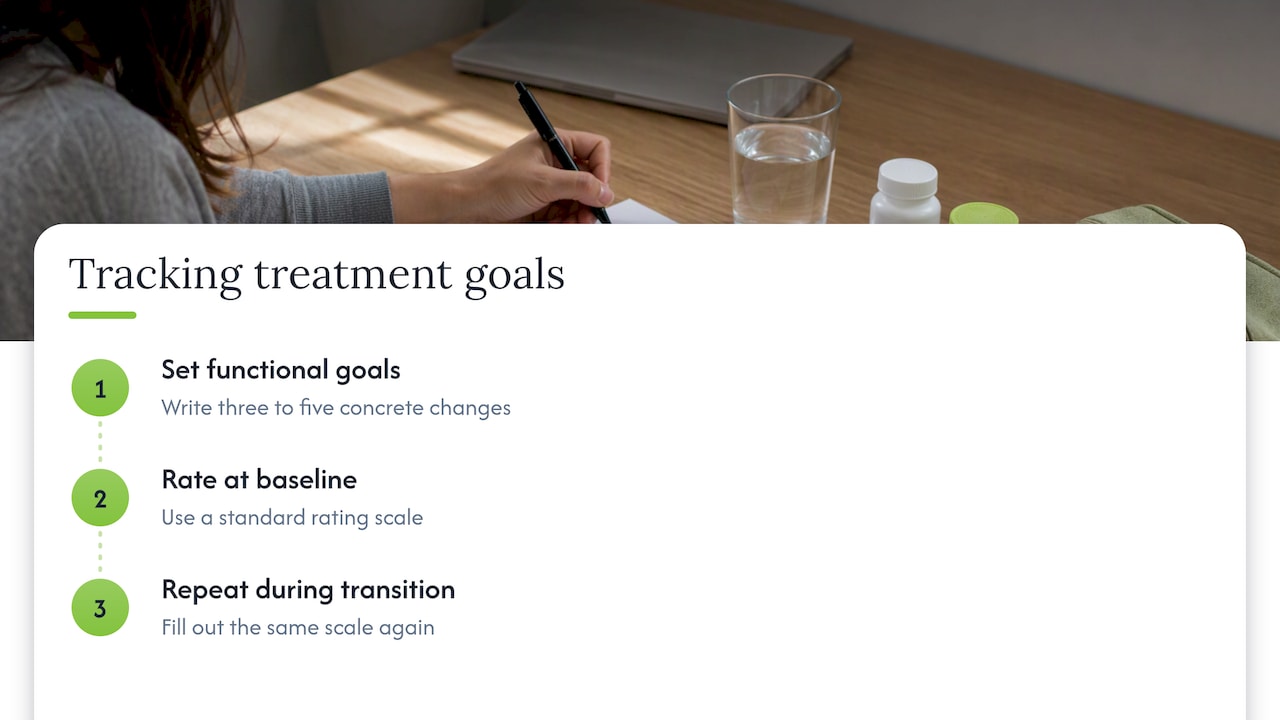
Sit down before the switch and write three to five things you want to change. Not “be less ADHD.” Something you could check on a Thursday afternoon. Finishing a work report without losing an hour to your phone. Getting through a school pickup without snapping. Falling asleep by a reasonable hour. Remembering to eat lunch. AACAP’s medication guide is written for parents, but the idea carries over to adults: treatment goals are about daily function, not only about a symptom list.
Then add a number. A standard rating scale such as the Adult ADHD Self-Report Scale, filled out at baseline and again during the transition, gives you and your prescriber something steadier than memory. CHADD’s guidance on stopping and changing ADHD medication makes the same point: systematic tracking beats anecdotal impressions, especially when you need to tell whether symptoms have truly returned after stopping a drug.
A few people also like to build non-drug routines around the change, particularly for sleep and focus. If that appeals to you, this overview of binaural beats protocols for sleep, focus and calm is one place to read about sound-based approaches. Treat them as a supplement to a plan you have made with your prescriber, not a replacement for it.
Stimulant to stimulant
The two main stimulant families are methylphenidate (Ritalin, Concerta, Focalin and others) and amphetamine (Adderall, Vyvanse, Dexedrine and others), as AACAP lists them. They act on overlapping systems, but people can respond very differently to each.
This is the switch people worry about most, and often it is the simplest. A review in the medical literature notes that there is no universally accepted conversion factor between the two classes. In practice, a prescriber commonly stops the first and starts the second at a modest starting dose, then adjusts upward based on how you respond. Individual titration does the real work.
A children’s hospital prescribing guide takes a similarly careful line: it states that evidence for switching methylphenidate to amphetamines is limited, and it says patients should be monitored closely. We agree with that humility. A dose chart is a starting point, not a rule.
Some people ask about switching within a family, for example from one amphetamine formulation to another with a different duration. Expert opinion suggests adjusting the dose in proportion to the change in duration, but this is a prescriber’s calculation and a rough one. Please do not do the math yourself and then change your own pills.
What the first week often looks like
In our experience, the first few days on a new stimulant are information, not a verdict. You may feel more wired than you expected, or less. Appetite may change. Sleep may shift. We usually ask people to keep brief daily notes: dose, time taken, when it seemed to kick in, when it faded, appetite, mood, sleep. Five lines a day is enough.
One caution that matters: if you have a heart condition, high blood pressure or a family history of cardiac problems, tell your prescriber before any change, and call promptly if you notice chest pain, fainting or a racing heart. That is a reason to be seen, not to wait it out.
Stimulant to nonstimulant, and back
Nonstimulants include atomoxetine and the alpha-agonists guanfacine and clonidine. They tend to be chosen when stimulants cause trouble, are not tolerated, or are not a good fit for a given person’s health or history.
They work on a different timeline. Atomoxetine can take several weeks to reach full effect, often cited as four to six, where a stimulant is felt much faster. That has a practical consequence. If you are moving from a stimulant to atomoxetine, there may be a stretch where you feel worse before the new drug has built up. Some prescribers overlap the two for a while; others do not. This is exactly the sort of decision to make with your clinician, with a plan for what to do if the gap is rough.
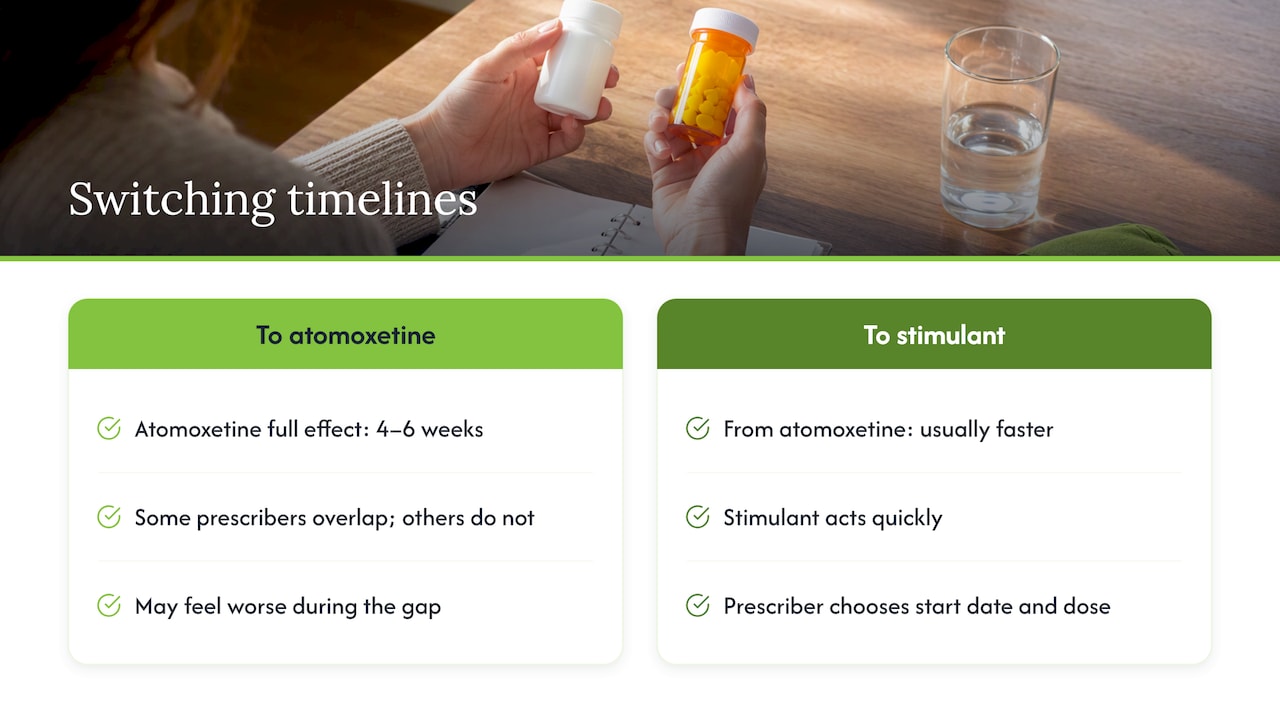
Going the other way, from atomoxetine to a stimulant, is usually faster because the stimulant acts quickly, though your prescriber will still choose the start date and dose.
Do you need to taper?
This is the question that matters most for safety, and the answer depends on the drug class.
| Medication type | Examples | Usual approach when stopping |
|---|---|---|
| Stimulants | Methylphenidate, amphetamine, lisdexamfetamine | Often can be stopped without a gradual taper |
| Atomoxetine | Atomoxetine capsules | The label describes it as something your prescriber may taper; follow their instructions |
| Alpha-agonists | Guanfacine, clonidine | Gradual taper over several days, to avoid rebound effects such as a sharp rise in blood pressure |
The FDA-posted atomoxetine label on DailyMed is the reference for that drug, and a clinical prescribing guideline summarizes the stimulant versus nonstimulant difference: stimulants can be stopped abruptly, while atomoxetine and alpha-agonists typically call for a gradual taper. Blood pressure is the specific worry with alpha-agonists.
A practical rule: never stop guanfacine or clonidine suddenly on your own, even if you feel fine or the side effects bother you. Call your prescriber first. If you have already missed several days and feel dizzy, have a pounding heart or a severe headache, seek medical care the same day.
And a note on stimulants: “no taper needed” does not mean “no plan needed.” Stopping can bring a crash in energy and mood for some days, and your original symptoms may come back more visibly. That is part of why the rating scale helps. It tells you whether what you feel is the old ADHD returning or the new drug not yet doing its job.
Giving the new medication a fair trial
Patience is the unglamorous part of this. We have learned that people who judge a medication on day two often discard something that would have worked, and people who suffer through six weeks of intolerable side effects often wait too long. The balance is judgment, and it is easier with a plan.
A reasonable framework to bring to your prescriber:
- Agree on the starting dose and the schedule for increases.
- Agree on which side effects you should report right away, and which can be watched.
- Set a check-in date, by phone, video or in person.
- Fill out the same rating scale at baseline, at the midpoint and at the decision point.
- Decide in advance what result would mean “keep going” and what would mean “adjust again.”
Telehealth can make those check-ins easier to keep. Controlled-substance rules have been changing, so it is worth reading what we have written on what ADHD telehealth in Texas can and cannot do and on the current U.S. telehealth prescribing rules. In Texas, a bill analysis of SB 2527 describes limits on prescribing controlled substances by telehealth and a prohibition on arrangements that rotate a different provider each month. The practical point for you: one continuing prescriber who knows your history is better medicine, and it is better for staying within the rules too.
How many switches is reasonable?
Here is what tends to reassure people. According to CHADD’s summary of adult ADHD medication research, about 90% of people achieve a favorable outcome after two medication trials, and most who persist find an effective option within three to four. These are group figures, and your own path may not follow them. Still, they are a fair counterweight to the thought that nothing will work.
The same source suggests that if a methylphenidate-based drug gave you no improvement, an amphetamine-based drug is a sensible next trial, and the reverse holds too. Recovery, if we can borrow the phrase, is a journey and not a straight line.
When it is time for a psychiatrist
If you have given a fair trial to both stimulants and nonstimulants and you are still struggling, the problem may not be the next drug on the list. A review of adult ADHD pharmacological management advises referral to a psychiatrist at this point, and notes that continued rounds of self-adjustment are rarely productive. A specialist can revisit the diagnosis, look for other things that look like ADHD or travel with it (anxiety, depression, sleep disorders, trauma), and rebuild the plan.
That is not a small point. In our practice, a fair number of “medication-resistant” ADHD stories turn out to include a second condition that was never treated. If you are unsure what a psychiatrist adds, our guide to the role of psychiatrists in adult ADHD goes through it, and medication versus therapy for ADHD can help you think about combining approaches. Our overview of ADHD treatment options for 2026 gives the wider picture.
Our perspective
We do not think of a switch as starting over. Every trial tells us something: how your body handles a drug, how long it lasts for you, what your sleep and appetite do, what your mood does when the focus improves. By the second or third conversation, we usually know much more than we did at the first.
We also notice that people often come in blaming themselves. They took it wrong, they did not try hard enough, they are the exception. Usually that is not the story. Medications for ADHD are matched by trial, and the matching takes some patience.
What we try to do is keep the process boring in the best sense. One change at a time, so we know what caused what. Written notes instead of memory. A set date to decide. And a direct conversation about what you want your days to look like, because a medication that lowers a score but leaves you flat is not a good result.
If something does not feel right, tell us. Not at the next visit, if it is serious. We would rather hear about it early.
— Felix
Getting help in North Dallas
If you are in Allen, Frisco, McKinney, Plano or elsewhere in North Dallas, or you want to be seen by telehealth in Texas, Nortex Psychiatry offers psychiatric evaluation and medication management for adults with ADHD, anxiety, depression and mood disorders. If an ADHD medication change is part of a bigger picture of low mood or treatment-resistant depression, we also offer interventional options, including TMS therapy, Spravato and ketamine therapy. To start a conversation about your medication plan, visit Nortex Psychiatry.
FAQ
Can I switch ADHD medications on my own?
We advise against it. Doses, timing and the need for a taper differ by drug, and some switches carry real risks, such as blood pressure effects when stopping alpha-agonists. Call your prescriber, tell them what is not working, and let them set the plan.
How long should I wait before deciding a new ADHD medication does not work?
It depends on the drug and the dose. Stimulants act quickly, but finding the right dose takes time, and some guidelines look at about six weeks at an optimal dose. Atomoxetine often takes four to six weeks to show its full effect. Ask your prescriber for a decision date at the start.
Do I have to taper off my stimulant before switching?
Usually not. Stimulants can generally be stopped without a gradual taper, though you may feel a short-term dip. Nonstimulants such as atomoxetine, guanfacine and clonidine often need a taper, so ask before you stop them.
What if none of the medications seem to work?
That is a signal to look more broadly, not to give up. After adequate trials of both stimulants and nonstimulants, guidance points toward psychiatric re-evaluation of the diagnosis and the full treatment plan. Other conditions, such as anxiety, depression or poor sleep, may be part of the picture.
Sources
- CHADD: Choosing the Best Medication for Adult ADHD
- CHADD: Discontinuing ADHD Meds
- AACAP: ADHD Medication Guide
- Clinical prescribing guideline for ADHD (NHS Scotland practice)
- ADHD and pharmacotherapy review (PMC)
- Prescribing guidelines for ADHD (Nationwide Children’s)
- DailyMed: Atomoxetine capsule label
- Pharmacological management of ADHD in adults (PMC)
- Texas SB 2527 bill analysis