


Depression with mixed features is a major depressive episode that comes with a few symptoms from the other side of the mood spectrum: racing thoughts, a surge of restless energy, little need for sleep, sometimes a strange edge of irritability or elation. You feel low and wired at the same time. It is more common than most people expect, it is often missed, and it changes how we treat the depression.
If that description sounds like your last few months, or like someone you love, this article is for you. We will walk through what the diagnosis means, how we tell it apart from ordinary depression and from bipolar disorder, why the usual first-line medication can backfire, and what a careful treatment plan looks like.
TL;DR
- Mixed features means you meet criteria for a major depressive episode and also have at least three manic or hypomanic symptoms on most days of that episode.
- It does not mean a full manic episode and a full depressive episode at once. The manic-side symptoms are often subtle.
- Antidepressants alone can sometimes make these symptoms worse, so this pattern needs closer monitoring than standard depression.
- Mixed features can be a clue that your mood disorder sits on the bipolar spectrum, even if you have never had a full manic episode.
- If you are in crisis, call or text 988. Otherwise, a thorough psychiatric evaluation is the right first step.
Table of Contents
- What “mixed features” actually means
- What it feels like from the inside
- Why it gets missed
- Mixed features and the bipolar spectrum
- Why antidepressants need extra care here
- How treatment usually works
- Mixed features compared with other patterns
- Perspective: what we have learned
- Supporting someone who may have mixed features
- When to book an evaluation
- Care in North Dallas
- FAQ
- Sources
What “mixed features” actually means
The term comes from the DSM-5, the manual psychiatrists use for diagnosis. Older editions only allowed a “mixed state” if someone met full criteria for both mania and depression at once, which almost never happened. The newer approach, described in this primary care review of the DSM-5 changes, replaced that with a specifier. A specifier is an add-on label to a diagnosis. It says: here is the depressive episode, and here is something extra running alongside it.
To qualify, you need a major depressive episode plus at least three of seven symptoms from the manic or hypomanic side, present most days of the current episode. The seven symptoms are:
- Elevated or expansive mood
- Inflated self-esteem or grandiosity
- More talkative than usual, or pressure to keep talking
- Flight of ideas or racing thoughts
- Increased energy or goal-directed activity
- Reckless involvement in high-risk activities
- Decreased need for sleep
The American Psychiatric Association’s summary of the specifier also makes the point that these symptoms should not be something your depression alone can explain. Irritability, distractibility and agitation overlap with plain depression, so they are not counted. That detail matters, and we come back to it below.
The specifier can also be applied the other way around, to a manic or hypomanic episode with depressive symptoms. Here we are focused on the version that shows up in a depressed person.
What it feels like from the inside
Patients rarely walk in and say they have mixed features. They say things like: “I can’t sleep, and I don’t even want to. I’m exhausted, but my mind won’t stop.” Or: “I feel hopeless, but I’ve been cleaning the garage at 2 a.m.” Or: “I’m snapping at everyone and I hate myself for it.”
In our work, a few patterns come up again and again:
- Sleep that shrinks without relief. You sleep four hours and feel wired, not rested. That is different from the insomnia of classic depression, where you lie awake feeling flat.
- Racing thoughts with a dark tone. The thoughts are fast, but they are not fun. They loop through regrets, worries, and worst cases.
- Energy with no pleasure in it. You are busy, restless, pacing. Nothing feels good.
- Impulsive choices. Spending, picking fights, a sudden risky decision, then a wave of guilt.
- Talking more, but not feeling better. Friends may think you seem fine, even animated, while you feel like you are coming apart.
That last one is why this goes unrecognized. From the outside, you can look more alive than you have in weeks. Inside, it is the opposite.
One caution: mixed states can raise the risk of self-harm thoughts, because the despair is paired with energy and impulsivity. If you are having thoughts of suicide, do not wait for an appointment. In the United States you can call or text 988, which offers free, confidential support around the clock from a trained crisis counselor. If you are in immediate danger, call 911.
Why it gets missed
There are a few reasons.
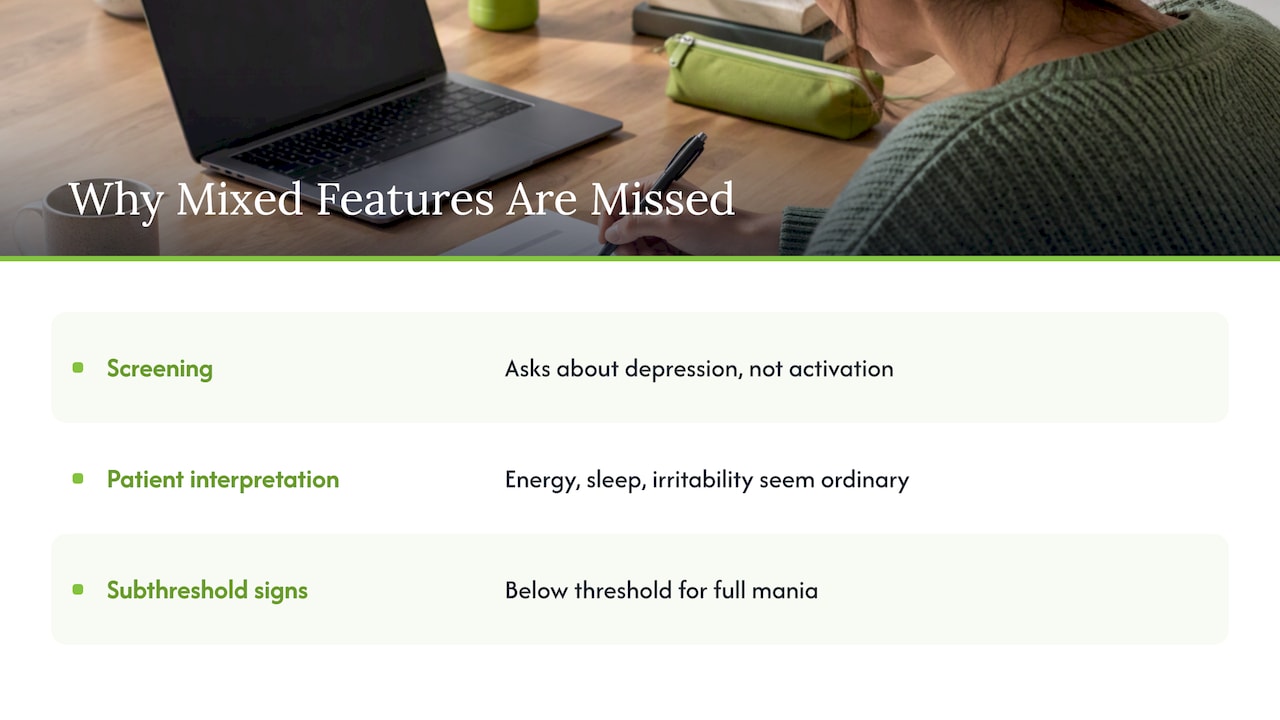
First, most people see a primary care provider or a quick telehealth visit first, and the screening questionnaires used there ask about depression only. They do not ask about racing thoughts or reduced need for sleep. So the picture stays half drawn.
Second, patients do not volunteer the “up” symptoms because they do not feel like symptoms. A burst of energy feels like relief. Reduced sleep feels like insomnia. Irritability feels like stress.
Third, the subthreshold manic symptoms are, by definition, below the level of a full manic episode. A clinician who is only listening for classic mania will not hear them.
If you have ever been told you have “treatment-resistant depression” after several antidepressant trials, it is worth asking whether mixed features were present all along. We are not saying this is always the answer. We are saying it is a question worth asking out loud.
Mixed features and the bipolar spectrum
This is the part that worries people, so let us be plain about it.
Having mixed features in a depressive episode does not mean you have bipolar disorder. It can, however, be an indicator that your mood disorder sits somewhere along the bipolar spectrum, even if you have never had a full manic episode. A review in CNS Spectrums describes depression with subthreshold manic or hypomanic symptoms as clinically relevant for exactly this reason, and a clinical overview from the Journal of Clinical Psychiatry notes that mixed presentations deserve special attention as possible warning signs for progression to bipolar disorder.
What we do with that information is practical. It shifts our attention away from antidepressant-only plans and toward mood stabilization. It also makes us ask more about family history, past episodes of unusually high energy, and how you responded to earlier medications.
If you want a deeper look at how we think through this line, we have written about the diagnostic line between bipolar disorder and depression, and about what to bring to an appointment so your psychiatrist can see the full picture. For adults wondering what the process involves, see our page on the bipolar diagnosis process.
Why antidepressants need extra care here
For standard major depression, an antidepressant is usually a reasonable first step. With mixed features, the calculation changes.
Expert consensus, summarized in a review of treatment recommendations for DSM-5-defined mixed features, is that antidepressant monotherapy may worsen the subthreshold manic symptoms that come with the depression. Put plainly, in some patients an antidepressant can act like fuel on a fire: more agitation, more insomnia, more racing thoughts. The same review points out that there are few randomized, placebo-controlled trials specifically for DSM-5-defined mixed features, so a lot of treatment is guided by clinical consensus, not by firm one-size-fits-all rules.
A psychiatric news article on managing mixed features adds that the medication options are similar whether the patient is considered unipolar or bipolar, with one important exception: frontline antidepressant use.
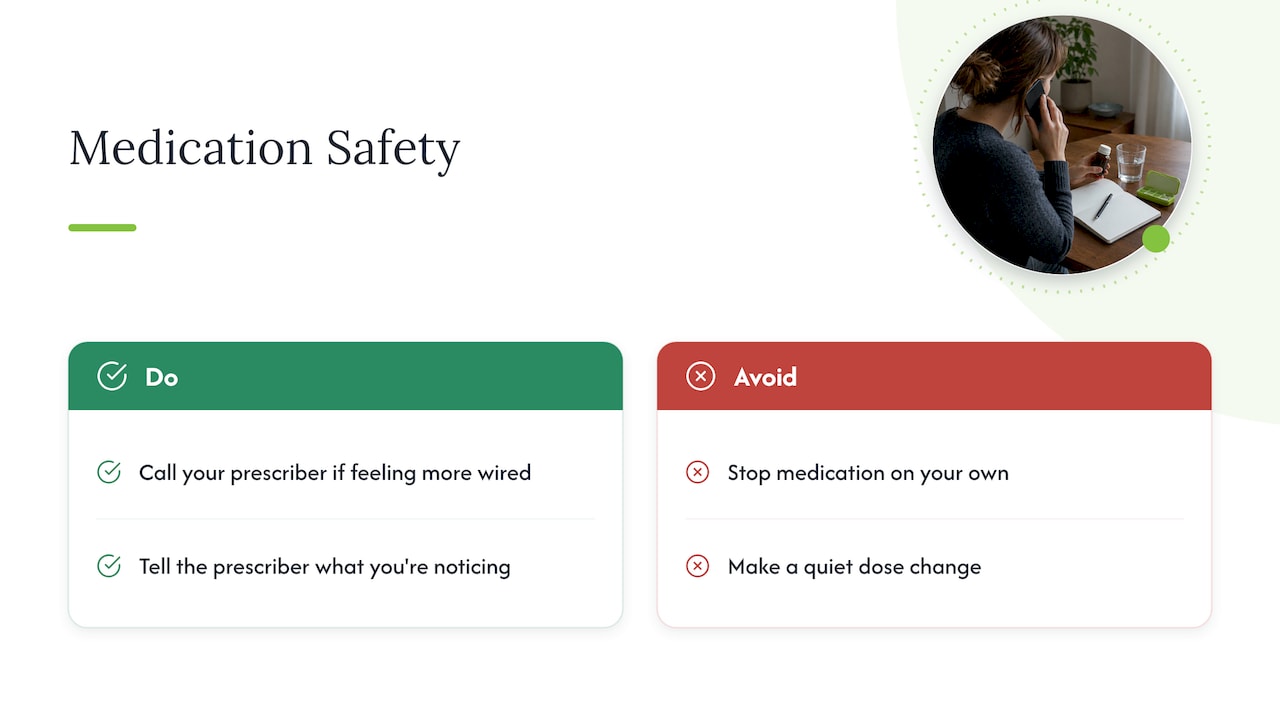
We want to be careful here. This does not mean antidepressants are forbidden, and it is never a reason to stop a medication on your own. Stopping abruptly can cause its own problems. If you suspect your medication is making you more wired, call the prescriber who manages it and tell them what you are noticing. That conversation is the right move, not a quiet dose change.
How treatment usually works
There is no single approved medication for “depression with mixed features.” What clinicians do is borrow from what is known about bipolar depression and mood stabilization, then individualize.
Medication
Second-generation (atypical) antipsychotics are a common backbone. Lurasidone, for example, is FDA-indicated for depressive episodes associated with Bipolar I Disorder, alone or alongside lithium or valproate. There is research looking at how these drugs perform when mixed features are present, including a 2025 systematic review and meta-analysis of pharmacological treatment for major depressive episodes with a mixed features specifier. Lithium, valproate and other mood stabilizers also have roles. Which one is right for you depends on your history, other health conditions, side-effect tolerance, and other medications. We would not pick from this list for you in a blog post, and neither should anyone else.
Therapy
Medication is rarely the whole plan. The National Institute of Mental Health describes psychotherapy, including cognitive behavioral therapy and family-focused therapy, as an important partner to medication in mood disorders. For many patients, the combination is steadier than either one alone. Sleep routines, tracking mood and energy day by day, and teaching family members what to watch for all pay off.
Close follow-up
This may be the most underrated part. With mixed features, we see patients more often early on, because the picture can shift. We are watching for three things: whether the depression is lifting, whether energy and sleep are settling, and whether any new high-side symptoms are appearing. Our overview of check-ins clinicians use for bipolar depression describes that rhythm in more detail.
When standard medications have not been enough
Some patients have already been through several medication trials without relief. For those patients, interventional options may enter the conversation. At our practice we offer Transcranial Magnetic Stimulation, Spravato, ketamine therapy and stellate ganglion block. We want to be honest: whether any of these fits someone with mixed features, or a bipolar-spectrum diagnosis, is an individual decision made after a full evaluation. It is not automatic. If you are curious about the TMS question specifically, we explain our thinking in Can TMS therapy help with bipolar disorder? and in a piece on TMS and mood instability.
Mixed features compared with other patterns
| Typical major depression | Depression with mixed features | Bipolar I depressive episode | |
|---|---|---|---|
| Mood | Low, flat, empty | Low, often with agitation or irritability | Low |
| Energy | Reduced | Reduced inside, restless outside | Usually reduced |
| Sleep | Too much or too little, feels unrefreshing | Often reduced with no feeling of tiredness | Varies |
| Thoughts | Slow, stuck | Racing, often dark | Varies |
| History of full mania | No | Not required | Yes, by definition |
| Antidepressant alone | Common first step | Needs closer monitoring | Generally avoided as a lone treatment |
Treat this table as a rough orientation, not a diagnostic tool. Real people do not fit neatly into columns, and that is exactly why the evaluation matters.
Perspective: what we have learned
We want to say something that does not always make it into textbooks. Many of the patients we see with this pattern have been struggling for a long time, and they often arrive embarrassed. They think the racing mind is a character flaw, or that their irritability means they are a bad parent or partner. It is usually a symptom, and a treatable one.
We have also learned to slow down. The urge, on the clinician’s side and the patient’s, is to fix the misery fast. But with mixed features, speed can be the problem. We often find that the first visit is mostly listening: sleep patterns across a typical week, what the nights feel like, which medications you have tried and what happened. A family member’s view, when you are comfortable sharing it, can reveal things you cannot see in yourself.
We do not pretend the evidence is tidy. There are fewer trials than we would like, and good clinicians disagree on details. What we can promise is careful attention, regular check-ins, and a willingness to change course. Recovery is a journey, not a straight line, and with this condition it tends to wobble a bit before it steadies.
— Felix
Supporting someone who may have mixed features
If you are reading this for a spouse, a teen, or a friend, a few things help.
- Describe what you see, not what you think it means. “You’ve been up until 4 a.m. all week and you seem on edge” lands better than “I think you’re bipolar.”
- Offer to come along. Having a second voice at the first appointment can make a real difference.
- Know the crisis number. The 988 Lifeline says safety plans and understanding risk factors are useful for families and caregivers, not just the person in crisis.
- Look after yourself. Supporting someone through a mixed episode is tiring.
If the person you care about has talked about suicide, this personal essay on how to help a suicidal friend offers a peer’s perspective on what to say and do. For parents of younger people, our guide to helping teens with mood disorders is a good place to begin.
When to book an evaluation
Consider reaching out if:
- You have been treated for depression and feel worse, more agitated, or more wired on an antidepressant.
- You sleep very little but are not tired.
- Your thoughts race while your mood stays low.
- You have had a stretch of unusually high energy at any point in your life.
- Bipolar disorder runs in your family and you now have depression.
Bring a list of your medications with doses and dates, a rough sleep log for two weeks if you can, and notes about any high-energy periods. If you can name a family member who knows you well, bring them, or ask them to write a few lines.
Care in North Dallas
Nortex Psychiatry is based in Allen, Texas, and we see adults and families from Frisco, McKinney, Plano and surrounding communities, in person and by telehealth. We start with a thorough psychiatric evaluation, then build a plan around you, covering medication management and, where appropriate, our interventional options. You can learn more about us or request an appointment at nortexpsychiatry.com. If you want a wider view of how we approach mood conditions, our mood disorder treatment guide is a good companion read.
FAQ
Is depression with mixed features the same as bipolar disorder?
No. Mixed features is a specifier that can be added to major depression, and it does not require a history of mania. It can, however, suggest that your mood disorder sits on the bipolar spectrum, which is why a careful evaluation and history matter.
What are the treatment options for depression with mixed features?
Treatment usually combines medication, often a second-generation antipsychotic or a mood stabilizer, with psychotherapy and close follow-up. Antidepressants alone are used cautiously because they may worsen manic-side symptoms. The exact plan depends on your history and is made with your psychiatrist.
How is it diagnosed?
A clinician confirms that you meet criteria for a major depressive episode, then checks for at least three of the seven manic or hypomanic symptoms across most days of the episode. Sleep, energy, family history and past medication responses all shape the picture. There is no blood test or scan that settles it.
Should I stop my antidepressant if I think it is making me more agitated?
Not on your own. Stopping suddenly can cause withdrawal-type symptoms and other problems. Call the prescriber who manages the medication, describe what you are noticing, and ask whether a change is needed. If you feel unsafe, call or text 988, or 911 in an emergency.
Sources
- Mixed Specifier for Bipolar Mania and Depression: DSM-5 changes (PMC)
- APA: Mixed Features Specifier
- Treatment recommendations for DSM-5-defined mixed features (PubMed)
- Your Patient Has Mixed Features. Now What? (Psychiatric News)
- Diagnosing and treating major depressive episodes along the mood disorders spectrum (CNS Spectrums)
- Depression With Mixed Features (Journal of Clinical Psychiatry)
- Latuda prescribing information (FDA)
- Pharmacological treatment for MDE with mixed features: meta-analysis (PMC)
- Bipolar Disorder (NIMH)
- 988 Lifeline crisis center FAQ
- 988 Lifeline: support for loved ones