


Bipolar disorder is diagnosed clinically, not with a blood test or brain scan. A psychiatrist or trained clinician evaluates your symptoms against the DSM-5-TR criteria for manic, hypomanic, and depressive episodes, then confirms the pattern with collateral history from people who know you and basic labs that rule out other causes. There is no shortcut here, and you should be skeptical of anything that promises one.
Here’s what that actually looks like once you’re sitting in the room:
- A structured psychiatric interview covering your mood history, sleep, energy, and behavior over months or years, not just today.
- One or more validated screening questionnaires, like the Mood Disorder Questionnaire, used to flag whether a fuller workup is warranted.
- Collateral history: a partner, parent, or close friend often notices things you did not, or remembers them differently than you do.
- Basic bloodwork (thyroid panel, CBC, metabolic panel) and sometimes a urine drug screen, to rule out conditions that mimic mood episodes.
If you’re heading into a first appointment, bring a rough timeline of your mood episodes, a list of current and past medications, and if possible, a family member willing to fill in gaps you might not see clearly yourself. If you’re in crisis right now, if you’re having thoughts of harming yourself, or if someone around you is behaving in a way that seems dangerously manic, that’s not a “wait for the next available appointment” situation. That’s an emergency room or crisis line, tonight.
Key Takeaways
Bipolar disorder is diagnosed through a structured clinical evaluation combining DSM-5-TR criteria, collateral history, validated screening tools, and lab testing to exclude other causes.
| Point | Details |
|---|---|
| Diagnosis is clinical, not lab-based | No blood test or scan confirms bipolar disorder; the DSM-5-TR criteria and history drive the diagnosis. |
| Screening tools triage, they don’t diagnose | The MDQ and HCL-32 flag who needs a full evaluation but carry real false-positive and false-negative rates. |
| Collateral history is often decisive | Family or partner observations frequently reveal hypomanic episodes patients don’t recognize in themselves. |
| Labs rule out mimics | TSH, CBC, CMP, and urine drug screens catch thyroid disease and substance causes before a diagnosis is finalized. |
| Diagnosis can take multiple visits | Confirming bipolar II, especially, often requires longitudinal follow-up rather than a single appointment. |
| Nortexpsychiatry offers full diagnostic evaluations | In-person and telehealth psychiatric assessments in North Dallas include structured interviews, collateral gathering, and follow-up to confirm diagnosis accurately. |
Table of Contents
- Who Makes the Bipolar Diagnosis, and When Should You Be Referred?
- What Are the DSM-5 Criteria for Mania, Hypomania, and Depression?
- What Happens During the Clinical Interview and Psychiatric History?
- How Do Screening Tools and Mood Charts Support Diagnosis?
- What Physical Exams and Lab Tests Rule Out Other Causes?
- How Do Clinicians Rule Out Other Conditions That Look Like Bipolar Disorder?
- Why Do Bipolar Diagnoses Take So Long to Get Right?
- What Does the Diagnostic Timeline Actually Look Like Across Visits?
- When Should You See a Psychiatrist or Go to Emergency Care?
- How Does Collateral History Change Diagnostic Accuracy?
- A Clinician’s Honest Take on Diagnostic Uncertainty
- How Nortexpsychiatry Supports the Diagnostic Process
- Sources
- FAQ
Who Makes the Bipolar Diagnosis, and When Should You Be Referred?
Primary care physicians can and do start this process, but they rarely finish it. A family doctor might notice signs during a routine visit or a depression screening, but a confirmed bipolar diagnosis usually needs a psychiatrist’s eye, because distinguishing bipolar II from recurrent unipolar depression takes training most primary care visits don’t have time for.
In our own practice, we see this play out constantly: someone gets treated for depression for years, the antidepressant never quite works, and nobody stopped to ask about the two weeks last spring when they barely slept and started three new hobbies. That’s the gap specialty psychiatric evaluation is built to close.
Here’s roughly how the referral landscape works:
- Primary care physicians often catch the first signs and can prescribe initial treatment, but typically refer for diagnostic confirmation when bipolar disorder is suspected.
- Psychiatrists conduct the full diagnostic evaluation, including differential diagnosis and treatment planning.
- Psychiatric nurse practitioners frequently handle both evaluation and ongoing management, especially in outpatient settings.
- Emergency clinicians get involved when someone presents in acute mania, severe depression with suicidal ideation, or psychosis. This is stabilization, not long-term diagnosis.
- Behavioral health teams coordinate care when there are overlapping concerns, like substance use or trauma history, that complicate the picture.
You should ask for a psychiatric referral, specifically, if you’ve had a depression diagnosis that isn’t responding to standard treatment, if an antidepressant seemed to trigger unusual energy or agitation, or if anyone close to you has raised concerns about episodes you don’t fully remember. Telehealth has made this faster in a lot of cases. A telehealth psychiatric evaluation can often happen within days rather than the weeks a specialty referral used to take.
What Are the DSM-5 Criteria for Mania, Hypomania, and Depression?
The diagnostic criteria sound technical, but understanding them actually helps you describe your own experience more precisely, which speeds everything up.
A manic episode, under DSM-5-TR, requires a distinct period of abnormally elevated, expansive, or irritable mood and abnormally increased activity or energy, lasting at least one week (or any duration if hospitalization is required). During that period, at least three additional symptoms must be present (four if the mood is only irritable): inflated self-esteem or grandiosity, decreased need for sleep, unusual talkativeness, racing thoughts, distractibility, increased goal-directed activity, or risky behavior like spending sprees or impulsive decisions. The episode has to be severe enough to impair functioning, require hospitalization, or involve psychosis.
A hypomanic episode looks similar but smaller. The minimum duration drops to four consecutive days, the change in functioning has to be observable to others, but it does not cause marked impairment, does not require hospitalization, and never involves psychotic features. This is the distinction that trips up more diagnoses than almost anything else in this field, because hypomania often feels good to the person experiencing it. Productive, even.
A major depressive episode requires five or more symptoms (depressed mood or loss of interest being one of the required two) over a two week period, including changes in sleep, appetite, energy, concentration, or thoughts of death. Here’s the catch: a depressive episode looks identical whether it’s part of unipolar depression or bipolar disorder. The only thing that separates them is whether a manic or hypomanic episode has ever occurred, which is why history matters more than the current presentation.
Pro Tip: Because hypomania often doesn’t register as a problem, don’t just ask yourself “have I ever felt manic?” Ask more concretely: has anyone ever told you that you were talking too fast, spending money you didn’t have, or not sleeping but somehow still had energy? Those specific, observable details are what clinicians are actually listening for.
| Episode Type | Minimum Duration | Symptom Count | Impairment Required |
|---|---|---|---|
| Manic episode | 7 days (or any length if hospitalized) | 3+ (4+ if mood is only irritable) | Marked impairment, hospitalization, or psychosis |
| Hypomanic episode | 4 consecutive days | 3+ (4+ if mood is only irritable) | Observable change, no marked impairment |
| Major depressive episode | 2 weeks | 5+, including depressed mood or anhedonia | Significant distress or functional impairment |
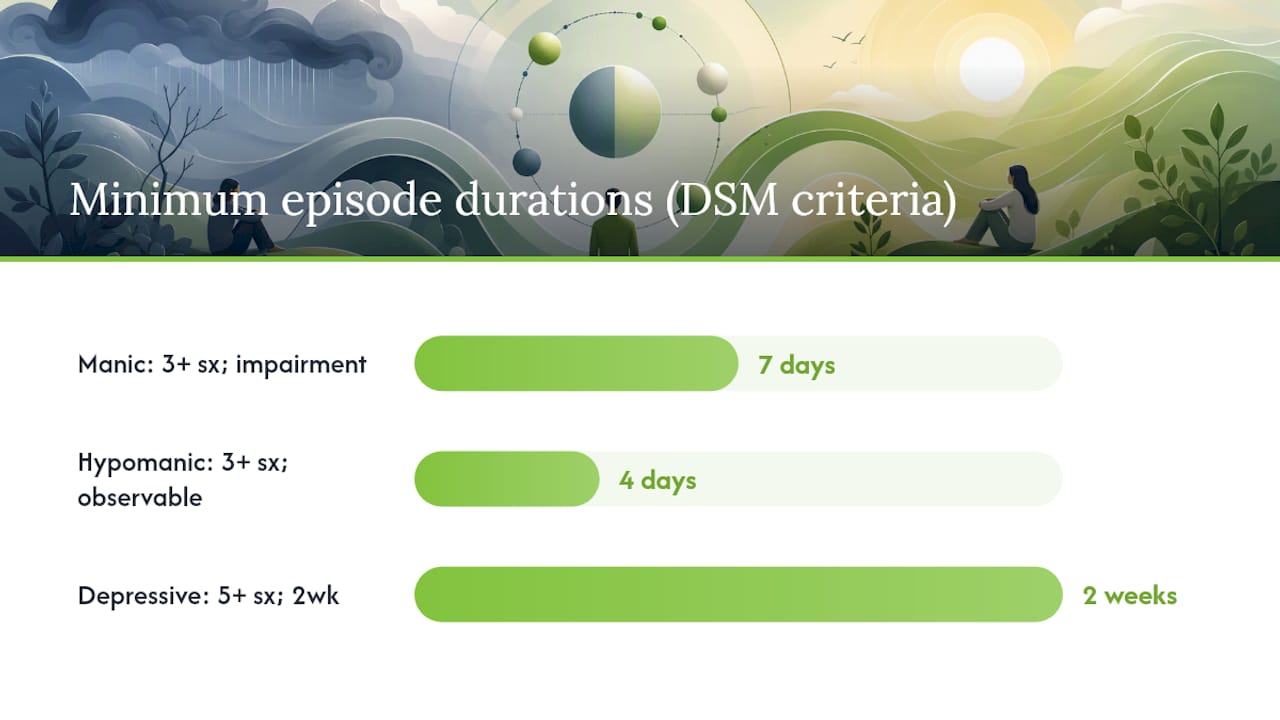
Clinicians use this framework to sort patients into subtypes. Bipolar I requires at least one manic episode; depressive episodes are common but not required for diagnosis. Bipolar II requires at least one hypomanic episode and at least one major depressive episode, without ever having had a full manic episode. Cyclothymic disorder involves chronic, fluctuating hypomanic and depressive symptoms that don’t meet full episode criteria, persisting for at least two years. Specifiers like “rapid cycling” (four or more mood episodes in a year), “mixed features” (manic and depressive symptoms overlapping), or “peripartum onset” get added when they apply, because they change treatment decisions.
What Happens During the Clinical Interview and Psychiatric History?
The interview itself follows a fairly consistent sequence, even though the conversation feels organic when you’re in it.
- Intake forms and initial screening. Most practices, including ours, ask you to complete symptom checklists before you even meet the clinician, which saves time in the room.
- The focused psychiatric interview. This covers your current symptoms in detail: onset, duration, severity, and what’s changed recently.
- Past psychiatric history. Prior diagnoses, prior treatments, hospitalizations, and how you responded to medications, especially antidepressants.
- Medication and substance review. What you’re taking now, what you’ve taken before, and any alcohol or drug use that could be contributing.
- Family psychiatric history. Bipolar disorder runs in families more than most psychiatric conditions, so a parent or sibling with the diagnosis raises suspicion considerably.
- Functional history. How your mood shifts have affected work, relationships, and sleep, over the full span of your adult life, not just recent weeks.
- Safety assessment. Direct questions about suicidal thoughts, self-harm, and any history of risk, asked plainly and without judgment.
To probe for past hypomania or mania, we rarely ask “have you ever had mania?” That question is almost useless. Instead we ask about specific behavioral anchors: periods of needing far less sleep without feeling tired, unusual spending, impulsive decisions you later regretted, or racing thoughts that made it hard to finish a sentence. Patients often present during a depressive episode and don’t spontaneously mention the highs, so clinicians have to go looking for them.
Once we have a rough timeline, we start sequencing episodes: when did the first depressive episode happen, was there ever a period before or after it that looked different, and how have things changed with each medication tried. This longitudinal mapping is where the real diagnostic work happens.

Pro Tip: Before your appointment, write down approximate dates, even rough ones like “spring of 2023,” for any period that stands out, whether it felt like a low or an unusually high stretch. Specific behaviors (three days without sleep, an impulsive trip, a big argument that seemed out of character) are more useful to a clinician than general descriptions like “I was moody.”
How Do Screening Tools and Mood Charts Support Diagnosis?
Screening tools are triage instruments. They tell a clinician whether a full diagnostic interview is warranted. They do not, on their own, diagnose anything.
The three most commonly used are the Mood Disorder Questionnaire (MDQ), the Hypomania Checklist (HCL-32), and the Bipolar Spectrum Diagnostic Scale (BSDS). Each asks you to reflect on past periods of elevated mood or energy and rate how strongly they apply. A positive score on any of these prompts a deeper conversation. It does not settle the question.
Sensitivity and specificity matter here. The MDQ has reported sensitivity around 73 to 80 percent, with variable specificity, meaning it catches most true cases but also flags a meaningful number of people who don’t actually have bipolar disorder. The HCL-32 runs slightly higher on sensitivity, around 82 percent, but tends toward lower specificity in some studies. That combination is exactly why a positive screen leads to a full clinical interview rather than a diagnosis on the spot.
Mood charting fills a different gap: it establishes pattern and duration over time, which a single appointment can’t capture no matter how thorough the interview is. A useful mood chart tracks a handful of variables daily: overall mood on a simple scale, hours slept, energy level, and any notable events or medication changes. Most clinicians find that two to three months of consistent tracking gives enough data to start seeing real patterns, though longer is better if you can manage it. If you want a structured way to start this before your first visit, a self-assessment tool can help you organize what you’re noticing into something a clinician can actually use.
What Physical Exams and Lab Tests Rule Out Other Causes?
Before anyone settles on a bipolar diagnosis, a clinician has to make sure something else isn’t causing the symptoms. This step gets skipped more often than it should, and it shouldn’t be.
Standard baseline testing at an initial evaluation typically includes:
- Thyroid panel (TSH) to rule out hyperthyroidism, which can produce symptoms that look remarkably like mania, and hypothyroidism, which can mimic depression.
- Complete blood count (CBC) to check for anemia or infection that could be affecting mood and energy.
- Comprehensive metabolic panel (CMP) to assess kidney and liver function, particularly relevant before starting mood stabilizers.
- Urine drug screen to identify substance use that could be causing or mimicking mood episodes.
- Pregnancy test, when clinically indicated, since it affects medication choices significantly.
Thyroid dysfunction alone accounts for a surprising number of mood presentations that get misread early on, which is why VA/DoD clinical guidelines list it as a standard part of the initial workup rather than an optional add-on.
Neuroimaging or an EEG isn’t part of a routine bipolar workup, but we’ll order it when something doesn’t fit the usual pattern: neurologic symptoms, a first episode of psychosis with no prior psychiatric history, a sudden and unexplained change in mental status, or focal findings on physical exam. Those situations point toward something structural or neurological that needs its own investigation.
Medication reconciliation deserves its own mention here. Steroids, certain antibiotics, stimulants, and even some over-the-counter supplements can provoke manic-like symptoms or mimic mood instability. Going through every medication and supplement you take, prescription or not, is a routine part of a careful evaluation, not an afterthought.
How Do Clinicians Rule Out Other Conditions That Look Like Bipolar Disorder?
Several conditions overlap with bipolar disorder closely enough that getting the differential wrong is common, and it happens even to experienced clinicians when the history is incomplete.
- Unipolar major depressive disorder. The depressive episode looks identical; only a documented history of mania or hypomania separates the two.
- Substance or medication-induced mood disorder. Stimulants, alcohol withdrawal, and corticosteroids can all produce manic or depressive symptoms that resolve once the substance is addressed.
- ADHD. Impulsivity and distractibility overlap with hypomania, but ADHD symptoms are lifelong and consistent, while bipolar symptoms come in distinct episodes with clear before-and-after contrast.
- Personality disorders, particularly borderline personality disorder, involve mood instability that shifts hour to hour or day to day, in reaction to interpersonal events, rather than the sustained days-long episodes bipolar disorder requires.
- Primary psychotic disorders, like schizophrenia, can share features with severe mania but lack the episodic mood component that defines bipolar disorder.
- Medical causes, hyperthyroidism chief among them, produce mood and energy changes that resolve once the underlying condition is treated.
Clinicians lean on a few things to sort this out: the timeline of symptoms, what collateral sources report, how someone has responded to past medications (particularly whether an antidepressant ever seemed to trigger unusual energy), and the overall quality of the symptoms rather than just their presence.
Some findings push the differential more strongly toward bipolar disorder:
| Signal | Why It Matters |
|---|---|
| Family history of bipolar disorder | Genetic loading substantially raises pretest probability |
| Early-onset depression (onset in youth) | Associated with higher rates of eventual bipolar diagnosis |
| Antidepressant-induced mania or agitation | A classic and often underrecognized red flag |
| Distinct, time-limited hypomanic episodes | Distinguishes from the constant traits of ADHD or personality disorders |
A concrete example we come back to often: ADHD symptoms are there Monday through Sunday, every week, for as long as the person can remember. Hypomania shows up for four days, disappears, and the person goes back to baseline. That contrast, not the symptoms themselves, is usually what separates the two.
Why Do Bipolar Diagnoses Take So Long to Get Right?
This is the part of the process that frustrates patients most, and honestly, it frustrates us too.
Most people aren’t correctly diagnosed until six to ten years after their first contact with a healthcare provider. That delay isn’t a rare failure. It’s closer to the norm.
A systematic review of diagnostic delays points to a mix of causes: stigma that keeps people from disclosing symptoms fully, limited clinician awareness of how bipolar II presents, and the simple fact that most people seek help while depressed, not while manic or hypomanic.
The common pitfalls we see, on both sides of the exam table:
- Depressive-first presentation. People almost never walk in during a manic episode asking for help. They walk in exhausted, hopeless, and depressed, which naturally steers the conversation toward unipolar depression first.
- Under-reporting of hypomania. If a period of high energy felt good or productive, most people don’t think to mention it, let alone frame it as a symptom.
- Comorbid substance use. Alcohol or drug use can mask or mimic mood episodes, muddying the timeline considerably.
- Diagnostic overshadowing. Once a label like “anxiety” or “depression” is applied, later symptoms sometimes get folded into that existing diagnosis instead of prompting a fresh look.
If you want to protect yourself against this, a few things genuinely help: bring a family member or close friend who’s known you for years, come with specific examples rather than general impressions, and if you’ve ever taken an antidepressant that seemed to backfire (more agitation, less sleep, unusual energy), say that explicitly. That detail alone reshapes a lot of evaluations.
What Does the Diagnostic Timeline Actually Look Like Across Visits?
Nobody gets a confirmed bipolar diagnosis in a single 30-minute appointment, and you should be wary of any clinician who claims otherwise.
- Intake. Symptom checklists, a brief history, and scheduling of the first full evaluation.
- First psychiatric assessment. Typically 60 to 90 minutes, covering the full interview outlined earlier, plus initial screening tool administration.
- Lab work and collateral gathering. Bloodwork gets ordered, and if you’ve brought a family member or given permission to contact one, that conversation happens around this stage too.
- Follow-up visit. Usually within two to four weeks, to review labs, discuss mood chart data if you’ve started one, and refine the diagnostic picture.
- Longitudinal monitoring. Ongoing visits, often monthly at first, where the clinician watches how symptoms evolve and how you respond to any treatment started.
A few practical notes worth keeping in mind:
- Bring prior medical and psychiatric records if you have them; a past hospitalization discharge summary can save weeks of reconstructing history from memory.
- Keep whatever mood chart or journal you’re using in one place, digital or paper, so you can hand it over rather than trying to recall details on the spot.
- Telehealth visits work well for most of this process, including collateral interviews conducted separately by phone or video, which is often more convenient for family members than an in-person visit.
Clinicians sometimes deliberately wait to confirm a diagnosis rather than rush it, because a single depressive episode simply doesn’t contain enough information to distinguish bipolar disorder from unipolar depression. That patience is not indecision. It’s how an accurate diagnosis gets made.
When Should You See a Psychiatrist or Go to Emergency Care?
Some situations don’t leave room for waiting on a scheduled appointment.
Seek immediate emergency care if you or someone you know is experiencing:
- Suicidal thoughts with any plan or intent, or recent self-harm.
- Severe mania involving dangerous behavior, such as reckless driving, extreme spending that threatens finances, or aggression.
- Psychosis: hallucinations, delusions, or a complete break from reality.
- An inability to care for basic needs, like eating, sleeping, or personal safety.
Outside of an emergency, here are questions worth bringing to an evaluation to move things along faster:
- “What specifically are you screening for, and why?”
- “What tests are you ordering, and what would a positive or negative result change?”
- “Based on what I’ve told you, does my history point toward bipolar I, bipolar II, or something else entirely?”
- “If we’re not sure yet, what would you want to see over the next few months to clarify things?”
- “Is it worth getting a second opinion if we’re still uncertain after a few visits?”
| When to Escalate | What to Expect |
|---|---|
| Suicidal ideation or intent | Emergency evaluation, same day |
| Diagnostic uncertainty after multiple visits | Request for psychiatric second opinion or formal reassessment |
| Antidepressant-induced mood switch | Medication review and reassessment for bipolar spectrum disorder |
| Severe mania or psychosis | Emergency stabilization, likely inpatient evaluation |
A second opinion isn’t a sign that your first clinician failed. Bipolar disorder, particularly bipolar II, can genuinely take time and multiple data points to confirm with confidence.
How Does Collateral History Change Diagnostic Accuracy?
We’ll say this plainly: collateral history is often the single most decisive piece of the entire evaluation, more than any questionnaire or lab result.
Here’s why. People experiencing hypomania frequently don’t perceive it as a problem while it’s happening. A person feeling unusually confident, energetic, and productive rarely thinks “this is a symptom.” Family members and close friends, though, often noticed something was different: faster speech, less sleep with no apparent tiredness, spending that seemed out of character, or judgment that felt off. Those outside observations frequently carry more diagnostic weight than the patient’s own recollection, simply because memory and self-perception during a mood episode are unreliable in predictable ways.
If you’re preparing for an evaluation, it helps to ask family members specific questions rather than open-ended ones: Did I seem to need less sleep during any stretch of time? Was there a period where my spending or decision-making seemed unusually impulsive? Did my speech or energy ever feel noticeably different to you? Organizing those answers, even loosely, before your appointment gives your clinician something concrete to work with rather than vague impressions.
Pro Tip: When we ask patients to involve a family member, we’re careful about how we frame it. This isn’t about catching someone in a lie or overriding their account. It’s about filling in blind spots that exist for genuinely biological reasons. Framing it that way, gently and without judgment, usually gets more honest cooperation and protects the trust in the room.
Family history also matters here in a different way. A documented genetic component to mood disorders means a parent or sibling with bipolar disorder should raise your clinician’s index of suspicion meaningfully, even before symptoms fully declare themselves.

A Clinician’s Honest Take on Diagnostic Uncertainty
Here’s something we wish more patients heard early on: uncertainty in this process is normal, not a sign that something’s being done wrong.
We’ve sat across from plenty of people who wanted a clean, immediate answer, and we understand that. Living with unexplained mood swings is exhausting, and the not knowing adds its own weight on top of the symptoms themselves. But bipolar disorder, especially bipolar II, sometimes needs more than one visit and more than one data point before an honest diagnosis can be made. Anyone who hands you a confident label after fifteen minutes without asking about your family, your sleep, or your history with past medications is skipping steps that matter.
What we’ve learned, gradually, is that the diagnostic process works best as a genuine partnership. Your account matters. So does what your partner or parent noticed. So does what your labs rule out. None of those pieces is sufficient alone, but together they build something reliable.
When we’re suspicious but not certain, our approach is usually to keep watching, gather more collateral information, and resist the urge to start an antidepressant by itself if there’s any real hint of a bipolar pattern. That last point matters more than people realize. Starting an antidepressant alone in someone with unrecognized bipolar disorder can trigger a manic switch, which sometimes ends up being the very thing that finally reveals the correct diagnosis, though obviously not the way anyone would choose to find out.
How Nortexpsychiatry Supports the Diagnostic Process
If you’ve read this far, you probably already suspect something beyond garden-variety depression or anxiety is going on, and you want a clinician who will actually take the time to work through it properly instead of reaching for the fastest label.
At Nortexpsychiatry, we offer both in-person and telehealth psychiatric evaluations across Allen, Frisco, McKinney, Plano, and the surrounding North Dallas area, which means you can start this process without rearranging your entire week around it. Our evaluations are built around exactly what this article has walked through: a full structured interview, validated screening tools where appropriate, collateral history gathered respectfully, and baseline labs to rule out medical causes before anything gets labeled. If a diagnosis isn’t clear after the first visit, we don’t force one. We build a follow-up plan, often incorporating mood tracking, to confirm the pattern over time rather than guessing.
If you’re ready to get a clearer answer instead of living with an educated guess, you can schedule a psychiatric evaluation and start the process on your own timeline, whether that’s in our office or from home.
Sources
- Bipolar disorder – StatPearls – NCBI Bookshelf
- VA/DoD clinical practice guideline for management of bipolar disorder
This article is general information, not a substitute for advice from a qualified doctor. Consult a qualified healthcare professional about your own circumstances before acting on anything here.
FAQ
Why is bipolar disorder so hard to treat?
It’s not that treatment doesn’t work; it’s that getting an accurate diagnosis often takes years, and treating unipolar depression with an antidepressant alone can worsen an undiagnosed bipolar pattern. Once diagnosed correctly, mood stabilizers and structured follow-up are effective for most people.
What does it feel like to have bipolar II specifically?
Bipolar II involves depressive episodes that can be severe and prolonged, alternating with hypomanic periods that often feel like unusual energy, confidence, or productivity rather than obvious impairment. Many people describe the hypomanic phase as feeling “like themselves, only more so,” which is exactly why it gets under-reported.
What is the average life expectancy for people with bipolar disorder?
Life expectancy statistics for bipolar disorder vary across studies and populations, and we won’t quote a specific number here without a reliable source behind it. What’s consistent across the research is that early, accurate diagnosis and consistent treatment meaningfully improve long-term outcomes and reduce relapse risk.
How hard is it to live with bipolar I disorder?
Bipolar I, with its full manic episodes, tends to involve more significant disruption to work, relationships, and daily functioning than bipolar II, particularly during untreated manic periods. With consistent treatment and monitoring, though, many people manage bipolar I successfully and maintain stable, functional lives.
Can a primary care doctor diagnose bipolar disorder, or do I need a psychiatrist?
A primary care physician can start the evaluation and may suspect bipolar disorder, but confirming the diagnosis typically requires a psychiatric evaluation, since distinguishing it from unipolar depression takes specialized training and time. If your primary care visit raises this concern, ask for a referral rather than waiting for it to be offered.
How long does the bipolar diagnosis process usually take?
Confirming a diagnosis can take anywhere from a single thorough evaluation to several months of follow-up visits, particularly for bipolar II, where longitudinal observation is often needed. Many people are not correctly diagnosed until six to ten years after their first contact with a healthcare provider, which is why persistence with follow-up matters.